I was in an Area Service meeting not long ago when a long-time member—someone I’ve known for two decades—decided it was the perfect time to publicly assassinate my character. No warning. No gentle lead-in. Just a sudden, full-volume, room-wide announcement that I was “a bully” for making a Fifth Concept statement.
I’ve been in Cocaine Anonymous since 1994. Thirty-one years sober. I’ve had three fantastic sponsors—real elder statesmen—who drilled into me the importance of putting “principles before personalities.” But let me tell you, it’s a lot harder to keep that principle front and centre when you’re being blindsided in a room of twenty-five people by someone you once shared a cigar with.
This guy—thirty-seven years in CA—decided Robert’s Rules of Order didn’t apply when it came to making sure everyone could hear his personal review of my conduct. He ignored the sanctity of process so he could swing his verbal bat in public. And after dropping the grenade, he left the meeting early. A real mic-drop moment.
Here’s the thing: I knew him when he was an elder statesman. Back then, he served without making it about himself. He had a calm way of reminding us the group’s Higher Power was in charge. But somewhere along the way, the elder statesman became the bleeding deacon. I’ve seen it before, and I know I’ll see it again, because it’s not rare.
In CA, a bleeding deacon is that long-timer who thinks the group can’t survive without them, resents change, and fights the group conscience instead of serving it. The roots are usually the same: stagnation, no new service commitments, no fresh challenges, no growth. They stop being accountable to a sponsor—or they have one who won’t call them out. Their minds close. “I know best” becomes the guiding principle. And any new idea is treated like a threat instead of an opportunity.
This guy’s service résumé lately? Shows up to one meeting a week. Recently took a GSR position for the first time in over a decade—not to carry the message, but to argue about updated bylaws. That’s not service. That’s politics.
We say alcohol is like truth serum, but anger works the same way. Not the whole truth, not God’s honest truth, but their truth—the one they’ve been nursing in silence, sometimes for years. When he blew up at me in that meeting, it wasn’t about my Fifth Concept statement. That was just the trigger. The real stuff—the long-stewed resentments, the unspoken judgments—came rushing out.
I’d love to say I responded with perfect restraint, but that’s not the truth. In that moment, with twenty-five sets of eyes on me, I felt like I’d been sucker-punched. My first reaction wasn’t serenity—it was fire. I raised my voice. I called him out for being out of line and out of order. I felt attacked, and I met attack with attack. Later in the meeting, when I had the floor again, I did what my sponsors taught me. I made amends to the group for letting my emotions get the better of me. I didn’t excuse my part just because “he started it.” I owned it. That’s the work—not that we always stay calm, but that we clean it up when we don’t.
My first three sponsors were the opposite of this. They had the ability to let go of something they’d helped create so it could grow. That’s the elder statesman’s gift—to be able to step back without resentment and trust that the fellowship will be guided by a Higher Power, even if the new direction isn’t the one they’d choose. It’s not easy. It requires humility, trust, and the willingness to be uncomfortable. It requires keeping our own spiritual house in order so our service is about the group, not about our identity.
The sad truth is this isn’t just about one man. He’s an example of something that happens in every fellowship: members with decades of sobriety who stop being challenged. No more deep Step work, no more serious sponsorship. Their world shrinks to one meeting a week, same people, same topics. And when change shows up? Rage. Rage against the dying of the light. It’s a spiritual sickness, plain and simple. Our literature warns that “we are never cured of our addiction.” That doesn’t just mean the drugs—it means the defects that drive it. If we’re not growing spiritually, we’re going backwards. And the longer we’ve been around, the easier it is to coast—until something threatens our comfort zone.
One bleeding deacon in a service body is bad enough. But stack up enough of them, and you’ve got a slow-motion collapse on your hands. They feed off each other’s resistance to change. They’ll kill a motion before it even hits the floor, drive away new servants, and argue over bylaw punctuation while the newcomer meeting across town folds for lack of support. Give them long enough without anyone speaking out or holding them accountable, and the Area will die—one meeting at a time, until there are none left.
This isn’t about shaming anyone. It’s a mirror. Because here’s the truth: I’m capable of becoming the same bleeding deacon if I stop doing the work. If I stop seeking guidance. If I start thinking CA needs me more than I need CA. That’s why we rotate service positions. That’s why we stay active in sponsorship, keep going to different meetings, and keep learning. My sponsors drilled it into me: service without the Traditions and Concepts becomes politics. Recovery without service becomes selfishness. The elder statesman keeps both in balance.
The fall from elder statesman to bleeding deacon doesn’t happen overnight. It’s death by spiritual neglect—and it can happen to any of us. The cure isn’t complicated: keep working the Steps, stay accountable to a sponsor who will call you out, stay willing to be uncomfortable, and let go when it’s time to rotate out. We keep what we have by giving it away—and that includes power, control, and the need to be right.
As for my old cigar buddy? I’ll leave his name out. That’s what “principles before personalities” means. But I’ll tell the story—because CA needs to remember that elder statesmen don’t just appear. They’re built, one day, one meeting, and one humble act of service at a time. And if we stop building, we start bleeding.
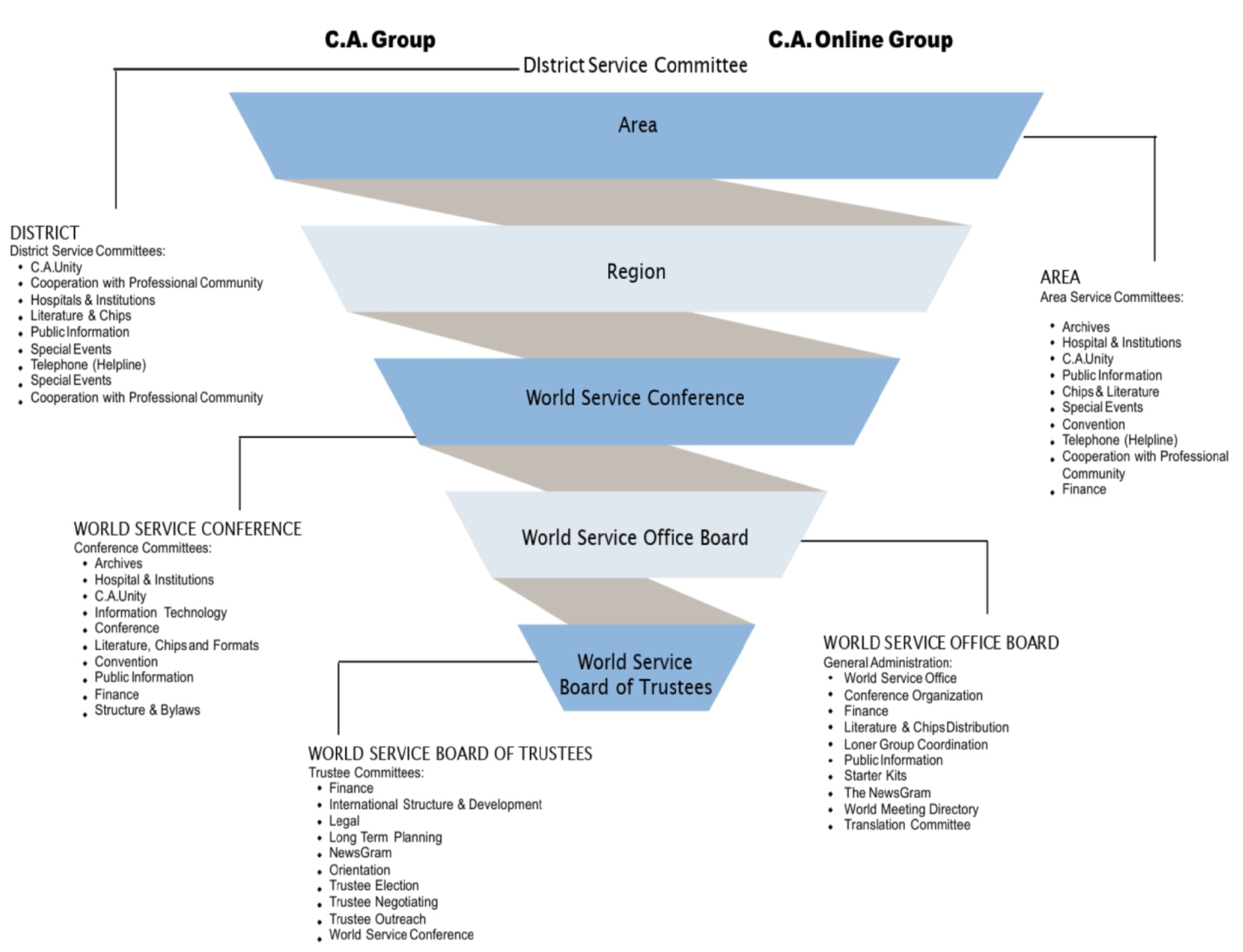
Groups and/or Online Groups, ought to be aligned with only one (1) Area, avoiding inaccurate Delegate counts, and permitted Area votes at Conference.”
Suggested Area Functions
The Area Service Committee is entrusted with local service board incorporation, if
required
Coordinates Area telephone services.
Distributes and/or sells literature and chips, carries out local translations where
required in accordance with the World Service office translation policy and process.
Standing Committees include:
a. Telephone (Helpline)
b. Hospitals and Institutions
c. Public Information
d. Archives
e. Convention
f. Chips and Literature
g. Finance
h. CPC (Cooperation with Professional Community)
i. Special Events
j. Unity
k. Internet
l. Translations
Maintains and updates a list of all Area meetings.
Maintains ongoing communications with the Districts.
Maintains ongoing communication with the World Service Office and WSC.
Publishes newsletter (subject to review by Regional Trustee).
Publishes and distributes Area Meeting Schedules.
Elects Delegates to the World Service Conference.
Holds Assemblies and/or monthly Service Meetings.
Sponsors service days and workshops.
Sponsors Area Conventions.
Establishes and administers a Central Office, if appropriate.
Maintains a bank account.
Area Service Meetings
Areas may hold two different types of Area Service Meetings:
1. Monthly Area Service Committee Meetings: These are administrative in nature where reports on day-to-day activities and issues are received, reviewed, and if appropriate, acted upon.
2. Annual, Bi-Annual, or Quarterly Assembly Meetings: Because of time and distance,these types of meetings may be held for these activities:
a. Election of WSC Delegates and Area Officers.
b. Treasurer’s report.
c. Local Convention report.
d. WSC Delegate report.
e. Central Office report, if applicable.
f. Old business/new business.
g. Decision of major importance.
Possible Voting Members
Area Officers, Committee Chairpersons, District Service Representatives, Group Service Representatives and Alternate GSR, WSC Delegates, Advisory Board/Steering Committee members, and other trusted servants.
Voting Procedures: (Determined by Area)
Voting examples can be found in the WSM WSC Parliamentary
Procedure Guidelines.
Area Expenses
Area expenses may include:
1. Costs for rent and coffee for service meetings
2. Chips and literature inventory
3. Telephone
4. Standing committees (e.g., costs of mailing, copying, etc.)
5. Central office workers
6. Insurance
7. Legal fees, accountant fees, and employee’s salary, or sales tax
8. Postage and supplies
9. Delegate expenses to the WSC, and
10. Bank charges
Area Service Positions:
Chairperson
Vice-Chairperson
Secretary
Treasurer
Chairperson
1. Two years continuous sobriety.
2. Two year commitment.
3. One year of active service in C.A.
4. Presides over monthly/quarterly meetings and arranges agenda.
5. Assumes responsibilities of coordinating all activities within the Area.
6. Encourages trusted servants to chair various Standing Committees.
7. Only votes in case of a tie.
8. To have all delegates credentialed upon election, but no later than 30 days prior to
the WSC, using the current credentialing platform.
Vice-Chairperson
1. One year continuous sobriety.
2. Two year commitment.
3. Six months of active service in C.A.
4. In absence of Chairperson performs those duties of Chairperson.
5. Chairperson of one Standing Committee.
6. Coordinates general Committee activities.
Secretary
1. One year continuous sobriety.
2. Two year commitment.
3. Six months of active service in C.A.
4. Keeps accurate minutes of each meeting.
5. General communications throughout the Area.
6. Records the number and location of each meeting in the Area.
Treasurer
1. Three years continuous sobriety.
2. Two year commitment.
3. One year of active service in C.A.
4. Gainfully employed and/or financially stable.
5. Bookkeeping or Accounting experience preferred.
6. Receives and deposits contributions from meetings and special events.
7. Keeps an accurate bookkeeping system.
8. Maintains bank account(s) with checks requiring two (2) signatures.
9. Gives regular financial report with a copy of the Area Bank Statement (with account
numbers blacked out).
10. Timely filings with regulatory agencies (e.g. state and local taxes, nonprofit corporation forms). To protect the Area’s non-profit status yearly filings are required. It is recommended that these filings be done by an independent
accountant.
11. Pays all expenses.
12. Passes on contributions to the Area and World Service.
Board of Directors, Area Advisory Committees, Advisory Boards, and/or Steering Committees
A Cocaine Anonymous corporation of any Area must have for legal reasons a certain number of Directors. These vary from state-to-state or province-to-province. These Directors shall at all times be accountable to their Area Service Committee. These Directors should never be excused from the responsibility to render proper reports of ALL significant actions taken. The Directors are directly responsible to their Area and should consult their Area Service Committee before an important decision or action is taken.
Our C.A. program rests squarely upon the principle of mutual trust. For purposes of advice and guidance, Area Service may create Advisory Boards or Steering Committees directly responsible to those they serve, principally the Area Service Committee. NOTE: The only “Board of Trustees” recognized and existing within Cocaine Anonymous is the World Service Board of Trustees (WSBT), which is directly responsible to the World Service Conference. The title “Board of Trustees” should not be used at the Area service level.
Area and District Committees
It is suggested that the following Committees exist at both the District and Area levels. When appropriate, Committees may be combined or added.
Telephone (Helpline): Responsible for the provision of information and assistance to individuals seeking aid by phone, and with the communication of messages received for other committees.
Hospitals and Institutions: Responsible for the coordination of and active participation in Twelve Step work within hospitals and institutions.
Public Information: Responsible for the distribution of literature and information to the public.
Archives: Responsible for the collection, organization, categorization, copying, preserving, and electronically storing all of Cocaine Anonymous’ historically valued documentation and memorabilia.
Chips and Literature Responsible: for the distribution of literature and chips to C.A. Districts, Groups, members and interested institutions.
Finance: Responsible for all matters relating to records, finances and expenditures. The committee makes recommendations on all matters pertaining to the administration and operation of finances and expenditures. The Finance Committee shall implement and oversee controls necessary to safeguard the assets of the Fellowship, including employment of a CPA (Certified Public Accountant) to make periodic audits.
Convention: Responsible for the coordination of conventions to carry the message of recovery, unity and service to members of Cocaine Anonymous.
Cooperation with the Professional Community (CPC): Responsible for a unique brand of 12-Step work by carrying the message of recovery to professionals, who in their line of work, may have some sort of supervisory capacity over or direct contact with individuals who may have a problem with cocaine and all other mind altering substances. The committee informs the professional community about C.A.: what we are, where we are and what we can and cannot do to help the addict who still suffers. The committee attempts to establish communication between C.A. members and the professional community to find productive methods of cooperation, not affiliation, within the C.A. traditions.
C.A. Unity Committee: Responsible for the communication and outreach among the diverse elements within the Fellowship at all levels, in the interest of carrying the C.A. message. It is also suggested that these committees sponsor annual workshops and other forums to promote C.A. unity.
Information Technology Committee: “The purpose of the committee is to serve as a resource for the C.A. service structure in areas of emerging technologies. In addition, we facilitate and assist Areas and Districts in approving their local websites, so that they may have a link directly from the C.A. web properties. The IT Committee, on an ongoing basis, works on adapting available technologies to better carry the message of C.A., while always keeping in mind the Twelve Traditions and Twelve Concepts of C.A., C.A. policies, privacy, and security.”
Translations: Responsible for local translation of materials. For C.A. copyright items in accordance with the World Service office translation policy and process.
C.A.’s First Tradition:
“Our common welfare should come first; personal recovery depends upon C.A. unity.”
Winning the newcomer’s confidence — A 12 Step Speaker Workshop
Facilitated By Cameron F.
“So you’ve been asked to share/speak at a meeting/convention… now what?
Far too often we hear speakers share: drunk-a-logs, war stories, junkie pride tales, even ramblings of incoherent thoughts and minutia of ones’ life. How can we do better?
“Each individual, in their personal stories, describes in their own language and from their own point of view the way they established their relationship with God. (A.A. 4th ed. p. 29)
“We can only clear the ground a bit. If our testimony helps sweep away prejudice…” (A.A. 4th ed. p. 55)
But, we must be careful not to drift into worry, remorse or morbid reflection, for that would diminish our usefulness to others. (A.A. 4th Ed. p. 86)

You talk too much…time to zip it up!
Communication is the Response You Get!
Learning Objectives:
By the end of this presentation, you’ll be able to:
List 10 strategies for overcoming the fear of speaking in front of an audience.
List 5 ways to conduct yourself when speaking virtually or in-person.
Identify 3 major benefits of speaking to a 12 Step meeting or event.
List 3 key elements for a compelling story.
Identify 3 ways to win the confidence of newcomers.
Know the 3 essential components for a well structured story.
Learn 3 ways to dynamically open your share.
Know 4 ways to identify and connect with your audience.
Identify 5 important ways to describe “what happened?”
Describe 3 ways to inspire others to work their program.
Learn 3 approaches to dynamically close your talk.
Dare to be outrageously yourself… express your own style.
The Fear of Public Speaking

Glossophobia, also known as the fear of public speaking, affects, to some degree, approximately 73% of the population, with around 15 million people experiencing it daily. This fear is more common than the fear of death and can significantly impact personal and professional lives.
Ninety percent (90%) of all glossophobia cases are caused by speaking in public and is triggered by poor preparation and lack of awareness about methods to manage it.
Q: What are we really afraid of when asked to share or speak at meeting, convention or roundup? Make a list of your fears?
Q: Why do your have these fears?
So many times, I’ve seen speakers go to the podium unprepared with no idea what they’re going to say… they just start talking about whatever stream of consciousness comes into their mind.

Luther Heggs aka Don Knotts Speech (Ghost & Mr. Chicken 1966)
This clip show how many things that can go wrong when speaking from the podium.
Ten Strategies for Overcoming the Fear of Public Speaking
Structure your presentation… avoid “stream of consciousness” sharing. This can be an impediment when it comes to delivering an effective message. The problem with stream of consciousness is that it is sometimes great and sometimes it’s a “bust.” And, if its a great presentation, most steam-of-consciousness speakers cannot duplicate it nor can they learn from their mistakes.
Write down your presentation to further embed it into your thought and memory processes. This is reinforced by rehearsing and practicing your key messages. And there’s lots of opportunities to do this in various discussion oriented meetings to practice and try out your key messages and how they affect your audience. Remember: Know your key messages and avoid memorizing your presentation.
Use your own words and avoid jargon and vulgar language. (know your audience i.e. A.A. vs. C.A. vs. N.A., etc.)
Rehearse your presentation… Practice, Practice, Practice.
Before Speaking: Take time for prayer & meditation:“Instead we let God demonstrate, through us, what God can do. We ask God to remove our fear and direct our attention to what God would have us be. At once, we commence to outgrow fear.” (A.A. 4th p. 68). Center yourself before a share. Relax your body, calm your emotions (deep breaths), still your mind. Visualize your performance, build it clearly in your mind and see its successful outcome.
When speaking, focus on your audience… most importantly… focus on carrying a message to “The Newcomer.” If I focus my thoughts on me and how good I want to look to the audience, I become nervous and inevitably makes mistakes, forget my train of thought, and get flustered. Instead, focus on the newcomer, focus on the person who needs to hear your story… remember I primary purpose is to carry the message to the addict who still suffers.
Record yourself when speaking. Use your smart phone’s “voice recorder.” Afterwards, listen to yourself speak, make notes and revise your share accordingly. Listening to yourself afterwards is important feedback for understanding what’s working and flowing and what doesn’t work.
Remember, you’ll never have a more accepting and forgiving audience. Twelve Step audiences are most forgiving… they’re going to clap and applaud for you regardless of how well or bad you do.
Share from the “I” perspective and avoid using “YOU” language. Avoid using “YOU” language versus communicating from an “I” perspective. Using “I” I did this, I experienced that… its yours, you own it, nobody can take it from you. With “YOU” language, You need to do this and you need to do that, it can often come across as “preachy” and self-righteous and turn the listening of your audience off.
Have fun!!!
Five Ways to conduct yourself when speaking virtually
Before presenting, take a look at yourself in the mirror or on camera—make sure you have your up-close and personal face on.” *Women… attention to make-up.
Sit comfortably in your chair (no standing) and make eye contact with camera.
Use a laptop or desktop computer, rather than a phone and make sure your screen is tilted correctly…we don’t want to see your nostrils or the top of your head.
Watch the facial expressions on your audience grid… are they engaged, smiling, laughing, nodding heads…
Smile and speak clearly, modulate your tempo for emphasis and be dynamic.
Five Ways to conduct yourself when speaking in-person
Be well groom, dress appropriately.
Stand in one place, plant your feet firmly… Make eye contact with someone in the audience, speak to that person, then move on to another, then another, pick a person from on side, then the other, also from front to back.
If no mic is present, project your voice as if speaking to someone at the back of the room. “Say it Loud – Say it Proud”
Take note of your audience’s engagement, are they engaged, smiling, laughing, nodding heads…
Smile and speak clearly, modulate your tempo for emphasis and be dynamic.
Suit up for success, you’ll feel and act empowered. Let your deportment shout out to your prospects that you have a real answer.
Three Benefits of Speaking:
1. Benefit #1: It Fulfills Tradition Five:
“Our one primary purpose—to carry the message—our hope, faith and courage—Our experience, strength and hope to the alcoholic or addict who still suffers.” Our job is to be of maximum service to God and our fellows. Meetings should be about our solution, a “pep rally” for the spiritual way of life. Let’s communicate that “THERE IS A SOLUTION.” Let’s impart our “Hope, Faith and Courage” that’s there’s a way out of this seemingly hopeless state of mind and body.
2. Benefit #2: It reinforces our identity as members of a Twelve Step program.
Two recovery genres: The Recovered Addict versus The Recovering Addict narrative. Recovery stories are consequential for the person’s experience of recovery, since it seems that the telling and retelling of an empowered “Recovered” narrative, with its clear beginnings, turning points, and favourable results may well be critical for a stable and consistent recovery. (Shohet 2007:344). Such narration articulates, but also facilitates, the Member’s consistent affiliation with and appropriation of 12 Step master narratives (Cain 1991).
Recovered versus Recovering is an old argument. The efficacy of telling and re-telling our story of “What We Were Like” and “What We Are Like Now” reinforces our new identities, it facilitates that Step Three promise: “We were reborn.” (A.A. 4th ed. p. 63)
Alternatively, the telling and retelling of ambiguous “always recovering” narratives, in which the addict questions received spiritual principles, ponder hypothetical life paths not actually pursued, and envision abstinence as both good and bad, may perpetuate a cyclical life course in which relapse recurs and permanent recovery eludes the 12 Step member. (Shohet 2007:344).
Central to the 12 Step recovery culture is the personal story of the recovered addict—“Our stories disclose in a general way what we used to be like, what happened, and what we are like now” (A.A. 2001:58).
Conversely…always recovering, never well, always sick, I’m only an “arms length away from my next drink, drug, or act” perpetuates the sick mind… we fail to put our thought life on a higher plane. (A.A. 4th ed. p. 86).
The Member’s personal story reinforces the figured world of 12 Step recovery. These narratives maintain the boundaries that structure and empower the 12 Step recovery culture.
By sharing their personal stories of “what they used to be like”, members identify as addicts. Their “war stories” convey important criteria for potential members to identify and label themselves as addicts (Holland 2001:71).
Furthermore, personal testimonies are significant to newcomers because the storylines of recovered addicts objectify the central cultural elements of the 12 Step world, such as the importance of attending meetings, getting a sponsor, helping other suffering addicts, doing service work for the 12 Step Group.
By listening to the narratives of recovered members, newcomers learn the culture of 12 Step recovery. The newcomer learns the model of a 12 Step testimonial by listening to other members and through telling their own story, the newcomer comes to understand their own life as a member of a 12 Step program (Holland 2001:71).
The 12 Step rhetorical language provides an attractive element that connects the newcomer to the 12-step culture and assures them that the drinking/using/acting-out problem can be solved—resulting in behavioral transformations of newcomers (Waldram 1997:74).
It’s about teaching our fellowship about how we carry the message—it’s about teaching others how to teach others to work the Twelves Steps of recovery.
3. Benefit #3: We suddenly realize in order to save ourselves, we must carry the 12 Step message to another alcoholic or addict. (AA. 4thed. p. xvi)
It is important for them (newcomers) to realize that your attempt to pass this (our message of experience, strength & hope) on to them plays a vital part in your recovery. Actually, they may be helping you more than you are helping them. (A.A. 4th ed. p. 94)
Newcomers teach us a lot about our program. Every time w carry the message to a suffering addict, we learn something new about ourselves, the newcomer and the program.
Three key elements for a compelling story:
Structure: Our stories disclose in a general way what we used to be like, what happened, and what we are like now. (A.A. 4th ed. p. 64)
Substance: The message which can interest and hold these alcoholic must have depth and weight. (A.A. 4th ed. p. xxviii)
Outcome:…we believe that it is only by fully disclosing ourselves and our problems that newcomers will be persuaded to say, “Yes, I am one of them too; I must have this thing.” (A.A. 4th ed. p. 29)

Avoid “drunk-a-logs” and “junkie-pride” stories. Our 12 Step audience already knows how to drink, use or act-out. We’re all experts in the problem of addiction.
Three ways to win the entire confidence of “Newcomers”
One: The ex-problem drinker (addict); Two: who has found this solution (a 12 Step Program); and Three: who is properly armed with facts about them self, can generally win the entire confidence of another alcoholic (addict) in a few hours. Until such an understanding is reached, little or nothing can be accomplished. (A.A. Big Book, 4th ed. 18-19)
Put another way:
One: My addiction is no longer a problem. Two: I have sobriety and I have a solution – The Big Book of A.A., a recovery recipe. Lastly, Three: I understand my problem, I know what it means to be an alcoholic or addict.
Three Types of Shares
Introductions: Short, less than a minute
Qualifying: Identifying – 3 minutes or less
Main Speaker: Sharing our hope, faith and courage – 20 – 60 minutes
Have a 15, 30, 45, 60 minute version of your talk. Be flexible. Sometimes a meeting’s preamble or members sharing can cut a speaker’s time short. This is why its important to know your presentation and its key messages.
Introducing Ourselves:
When sharing at a meeting, how should I introduce myself?
Hi, my name is ___ and I’m an addict.
Hi, my name is ___ and I’m a recovering addict.
Hi, my name is ___ and I’m a recovered addict.
Hi, my name is ___ and I’m a member of ___.
Hi, my name is ___ and I’m an addict who doesn’t use.
Hi, my name ___ and I’m an addict who knows how to stop.
Hi, my name is ___ and I’m an “intelligent agent, spearhead of God’s ever-advancing creation.”
Qualifying as an “addict”
What qualifies you to share a message?
What are the facts about yourself?
What can you say in three minutes or less that will persuade those in the meeting to say, “Yes, I’m like you and you’re like me, but you don’t do it anymore!”
Key elements include: lack of power, lack of control. Demonstrate the “old self” and the” new self.” Use examples of my opening (how I identify and qualify) “I’m an alcoholic/addict who doesn’t drink or use!” That’s what makes me a “member” of a 12 Step fellowship. If you’re still drinking/using you’re just an untreated alcoholic/addict.
Main Speaker Share:
Opening:Introduce yourself.
Share what we used to be like.Tell an effective “war story” and win the newcomer’s confidence. (A.A. Your Jay-walker story. p. 37-38)
Share what happened.How you hit bottom, reached a turning point, found that jumping off place, that moment of clarity, how you found and worked a 12 Step solution.
Share what we are like today.Talk about the promises fulfilled, how life has taken on new meaning, how we have found the fellowship we crave.
Closing your talk.Your signature sign-off.
You can change the order and structure of your share… for example… I share first, what I was like, then what I’m like today and lastly what happened.
Opening Your Share
Introduce yourself: Example: My name is Cameron and I’m an alcoholic addict who doesn’t drink or use.
Tell humorous analogy or short story
Cite a Big Book quote: “Practical experience shows that nothing insures immunity again drinking, using or acting-out as intensive work with other addicts… it works when all other activities fail.” p. 89
What WE Used to be Like: How to tell our “war story?”
Write out your jay-walker story.
Tell them (newcomers) enough about your drinking (using, acting-out) habits, symptoms, and experiences to encourage them to speak of themselves. Tell them how baffled you were, how you finally learned that you were sick. Give them an account of the struggles (failed strategies) you made to stop. Show them (newcomers) how the mental twist (how my mind lies to me) which leads to the first drink (drug, act) of the spree. (A.A. 4th ed. p. 91-92).
List habits, symptoms, and experiences—everyday drinking or using, black-outs, type of drugs, ways of using. Describe the event where you learned you were sick (different) and didn’t drink, use or act out like other people. Identify with your prospect share the failed strategies.
This part of your presentation illustrates that you are armed with the facts about yourself.
What Happened?
Tell him exactly what happened to you. Stress the spiritual feature freely. (AA. 4th p. 93)
Describe your last “bottom”…that “jumping off place, that turning point, that moment of clarity.”
Talk about how you found your sponsor?
Share your experience of attending meetings and how and when you started your step work.
Share about service work you’ve done?
Tell him exactly what happened to you. Stress the spiritual feature freely, but use everyday language to describe spiritual principles. 12 Steps is a spiritual/moral approach to the efficacy of addition – secular methods seem to fail us. There is no use arousing any prejudice he may have against certain theological terms and conceptions about which he may already be confused. Don’t raise such issues, no matter what your own convictions are. (A.A. 4th ed. p. 93)
What We are like now.
Talk about the “promises” fulfilled in your life.
How has your health, family, work and life has changed.
Share about the fellowship you have found.
State your sobriety time and other changes: i.e. no more raging, more relaxed, calm, serene and centered. Talk about your marriage, children, health (how you fixed your teeth), going back to school, business and retirement. Mention your speaking success, meetings you’ve started, service positions you’ve held, etc.
Signature Sign-off
Close with a short story — an analog — or a Big Book Quote.
Yes, I am one of them too; I must have this thing. (A.A. 4th ed. p. 29)
“We have recovered and been given the power to help others.” (A.A. 4th ed. p. 132)

“I’m Looking forward to hearing your share or talk at the next 12 Step recovery meeting or convention.”
For Speaker Coaching: You can reach out to me 416-533-6024 or cameronfr@gmail.com to discuss your presentation… and if you like we can do a dry run on zoom and record it and you can learn, adapt and improve your share.
Bibliography
Alcoholics Anonymous (A.A.) 2001. Alcoholics Anonymous, 4th Edition. Alcoholics Anonymous World Services Inc. New York.
Cain, Carol 1991. Personal Stories: Identity Acquisition and Self-Understanding in Alcoholics Anonymous. Ethos 19(2):210-253.
Holland, Dorothy C. 2001. Personal Stories in Alcoholics Anonymous. Identity and Agency in Cultural Worlds. Cambridge, Mass.: Harvard University Press. pp. 66-97
Shohet, Merav 2007. Narrating Anorexia: “Full” and “Struggling” Genres of Recovery Ethos: Journal of the Society for Psychological Anthropology 35 (3):344-382
Waldram, J.B. 1997. Aboriginal spirituality and symbolic healing. In The Way of the Pipe: Aboriginal Spirituality and Symbolic Healing in Canadian Prisons. Canada: Broadview Press, pp. 71-98.
About your Facilitator:
Cameron F. is a member of Cocaine Anonymous. His sobriety date is November 21, 2003. As a speaker of Twelve Step recovery, Cameron has spoken to numerous A.A. and C.A. Group meetings, District Roundups, Area Conventions and C.A. World Conventions. As of 2026, he has carried the message of recovery to audiences in 96 countries, including Canada (from every province) and the United States (all 50 States, including Hawaii), Antigua and Barbuda, Argentina, Australia, Austria, Bangladesh, Barbados, Belarus, Belize, Belgium, Bermuda, Benin (West Africa) Brazil, Bahrain, Cambodia, Czech Republic, China, Colombia, Costa Rica, Cyprus, Denmark, Dominican Republic, Dubai/United Arab Emirates, Ecuador, Egypt, El Salvador, England, Finland, France, Germany, Ghana, Greece, Guatemala, Hungary, Iceland, Indonesia, India, Iran, Iraq, Ireland, Israel, Italy, Jamaica, Japan, Kenya, Korea, Latvia, Lebanon, Luxembourg, Madagascar, Malaysia, Malta, Martinique, Mexico, Morocco, Nepal, Netherlands, New Zealand, Nigeria, Norway, Oman, Pakistan, Paraguay, Panama, Peru, Philippines, Puerto Rico, Poland, Portugal, Qatar, Republic of Georgia, Romania, Russia, Rwanda, Saudi Arabia, Senegal, Scotland, Serbia, Siberia, Singapore, Slovenia, South Africa, Spain, Sweden, Switzerland, Syria, Thailand, Trinidad & Tobago, Turkey, Uganda, Ukraine, Vietnam, Venezuela, Wales, Zambia and Zimbabwe.
During the 1990s, Cameron was CEO of a training and development company, Cameron taught audiences on how to be better podium speakers including, overcoming the fears of speaking, structuring your talk, dynamics for excellent presentations, powerful openings and closings, key messaging, etc. It is Cameron’s hope that this C.A. Service Sponsorship presentation will prove helpful to those who wish to carry a hopeful message to those who still suffer from addiction in and across the rooms of Twelve Step recovery.
1. Purpose: The World Service Conference of Cocaine Anonymous is the guardian of the world services and of the Twelve Steps and Twelve Traditions of Cocaine Anonymous. The Conference shall be a service body only, never a government for Cocaine Anonymous.
2. Composition of World Service Conference: The World Service Conference shall be composed of Area Delegates, the World Service Board of Trustees, Directors of the World Service Office, staff members of the World Service Office, and any other members of the Fellowship who wish to attend.
3. Conference Relation to C.A.: The Conference will act for C.A. in the perpetuation and guidance of its world services, and it will also be the vehicle by which the C.A. movement can express its view upon all matters of vital C.A. policy and all hazardous deviations from C.A. Tradition. Delegates should be free to vote as their conscience dictates; they should also be free to decide what questions should be taken to the Group level, whether for information, discussion, or their own direct instruction.
But no change in Article 10 of the Charter or in the Twelve Traditions of C.A., or in the Twelve Steps of C.A. may be made except by first asking the consent of the known C.A. Groups of the world. [This would include all C.A. Groups known to the recognized Areas around the world.] These Groups shall be suitably notified of any proposal for change and shall be allowed no less than six months for consideration thereof. And before any such Conference action can be taken, there must first be received in writing within the time allotted the consent of at least three-fourths of all those Groups who respond to such a proposal (not counting abstentions)
4. Conference Relation to the World Service Board of Trustees and its Corporate Services: It will be understood, as a matter of tradition, that a two-thirds vote of a Conference quorum shall be considered binding upon the World Service Board of Trustees and its related corporate services. A quorum shall consist of two-thirds of all the voting Conference members registered and present.
But no such vote ought to impair the legal rights of the World Service Board of Trustees and the service corporation to conduct routine business and make ordinary contracts relating thereto. It will be further understood, regardless of the legal prerogatives of the World Service Board of Trustees, as a matter of tradition, that a three-quarters vote of all the voting Conference members registered and present may bring about a reorganization of the World Service Board of Trustees and the Directors and staff members of its corporate services, if or when such reorganization is deemed essential. The term “reorganization” shall mean the removal of one or more Trustees and/or directors.
Under such a proceeding, the WSC may:
request resignations of WSBT and/or WSOB members,
remove members of WSBT and/or WSOB
nominate new Trustees and/or WSOB members;
make all other necessary arrangements, regardless of the legal prerogatives of the World Service Board of Trustees.
5. Delegate Elections: Area Delegate elections are held by Area service committee meetings or assemblies composed of elected General Service Representatives of all C.A. Groups desiring to participate, District Officers, Area Officers, Service Committee Chairpersons, and other members who are involved in C.A. service. Area Delegate elections may be held as needed 120 days prior to the next World Service Conference.
6. Term of Office of Delegates: The Area Delegates are to be elected for a term of four (4) Conferences. It is suggested that the spirit of rotation be followed. (WSC Amendment, 1996)
7. Annual Meeting: The Conference will meet at least once a year unless otherwise agreed upon by voting Conference members. Special meetings may be called as necessary by voting Conference members. The Conference may also render advisory opinions at any time by mail or telephone poll in aid of the World Service Board of Trustees or its related services.
8. The World Service Board of Trustees: Composition, Jurisdiction and Responsibilities: The World Service Board of Trustees of Cocaine Anonymous shall be an incorporated trusteeship, composed of addicts and non-addicts whose successors are elected by the Trustee Election Committee, these choices being subject, however, to the approval of the Conference. The World Service Board of Trustees is the chief service arm of the Conference and is essentially custodial in its character. (WSC Amendment, 1992)
Except for decisions upon matters of policy, finance, or C.A. Tradition, liable seriously to affect C.A. as a whole, the World Service Board of Trustees has entire freedom of action in the routine conduct of the policy and business affairs of the C.A. service corporations and may name suitable committees and elect Directors to its subsidiary corporate service entities in pursuance of this purpose.
Except in great emergency, neither the World Service Board of Trustees nor any of its related services ought ever to take any action liable greatly to affect C.A. as a whole without first consulting the Conference.
9. The World Service Conference: Its General Procedures: The Conference will hear the financial and policy reports of the World Service Board of Trustees and its related corporate services. The Conference will advise the Trustees, Directors, and staff members upon all matters presented as affecting C.A. as a whole, engage in debate, appoint necessary committees, and pass suitable resolutions by a two-thirds majority of voting members present for the advice or direction of the World Service Board of Trustees and its related services.
The World Service Conference Charter, the Bylaws of Cocaine Anonymous World Services, Inc., and the World Service Conference Standing Rules, or any amendments thereto, should always be subject to the approval of the World Service Conference by a two-thirds vote of all its voting Conference members present.
The Conference may also discuss and recommend appropriate action respecting serious deviations from C.A. Tradition or harmful misuse of the name “Cocaine Anonymous.”
The Conference may draft any needed Bylaws and will name its own officers and committees by any method of its own choosing.
The Conference at the close of each yearly session will draft a report of its proceedings, to be supplied to all Delegates and committee members; and also a condensation thereof, which will be sent to C.A. Areas throughout the world.
10. General Warranties of the Conference: In all its proceedings, the World Service Conference shall observe the spirit of the C.A. Tradition, taking great care that the Conference never becomes the seat of perilous wealth or power; that sufficient operating funds, plus an ample reserve, be its prudent financial principle; that none of the Conference members shall ever be placed in a position of unqualified authority over any of the others; that all important decisions be reached by discussion, vote, and whenever possible, by substantial unanimity; that no Conference action ever be personally punitive or an incitement to public controversy; that though the Conference may act for the service of Cocaine Anonymous, it shall never perform any acts of government; and that, like the Fellowship of Cocaine Anonymous which it serves, the Conference itself will always remain democratic in thought and action.
World Service Manual 2025 pp. 74 – 73 (Adapted from Robert’s Rules of Order)
The purpose of parliamentary procedure is:
“…to permit a majority to accomplish its ultimate purpose within a reasonable period of time but only after allowing the minority reasonable opportunity to express its views on the question at issue.”
– Lehr Fess, Former Parliamentarian, U.S. House of Representatives
This brief summary of parliamentary procedure, drawn largely from Robert’s Rules of Order, was prepared for use at the World Service Conference. The Conference believes that it may also be of use to Areas and Districts. Please use it in the spirit that it is intended; to aid in the orderly conduct of business meetings. It does not replace or take precedence over a charter, bylaws, standing rules, or the principles upon which the traditions, the steps and the Twelve Concepts for Service are based.
A potential exists for one or more people to use parliamentary procedure to control and/or otherwise manipulate a group away from its intention. Scrupulous and incessant attention to principle is the only way to prevent these guidelines for business meetings from being used to circumvent or unjustly influence the Group Conscience.
Recognition
A member desiring to speak or make a motion shall raise their hand until recognized by the Chairperson. For motions not requiring recognition, the member must stand and speak, interrupting the current speaker. The ONLY motions where this is in order are:
Objection to Consideration
Appeal from Decision
To Rise to a Point of Order
Parliamentary Inquiry
Main Motions
A Main Motion is any motion that brings business before the Conference. Main Motions must be seconded, are debatable and require a majority vote for adoption. Main Motions should be simply worded and not include arguments for their adoption. Complicated or long motions may be divided by a Motion to Divide so that portions of the Main Motion may be debated and voted upon separately.
Friendly Amendment
The offering and acceptance of “friendly” amendments is a regular practice on the Conference floor. Speakers are permitted to suggest changes to the wording, grammar, punctuation or minor changes in the content of Main Motions as practiced by the Conference, if accepted by the maker of the Main Motion and there are no objections from the floor, the changes are added to the Main Motion without a separate vote. If there is an objection, a Motion to Amend may be made.
Amend
Main Motions and the Motions to Limit Debate and Refer to Committee may be amended. Motions to Amend must be seconded, are debatable and require a majority vote for their adoption. Amendments to amendments are permitted but an amendment to an amendment may not be amended.
Lay on The Table
A motion tabled may not be taken from the table the same day. “Tabling” therefore has the effect of postponing action on the motion in question. The Motion to Table requires a second, but is not debatable. It requires a majority vote to Table.
Refer to Committee
Motions may require the attention of a standing committee (which always exists) or an ad hoc committee (created for a special purpose). The Motion to Refer must be seconded, is debatable and requires a majority to adopt. A motion “referred to committee” may be renewed on the floor after review by the committee.
Close (or Limit) Debate
Otherwise known as “Calling the Question,” the Motion to Close Debate and vote immediately on the Main Question requires a second, is not debatable and requires a 2/3rds majority to pass. The Motion to Limit Debate to, for example, 20 minutes, applies only to the Main Motion being considered and requires a 2/3rds majority.
Withdraw The Current Motion
A member making a motion may decide, after it has been seconded that they wish to withdraw the motion. The Chairperson will ask for objections. If there are any, the Chair will call for a vote on whether to allow the motion to be withdrawn. The Withdraw Motion is not debatable and requires a majority of those voting for adoption.
Reconsider
A Motion to Reconsider a previous vote, if successful, returns the previous motion to the floor as if no vote had ever been taken, and debate begins anew. The Motion to Reconsider may only be made and seconded by members who voted with the prevailing side. The Motion to Reconsider must be made in the same day as the motion being reconsidered. It is debatable, if the motion to which it applies was debatable. Adoption of a Motion to Reconsider requires a simple majority vote. No motion may be twice reconsidered.
Rescind (Passed Motion)
The Motion to Rescind, unlike the Motion to Reconsider, overturns the passage of the previous motion. If the Motion to Rescind succeeds, the affected motion (which previously passed) now fails. Any member may make or second a Motion to Rescind, and it may apply to any motion passed at any time during the Conference. It requires a second and is debatable. It requires a 2/3 vote, to pass unless at least one day’s notice is given of the attempt to rescind. If previous notice is given, only a simple majority is required to adopt.
Suspend The Rules
This Motion must be qualified by stating why the rules should be suspended, i.e. to consider a motion out of order of the agenda or accepted procedure. Suspending the rules may not be used to bypass the charter or bylaws, but may be used to suspend the effect of standing rules or previous motions. This motion is not debatable; it requires a second and must be passed by 2/3 majority. It is in effect only until the reason for suspension is resolved.
Objection to Consideration
Occasionally, a ridiculous, offensive or repugnant motion is made by an obstreperous member to insult or otherwise waste the Conference’s time. A member may rise without being recognized, saying, and “Madame /Mr. Chairperson, I object to the consideration of this motion.” This motion requires no second and is not debatable, and must be made before debate starts. The Chairperson must immediately call for a vote. If more than one third vote for the consideration of the motion, the objection is overruled.
Appeal From Decision
Any decision by the Chairperson (or Parliamentarian) may be appealed. The appeal is debatable only if the challenged decision refers to a debatable motion. The appeal requires a second and a majority vote reverses the decision of the Chair. All appeals must be made immediately after the decision in question.
Requests And Inquiries
Parliamentary Inquiry– A member who has a question regarding parliamentary procedures, rules of order, and items in the World Service Manual or parliamentary strategies may make a parliamentary inquiry of the chair. Without being recognized by the chair, a member may rise saying “Madame/Mr. Chairperson, I have a parliamentary inquiry.” The question must be related to the business at hand and asks for the opinion of the chair. It is not a ruling of the chair and cannot be appealed. If a motion is made despite the chair’s opinion, and the chair then rules the motion out of order, that ruling may be appealed.
Point of Order– A member who feels that the parliamentary procedure is out of order may rise saying “Madame/Mr. Chairperson, I rise to a point of order!” When the chairperson asks for their point, (s)he states where a motion is out of order, where a parliamentary procedure is incorrect, where a proposed motion violates the charter, a previously enacted bylaw, a standing rule or a motion. The Chairperson immediately rules on the validity of the point, subject only to appeals.
Point of Information– A “Point of Information” is a request for information about a motion or the suspected impact of a motion being considered.
Motion to Adjourn (Recess)
The Motion to Adjourn is debatable only when there are no other motions before the Conference. It is in order only when the time for the next meeting has been determined. To adjourn for a short period (Recess), the motion to Recess may be made. The duration of the Recess is required in the motion. It is advisable that the reason for the Recess be stated.
Example: I move we recess until 1 PM for lunch.
Example: I move we recess for 15 minutes to get coffee.
Rules For Votes on Motions
Quorum
A quorum shall be defined to be 2/3 of the Conference votes present at Roll Call for that particular Conference Session. The membership of the Conference shall be determined by a call of the roll at the first regularly scheduled session of each Conference day. It is the Chairperson’s responsibility to verify that a quorum is present whenever there is a vote on any motion. A member doubtful of the quorum may rise to a Point of Order by saying, “I question the quorum” or “I challenge the quorum.” Rules and precedence are the same as for Rise to a Point of Order. NOTE: A quorum is not necessary for discussion, debate, or committee reports.
Pass/Fail
A simple majority is defined to be 50 % plus 1 of votes cast excluding abstentions. Most motions require only a simple majority. The following motions require a 2/3rds margin:
Motion to Close (or Limit) Debate
Motion to Suspend the Rules (Charter or Bylaws)
Motion to Object to the Consideration
Determination of whether a motion passes or fails shall be as follows:
If AYES > NAYS then Motion passes.
If AYES < NAYS then Motion fails.
If AYES = NAYS then Chairperson casts deciding vote.
Methods: Voting shall be by one of five methods.
Voice: If the Chairperson or a member is in doubt of the outcome, either may call “Division” of the House. The Chairperson will then call for show of Hands.
Hands: The Chairperson makes a visual inspection of hands raised for and against and declares the result. Questionable results will be counted.
Count: The Chairperson shall appoint two assistants to help count the votes. When all three counters agree, the outcome will be announced.
Secret: Rarely used, but the Chairperson may call for a ballot where the anonymity of votes is considered important.
Electronic: To be used at the discretion of the Chairperson.
The Chairperson decides which method of voting will best serve the interests of the Conference, except when a Division of the House is called.
Elections
The Chairperson shall call for elections where necessary or as the agenda specifies. The procedure shall be to ask for nominations from the floor. Nominations must be seconded. After a cogent pause in nominations, the Chairperson shall ask someone to move that nominations be closed. This requires a second before voting. The Chairperson shall determine if those nominated shall speak. The election shall proceed after the candidates have left the room. If one candidate does not receive a majority of the votes, the two receiving the most votes shall remain outside the room while a runoff election is held. If a secret ballot is held, it is not necessary for the candidates to leave the room.
Listen to the audio presentation of the slide show.
Learning Objectives
List 10 strategies for overcoming the fear of public speaking.
List 5 ways to conduct yourself when speaking virtually or in-person.
Identify 3 major benefits of speaking to a 12 Step meeting or event.
List 3 key elements for a compelling story.
Identify 3 ways to win the confidence of newcomers.
Know the 3 essential components for a well structured story.
Learn 3 ways to dynamically open your share.
Know 4 ways to identify and connect with your audience.
Identify 5 important ways to describe “what happened?”
Describe 3 ways to inspire others to work their program.
Learn 3 approaches to dynamically close your talk.
About your Facilitator:
Cameron F. is a member of Cocaine Anonymous. His sobriety date is November 21, 2003. As a speaker of Twelve Step recovery, Cameron has spoken to numerous A.A. and C.A. Group meetings, District Roundups, Area Conventions and C.A. World Conventions. He has spoken to audiences across Canada (from every province) and the United States (all 50 States, including Hawaii), Argentina, Australia, Austria, Bangladesh, Barbados, Belarus, Belize, Belgium, Bermuda, Benin (West Africa) Brazil, Bahrain, Cambodia, China, Costa Rica, Cyprus, Denmark, Dominican Republic, Dubai/United Arab Emirates, Egypt, England, Finland, France, Germany, Greece, Guatemala, Iceland, Indonesia, India, Iran, Iraq, Ireland, Israel, Italy, Jamaica, Japan, Kenya, Korea, Latvia, Lebanon, Madagascar, Malaysia, Malta, Martinique, Mexico, Morocco, Netherlands, New Zealand, Nigeria, Norway, Oman, Pakistan, Paraguay, Panama, Peru, Philippines, Puerto Rico, Poland, Portugal, Qatar, Romania, Russia, Rwanda, Saudi Arabia, Senegal, Scotland, Siberia, Singapore, Slovenia, South Africa, Spain, Sweden, Switzerland, Thailand, Turkey, Ukraine, Venezuela, Zambia and Zimbabwe.
During the 1990s, Cameron was CEO of a training and development company, Cameron taught audiences on how to be better podium speakers including, overcoming the fears of speaking, structuring your talk, dynamics for excellent presentations, powerful openings and closings, key messaging, etc. It is Cameron’s hope that this C.A. Service Sponsorship presentation will prove helpful to those who wish to carry a hopeful message to those who still suffer from addiction in and across the rooms of Twelve Step recovery.
Much like sobriety, service is both easier and more enjoyable when we have the benefit of one-on-one guidance from someone whose knowledge and experience we trust. Fully understanding our role in C.A.’s service structure and navigating business meetings often requires asking many questions, but during a service meeting may not be the ideal time to get the answers we seek. This is why many of us have a service sponsor in addition to our recovery sponsor. The purpose of this pamphlet is to explain the difference between the two types of sponsorship and provide a better understanding of how to create an effective service sponsorship relationship.
What is Service Sponsorship and How Does It Differ from Recovery Sponsorship?
Most of us have a wonderful recovery sponsor, who has shared their experience and guided us through the C.A. Twelve-Step program. Our recovery sponsor helps us understand how to practice the Twelve Steps and perhaps the Twelve Traditions in our everyday lives. They may or may not have experience at various levels of service. Some of us, inspired by service work at Group level, are interested in committing to serve at District, Area, and World. To help us on that journey, it can be very useful to ask for additional help from a member who has experience of the specific service work we are interested in.
The concept is similar to the relationship an individual has with their recovery sponsor. Quite simply, a service sponsor is a member who can help guide us by sharing their experience and knowledge of service to our Fellowship. Our service sponsor’s goal is to help us become a more effective trusted servant.
A service sponsor will be able to share their understanding of our Twelve Traditions, Twelve Concepts, and the content of our World Service Manual, including C.A.’s service structure. They will also be able to share their experience and knowledge about the work of our service committees and how they operate. This can help guide us to where we would like to apply our time and efforts.
An understanding of the principles contained within the Twelve Steps of C.A. is imperative to begin a journey of service. We urge you to also study and practice the additional principles contained within the Twelve Traditions and Twelve Concepts of C.A.
Service at levels beyond our home group may seem daunting, but it need not be. There are lots of members who can help demystify the processes and aid us in gaining the confidence to participate in a new service role. We suggest you seek guidance from a member who conducts themselves and carries out service in a manner attractive to you.
Both types of sponsors make use of written materials produced by or approved for use in C.A. to help educate the sponsee, sharing their own experience as they do so. Recovery and service sponsors also teach sponsees how to find and use these resources.
A service sponsor’s guidance should be grounded in the Twelve Traditions, Twelve Concepts, and applicable guidelines. This dedicated guidance helps bring more of our fellows into our service structure, which ensures the continued presence and growth of our Fellowship.
Once we are guided to gain our own knowledge and experience of service, we are then able to sponsor others. As with service at any level, service sponsorship can be a valuable experience that contributes to individual growth while also supporting the Fellowship as a whole.
2
What Are the Benefits and Rewards of Service Sponsorship?
Perspectives from service sponsees:
Directly after finishing my first set of Steps, I got a service sponsor (someone who had served at the level I wished to serve at one day). After going through the Traditions and Concepts with him, I got my first District service position.
I gained an idea of the time and effort that would be required to fulfill my service commitment. This helped inform my decision on what, when, and how to be of service so that I did not overextend myself.
With my service sponsor, I studied the A.A. Service Manual1as well as C.A.’s World Service Manual, Traditions, and Concepts. This increased my confidence in navigating the service structure at the Group, Area, and World Service levels. I also learned where to find the answers when I had questions.
My service sponsor taught me about Robert’s Rules of Order (parliamentary procedures) and how to apply them properly. This helped me participate in service meetings with a better understanding of the procedures and how to use them.
I had someone I could always ask for guidance as I journeyed through the service structure. My service sponsor gave me an idea of the work done by each committee and helped me navigate my new position.
I learned about the humility needed to step down, step aside, and help mentor the next trusted servant. It is important to ensure that the spirit of rotation is alive and well.
After studying the Traditions and Concepts with my service sponsor, I went through them with each of my service sponsees.
Having a better understanding of the principles involved in service helped me enjoy the process in a way I had not been able to previously. I’m grateful I had the courage to ask what seemed like an almost endless list of questions and that someone was willing and able to answer them.
Perspectives from service sponsors:
Being a service sponsor is another way to share my experience. I can cite many examples of how I have learned and grown as a trusted servant over the years.
I appreciate the opportunity to revisit and expand my own understanding of the Twelve Traditions, Twelve Concepts, and Robert’s Rules of Order. Going over them one-on-one and answering questions can give me a much-needed, fresh perspective.
Helping others with an understanding of the phrase “principles before personalities” shines a light on how well I’m practicing that myself.
I enjoy seeing others connect with the spiritual aspects of service and embrace this crucial aspect of Step Twelve in carrying the C.A. message. It’s rewarding when I can help someone who has become restless and/or unhappy in their recovery rediscover the joy of getting out of themselves by being of service to others.
I’ve seen how unity increases within the Fellowship when our members understand our service structure and how they can be most effective within it (choosing new positions that are a good fit, better fulfilling current commitments, etc.). It’s important to set our trusted servants up to succeed, so they in turn can pass on their own enthusiasm and knowledge to others.
1) At the 2004 World Service Conference, an Advisory Opinion was passed that, “The book A. Service Manual Combined With Twelve Concepts for World Service is a valuable tool of recovery in service, and as such, it is the opinion of Cocaine Anonymous that meetings and service meetings within the Fellowship should be allowed to have this book available to support the members in their recovery.”
3
Finding a Service Sponsor
Possible qualifications for a service sponsor include:
Experienced in C.A. service;
Understands and practices the Twelve Traditions and Twelve Concepts;
Uses and has experience with the C.A. World Service Manual and applicable local guidelines;
Has a working knowledge of Robert’s Rules of Order (parliamentary procedures);
Knowledgeable and even-tempered;
Participates in service with enthusiasm;
Speaks positively of service and is happy to serve without credit;
Shares openly during regular C.A. meetings about their experience with service and the resulting rewards;
Supports C.A. group conscience decisions wholeheartedly, even when disagreeing with them;
Comfortable with those they sponsor disagreeing with their own opinion while actively doing service;
When lacking knowledge and experience, freely admits it and suggests other C.A. members who could help;
Humbly practices the spirit of rotation in service commitments;
Promotes a spirit of unity within the Fellowship of Cocaine Anonymous.
Some of the ways we have found a service sponsor include:
Observing how others conduct themselves in service and finding someone whose behavior we want to emulate;
Listening to and identifying with what others share about service in regular C.A. meetings;
Sharing at meetings that we are looking for a service sponsor;
Asking other C.A. members to recommend a service sponsor;
Showing up early and/or spending time after C.A. business meetings to get to know the people attending;
Participating in C.A. activities or events related to service and unity.
As with choosing a recovery sponsor, remember that this does not have to be a life-long relationship. Many of us have changed service sponsors as our service journey unfolded. Whether you are a newcomer hesitant about “imposing on” someone or a member who has been around for some time trying to go it alone, service sponsorship is yours for the asking.
Now That You’ve Found a Service Sponsor, What Do You Do?
First, set up an agreed meeting time. This is a mutual relationship that helps both the sponsor and sponsee. Learning about the Traditions and Concepts builds on the principles learned in the Steps. These principles can be applied in all our affairs.
The service sponsorship journey can be as wide or narrow a path of study as both desire; plus it can change over time. Some possible study materials include the Twelve Traditions, the Twelve Concepts, Robert’s Rules of Order, the C.A. World Service Manual, the A.A. Service Manual Combined With Twelve Concepts for World Service, and local service guidelines.
Ask questions. We all find ourselves in service in various stages and don’t always know what we are supposed to do. Asking questions helps us look at service from different perspectives. Often we grow
4
in our service by sharing our experiences, both our successes and our challenges. Share with your service sponsor what you are going through and what excites you.
There is no required path of study, but we suggest some heartfelt conversation between sponsor and sponsee about needs and expectations. Service sponsorship helps share our collective knowledge. Have fun, enjoy the journey, and others will want to join you in service.
C.A. Guidelines and Workbooks (available for download from ca.org):3
Cocaine Anonymous World Service Manual (of particular note are the Acronyms Used in The World
Service Manual, the Service Structure Chart, and the Robert’s Rules of Order Motion Chart) CAWSC Unity Committee Guidelines/Duties
Cocaine Anonymous World Service Archive Committee “Pass-It-On” Archiving Guidelines and Procedures
Cocaine Anonymous World Service Conference Committee Guidelines
Cocaine Anonymous World Service Conference Hospitals and Institutions Committee Suggested Guidelines and Information
Cocaine Anonymous World Service Convention Committee Guidelines
Cocaine Anonymous World Service Literature, Chips, and Formats Committee Guidelines Cocaine Anonymous World Service Public Information Handbook Cocaine Anonymous World Service Structure and Bylaws Guidelines
Financial Guidelines for Groups, Districts, Areas & Sub/Standing Committees of Cocaine Anonymous
Information Technology (IT) Committee Workbook and Guidelines
The A.A. Service Manual Combined With Twelve Concepts for World Service1
Robert’s Rules of Order by Henry M. Robert III, et al.
2) For a complete list of all WSC-Approved Literature, Books and Guidelines, see the appendix of the C.A. World Service Manual.
3) Titles subject to change as updates are approved by the annual World Service Conference.
4) At the 1989 World Service Conference, an Advisory Opinion was passed that, “The books Alcoholics Anonymous and Twelve Steps and Twelve Traditions of Alcoholics Anonymous are two of our most valuable tools of recovery and as such, it is the opinion of Cocaine Anonymous that meetings should be allowed to have these books available to support members in their recovery.”
While our literature has preserved the integrity of the A.A. message, sweeping changes in society as a whole are reflected in new customs and practices within the Fellowship. Taking advantage of technological advances, for example, A.A. members with computers can participate in meetings online, sharing with fellow alcoholics across the country or around the world. In any meeting, anywhere, A.A.’s share experience, strength, and hope with each other, in order to stay sober and help other alcoholics. Modem-to-modem or face-to-face, A.A.’s speak the language of the heart in all its power and simplicity.(A.A. 4th ed. p. xxiv)
“Soon was beset by these very problems on every side and in every group. But out of this frightening and at first disrupting experience grew that AA’s had to hang together or die separately. We had to unify our fellowship or pass off the scene.”
Thinking of reopening to in person meetings? We suggest using the traditions as a tool to help your group decide whether you should or not. As well as looking at some risk factors associated with Covid-19.
Tradition 1: Our common welfare should come first, personal recovery depends upon CA unity.
What happens if someone comes in drunk or high and doesn’t abide by the social distancing of 6 ft apart or wear a mask? (this doesn’t have to be someone under the influence it could be anyone)
Would this affect the group harmony/unity?
Tradition 2: For our group purpose there is but one ultimate authority – A loving God as he may be expressed in our group conscience. Our leaders are but trusted servants; they do not govern.
Do I participate in debate with information and facts instead of fear?
Is my conscience carrying the best intentions for my group and our fellowship as a whole, or is it based on my own interests and ego?
By utilizing the knowledge and expertise of experts around the world to inform my group I am a responsible trusted servant of my group. Do I recognize that I have no expertise on this pandemic?
Tradition 3: The only requirement for CA membership is a desire to stop using cocaine and all other mind-altering substances.
If the room my group is in, is at capacity and I need to turn someone away, how does that affect membership? Who is responsible for saying who stays or not?
Tradition 4: Each group should be autonomous except in matters affecting other groups or C.A. as a whole.
Am I considering the implications that opening a meeting in person may have on other groups or the fellowship as a whole?
Do I understand that my decisions and actions today may have a lasting effect on our fellowship for years to come?
Am I teaching others how to use and access online meetings?
Tradition 5: Each group has but one primary purpose – to carry its message to the addict who still suffers.
Do I help my group in every way possible to fulfill its primary purpose during this pandemic?
Tradition 6: A C.A. group ought never endorse, finance, or lend the C.A. name to any related facility or outside enterprise, lest problems of money, property and prestige divert us from our primary purpose.
Am I trying to be prestigious by having an in person meeting before everyone else? Is my ego getting in the way of channeling Gods will into my decisions?
Should I try to lease my own building so I can have meetings?
Is having a meeting outside in a public place ok for anonymity? Would a newcomer feel comfortable to share?
Tradition 7: Every C.A. group ought to be fully self-supporting, declining outside contributions.
If my group meets in person with a limited amount of people will we still be able to pay the rent and any other expenses incurred with donations to the basket?
Tradition 8: Cocaine Anonymous should remain forever non-professional, but our service centers may employ special workers.
Is there going to be someone to sanitize all areas of the room that the group meets or would the group need to hire some outside help?
Tradition 9: C.A., as such, ought never be organized; but we may create service boards or committees directly responsible to those they serve.
Can I help our fellowship continue to grow during this pandemic with meeting online, and helping others that may struggle with technology?
Can I form a committee to gather and share knowledge during the pandemic that may be useful in helping our group make a decision to re-open our meeting?
Will our group be able to make sure we follow the laws and protocols our province and city? Do we need to form a committee to do this?
Tradition 10: Cocaine Anonymous has no opinion on outside issues; hence the C.A. name ought never be drawn into public controversy.
Do I recognize that I have no opinion on medicine or treatment of Covid-19, but still need to be able to make a decision on how/when to hold our meetings? (Online or in-person)
Is it possible that meeting in-person at this time could create controversy at the public level? What happens if there is an outbreak at a meeting and it is posted on the news? Would we be able to attract newcomers and maintain our tradition 5?
Can I participate in debate involving our group or fellowship without bringing my own personal fears into it?
Tradition 11: Our public relations policy is based on attraction rather than promotion; we need always maintain personal anonymity at the level of press, radio, television and films.
Am I ok with giving my full name and phone number in case of an outbreak?
If an outbreak should occur, and having to provide our names to public health, would this affect our personal anonymity as a cocaine anonymous group?
Tradition 12: Anonymity is the spiritual foundation of all our Traditions, ever reminding us to place principles before personalities.
How will our fellowship become more successful if “we did this” instead of “I did this”?
Can I be a small part of Gods grand plan?
What are the C.A. Archives going to look like when this pandemic is over? Did we stay harmonized or dismantle?
A Cocaine Anonymous corporation of any Area must have for legal reasons a certain number of Directors. These vary from state-to-state or province-to-province. These Directors shall at all times be accountable to their Area Service Committee. These Directors should never be excused from the responsibility to render proper reports of ALL significant actions taken. The Directors are directly responsible to their Area and should consult their Area Service Committee before an important decision or action is taken.
Our C.A. program rests squarely upon the principle of mutual trust. For purposes of advice and guidance, Area Service may create Advisory Boards or Steering Committees directly responsible to those they serve, principally the Area Service Committee.
NOTE: The only “Board of Trustees” recognized and existing within Cocaine Anonymous is the World Service Board of Trustees (WSBT), which is directly responsible to the World Service Conference. The title “Board of Trustees” should not be used at the Area service level.
AREA AND DISTRICT COMMITTEES
It is suggested that the following Committees exist at both the District and Area levels. When appropriate, Committees may be combined or added.
TELEPHONE (HELPLINE): Responsible for the provision of information and assistance to individuals seeking aid by phone, and with the communication of messages received for other committees.
HOSPITALS AND INSTITUTIONS: Responsible for the coordination of and active participation in Twelve Step work within hospitals and institutions.
PUBLIC INFORMATION: Responsible for the distribution of literature and information to the public.
ARCHIVES: Responsible for the collection, organization, categorization, copying, preserving, and electronically storing all of Cocaine Anonymous’ historically valued documentation and memorabilia.
CHIPS AND LITERATURE: Responsible for the distribution of literature and chips to C.A. Districts, Groups, members and interested institutions.
FINANCE: Responsible for all matters relating to records, finances and expenditures. The committee makes recommendations on all matters pertaining to the administration and operation of finances and expenditures. The Finance Committee shall implement and oversee controls necessary to safeguard the assets of the Fellowship, including employment of a CPA (Certified Public Accountant) to make periodic audits.
CONVENTION: Responsible for the coordination of conventions to carry the message of recovery, unity and service to members of Cocaine Anonymous.
COOPERATION WITH THE PROFESSIONAL COMMUNITY (CPC): Responsible for a unique brand of 12-Step work by carrying the message of recovery to professionals, who in their line of work, may have some sort of supervisory capacity over or direct contact with individuals who may have a problem with cocaine and all other mind altering substances. The committee informs the professional community about C.A.: what we are, where we are and what we can and cannot do to help the addict who still suffers. The committee attempts to establish communication between C.A. members and the professional community to find productive methods of cooperation, not affiliation, within the C.A. traditions.
C.A. UNITY COMMITTEE: Responsible for the communication and outreach among the diverse elements within the Fellowship at all levels, in the interest of carrying the C.A. message. It is also suggested that these committees sponsor annual workshops and other forums to promote C.A. unity.
INFORMATION TECHNOLOGY COMMITTEE: “The purpose of the committee is to serve as a resource for the C.A. service structure in areas of emerging technologies. In addition, we facilitate and assist Areas and Districts in approving their local websites, so that they may have a link directly from the C.A. web properties. The IT Committee, on an ongoing basis, works on adapting available technologies to better carry the message of C.A., while always keeping in mind the Twelve Traditions and Twelve Concepts of C.A., C.A. policies, privacy, and security.”
TRANSLATIONS: Responsible for local translation of materials. For C.A. copyright items in accordance with the World Service office translation policy and process.
This presentation is designed to give C.A. Members a general understanding on how parliamentary procedure can be used at a Group, District, Area and World Conference level of services.
The World Service Conference uses Robert’s Rules of Order with some modifications.You can find an abridged version of Robert’s Rules and their modifications in your World Service Manual (2022) on pages 85 through 92.
We have created a series of mock motions to illustrate parliamentary procedure. This presentation won’t cover every aspect of parliamentary procedure that you may encounter, but should illustrate most of the more common ones.
Motions typically take place either in the “Old Business” or “New Business” section of the Agenda.For the purposes of this play, we assume all the players can make motions.
MAKER of MOTION
I (Convention Hospitality Committee member) move that: “When Area’s business runs over into the lunch hour that it adopt an official pizza lunch, to be effective immediately.”
SECONDER
Second!
CHAIR
It has been moved and seconded that: “When Area’s business runs over into the lunch hour that it adopt an official pizza lunch, to be effective immediately.” Is there any discussion on this motion?
The participating members raise their hands to be recognized.
NARRATOR
In order for anything to be considered by the Service Committee it must first be entered in the form of a motion.A Motion must be seconded before it can be debated and/or voted upon.This particular Motion is called a Main Motion because there are no previous pending motions.The Chairperson has called those members who have asked to be recognized by raising their hands.Once recognized they may proceed to speak in the order in which they were recognized.
The motion that the maker presented is stated simply and directly without any of the arguments that they might use to support or argue for their motion.The Chair will ask the maker of the Motion first if they wish to speak first.If the maker does not speak then the first in line will start when given the go-ahead by the Chairperson.
CHAIR
Would the Committee like to speak to its motion?
Thank you, Mr. Chair.I speak in favor of the motion.The Committee has worked long and hard to create an environment that is business like but fun.We have taken into consideration the opinions of many individuals that work in the various levels of C.A. Service and this is the result of that dialogue and the group conscience taken by the Hospitality Committee.I urge you to vote in favor of this motion.
A MEMBER INTERRUPTS:Point of Order!
CHAIR
Please state your “point of order.”
POINT OF ORDER
Mr. Chair I believe this motion is out of order as we can’t make a decision that requires distribution of Area funds, without GSRs having time to bring this matter back to their Groups for discussion.
CHAIR
Thank you. No, all of the requirements have been met by this motion. The Area Service Committee and attending GSR’s have been given responsibility to disburse monies on behalf of the groups that serve the Area as a whole. Furthermore, Concept Three, “the Right of Decision” also give GSRs the responsibility to make decisions as business arise at Area.
Thank you Mr. Chairman.
NARRATOR
When the motion’s maker spoke to this motion they stated their position in the very beginning in a clear and concise manner.When the point of order was called out, the person making the “point of order” did not wait to be recognized, since points of order must be raised immediately prior to any other business.That is exactly how a point of order must be raised. Complex motions or those motions with substantial impact on C.A. ought be presented, seconded, and then tabled to be taken back to the Groups, Committees, etc. for thoughtful consideration.
CHAIR
Member is recognized and has the floor.
I have a Point of information.
CHAIR
Very well.What is your question?
Yes Mr. Chairman, thank you.Isn’t the Area Service Committee obligated to follow the selections of the Hospitality Committee when picking a vendor to purchase the pizza from?
CHAIR
Would the motion’s maker care to answer?
MOTION MAKER
Thank You, Mr. Chairman.No, the Area Service Committee can select any contractor if it has a basis for making that decision and that this motion considers the Area Service Committee as part of the process in making those selections.
NARRATOR
You will notice that the Point of Information, is a question asked of or through the Chair by a member who has been recognized, not a new piece of information shouted out from the floor.You must be recognized by the chair to ask your question.If you shout “Point of Information” out from the floor, you will be taunted by the Chair.
Points of Information are taken in order as the individual is recognized during debate.The Chair will either answer the question or call upon another to provide the answer.Only one question may be asked.However, since the point of information is not debate, asking a question does not stop the member for also being recognized for debate later on the same motion.Persons wishing to debate twice on a motion must wait until no one else wishes to debate a first time.Closing debate stops both debate and questions.
GSR WITH FRIENDLY AMENDMENT
I have a friendly amendment to offer:I would like to make pepperoni the official topping of this Area.
NARRATOR
A friendly amendment is an amendment without a formal motion offered by a member when a small correction or change appears necessary. A friendly amendment must be accepted by unanimous consent of the voting members present, It does not matter if the maker of the motion accepts it or not. It must be accepted by the Area Service Committee as a whole. Once the chair has read a motion into the record, it belongs to the Area as a whole, not the original maker of the motion. NOTE: the member was clear about how they wanted the item to be changed and was prepared when he spoke.
CHAIR
“Are there any objections to the friendly amendment?” If none, it is accepted. If even one member raises a hand in objection, it fails.
UNITY CHAIR WITH FRIENDLY AMENDMENT:
Parliamentary Inquiry!!
CHAIR
Yes ?What is your Parliamentary Inquiry?
Can I make a Motion to Amend at this time, since my friendly amendment was rejected?
CHAIR
Normally you could, but you’ve relinquished the floor, so you’ve had your turn.But someone else in line could when it’s their turn.
ANOTHER FRIENDLY AMENDMENT
I move to amend the motion to insert “and pepperoni be the official topping”, after “The Area Committee adopt a monthly official pizza lunch.”
SECONDER
Second!
CHAIR
“Are there any objections to the friendly amendment?” If none, it is accepted. If even one member raises a hand in objection, it fails.
It has been moved and seconded to amend the motion on the floor to read as follows:“When Area’s business runs over into the lunch hour that it adopt an official pizza lunch, and pepperoni be the official topping, to be effective immediately.” Is there any debate?
ANOTHER FRIENDLY AMENDMENT
I would like to offer a friendly amendment that “and pineapple” be added after pepperoni
CHAIR
Are there any objections from the floor to adding “and Pineapple” after pepperoni?
Seeing none the motion now reads “When Area’s business runs over into the lunch hour that it adopt an official pizza lunch and that pepperoni and pineapple be the official topping, to be effective immediately.”
MEMBER:
I speak in favor of this motion to amend.I love pepperoni, it makes me happy to eat it, and it’s so good for you too! And we all know everyone loves pineapple, right? It is the best one.
CHAIR
Is there any further debate?
ADDITIONAL AMENDMENT
Mr. Chair, I would like to make a friendly amendment to also order hot wings as part of the pizza lunch.
CHAIR
Thank you, but I am going to rule that out of order as it would be an amendment to an amendment that has already been amended. As you may be aware, as per Robert’s Rules of Order, no motion may have more than two amendments to it. Any such motion regarding chicken wings would have to be a separate motion following the completion of the present motion on the floor.
CHAIR
Hearing no further debate please prepare yourselves to vote on the motion to amend the main motion to insert “and pepperoni and pineapple be the official topping”, after “The Area adopt a monthly official pizza.”
(EVERYONE THAT HAS A VOTE WILL VOTE TO APPROVE THE AMENDMENT)
CHAIR
All those in favor please raise your hands.All opposed?The ayes clearly have it. The motion on the floor now reads: “When Area’s business runs over into the lunch hour that it adopt an official pizza lunch, and pepperoni and pineapple be the official topping, to be effective immediately.”Any further debate on the Main Motion, as amended?
NARRATOR
If the debate continues whereby it seems there are no new points being made, a member who has the floor can “Call the Question” — a Motion to Close Debate and vote immediately on the Main Question requires a second, is not debatable and requires a 2/3rds majority to pass. The Motion to Limit Debate to, for example, 20 minutes, applies only to the Main Motion being considered and requires a 2/3rds majority. NOTE: With a call to question, there must be others in line to debate after the person making the call to question, or it is out of order.
There is no further debate.
CHAIR
Thank you .Please prepare yourself to vote on the main motion: “When Area’s business runs over into the lunch hour that it adopt an official pizza lunch and pepperoni and pineapple be the official topping, to be effective immediately.” All those in favor please raise your hands.(Everyone but Opposing members raises their hand)All those opposed? (Opposing Members raise hands)It appears that the ayes have a majority and the motion passes.
NARRATOR
Instead of relying upon a friendly amendment, the proposed changes to the main motion are in the form of a motion to amend.This motion is debatable and is voted upon before considering the main motion.The Chairperson must read the motion as amended if the amendment is passed.In addition, the Chairperson must always read the motion, prior to taking a vote.
Besides Points of Order, there are several other times where a member may call out from the Floor without being recognized.One of these is a “Parliamentary Inquiry” where a member needs to know the proper procedure for an urgent matter.Another is to “Appeal from a Decision of the Chair”; as such decisions must be appealed immediately.Another is the “Motion to Reconsider”…
CHAIR
Is there anything further that the Committee…
Member raises their hand is recognized by the chair.
OPPOSING GSR – I’d like to make 5th Concept Statement.
NARRATOR
A 5th Concept Statement must be made before the next item of business. NOTE: The chair may allow the 5th concept statement to be heard at any point during the same business meeting.
CHAIR
Asks the Member, Did you vote on the losing side? Member replies, “YES.”
Chair recognizes the member to make a 5th Concept Statement.
I speak against the motion as submitted.While I believe that the Committee has worked very hard on this I am not sure that we have considered everything about this.
Member raises their hand is recognized by the chair.
MEMBER
I move to reconsider the previous motion.I voted with the prevailing side.
SECONDER
Second!
CHAIR
A Motion to Reconsider has been made and seconded.Is there debate on this motion?
Members raise their hands and are recognized by the chair.
Member: I have had second thoughts about our voting on the motion without sufficient debate on whether to include it in the Manual or not.I believe we are doing ourselves and the Fellowship a disservice if we do not consider all the possibilities from our action here today.
Member: I speak against the motion to Reconsider.I believe that the issue was clear at the outset and the limited debate did not indicate lack of participation but a good understanding of the issue.I don’t think that additional debate on the motion would resolve the minority’s problem with the motion or change the minds of any significant number of the majority.
Member: I speak against the motion. My argument has already been made. Thank you.
Narrator
Please notice how, having already heard the points he wanted to bring up, simply stated his position, and took a seat. This is a very effective way to make proper use of valuable conference floor time. Hearing repetitive debate is not the best way to get your point across.
CHAIR
There being no further debate, prepare yourselves to vote.All in favor of the motion to reconsider the previous motion raise your hands.All opposed? (Everyone else with votes raise their hands).The motion clearly fails.Let’s move on to the balance of our Committee reports.
NARRATOR
To finish off our presentation,used a procedure that can be confusing when first faced on the Conference floor. A motion to reconsider a previous motion may only be made by a member that voted with the prevailing side when the motion was first voted upon.Both passed and failed motions may be reconsidered.Any member may second, regardless of their previous vote.Since the original motion was debatable the motion to Reconsider was also debatable.Notice that both members debated the reasons for and against the motion to Reconsider, not the original motion.A member arguing a motion not on the floor, such as the original motion here, would be ruled out of order.If the motion to Reconsider had passed, the original motion would have returned to the floor, with debate and amendment again in order.Anyone may discuss motions with the permission of the Chairperson but may only make motions if they have a vote during that session, except on behalf of their committee.
This concludes our dramatization.We hope that you have a clearer understanding of how Robert’s Rules of Order will work at the Group, District, Area or World level of service.
While our literature has preserved the integrity of the A.A. message, sweeping changes in society as a whole are reflected in new customs and practices within the Fellowship. Taking advantage of technological advances, for example, A.A. members with computers can participate in meetings online, sharing with fellow alcoholics across the country or around the world. In any meeting, anywhere, A.A.’s share experience, strength, and hope with each other, in order to stay sober and help other alcoholics. Modem-to-modem or face-to-face, A.A.’s speak the language of the heart in all its power and simplicity.(A.A. 4th ed. p. xxiv)
Sunday, May 2nd, 2021 — 10:30 am (EST) 3:30 pm (GMT)
Thinking of reopening to in person meetings? We suggest using the traditions as a tool to help your group decide whether you should or not. As well as looking at some risk factors associated with Covid-19.
Tradition 1: Our common welfare should come first, personal recovery depends upon CA unity.
What happens if someone comes in drunk or high and doesn’t abide by the social distancing of 6 ft apart or wear a mask? (this doesn’t have to be someone under the influence it could be anyone)
Would this affect the group harmony/unity?
Tradition 2: For our group purpose there is but one ultimate authority – A loving God as he may be expressed in our group conscience. Our leaders are but trusted servants; they do not govern.
Do I participate in debate with information and facts instead of fear?
Is my conscience carrying the best intentions for my group and our fellowship as a whole, or is it based on my own interests and ego?
By utilizing the knowledge and expertise of experts around the world to inform my group I am a responsible trusted servant of my group. Do I recognize that I have no expertise on this pandemic?
Tradition 3: The only requirement for CA membership is a desire to stop using cocaine and all other mind-altering substances.
If the room my group is in, is at capacity and I need to turn someone away, how does that affect membership? Who is responsible for saying who stays or not?
Tradition 4: Each group should be autonomous except in matters affecting other groups or C.A. as a whole.
Am I considering the implications that opening a meeting in person may have on other groups or the fellowship as a whole?
Do I understand that my decisions and actions today may have a lasting effect on our fellowship for years to come?
Am I teaching others how to use and access online meetings?
Tradition 5: Each group has but one primary purpose – to carry its message to the addict who still suffers.
Do I help my group in every way possible to fulfill its primary purpose during this pandemic?
Tradition 6: A C.A. group ought never endorse, finance, or lend the C.A. name to any related facility or outside enterprise, lest problems of money, property and prestige divert us from our primary purpose.
Am I trying to be prestigious by having an in person meeting before everyone else? Is my ego getting in the way of channeling Gods will into my decisions?
Should I try to lease my own building so I can have meetings?
Is having a meeting outside in a public place ok for anonymity? Would a newcomer feel comfortable to share?
Tradition 7: Every C.A. group ought to be fully self-supporting, declining outside contributions.
If my group meets in person with a limited amount of people will we still be able to pay the rent and any other expenses incurred with donations to the basket?
Tradition 8: Cocaine Anonymous should remain forever non-professional, but our service centers may employ special workers.
Is there going to be someone to sanitize all areas of the room that the group meets or would the group need to hire some outside help?
Tradition 9: C.A., as such, ought never be organized; but we may create service boards or committees directly responsible to those they serve.
Can I help our fellowship continue to grow during this pandemic with meeting online, and helping others that may struggle with technology?
Can I form a committee to gather and share knowledge during the pandemic that may be useful in helping our group make a decision to re-open our meeting?
Will our group be able to make sure we follow the laws and protocols our province and city? Do we need to form a committee to do this?
Tradition 10: Cocaine Anonymous has no opinion on outside issues; hence the C.A. name ought never be drawn into public controversy.
Do I recognize that I have no opinion on medicine or treatment of Covid-19, but still need to be able to make a decision on how/when to hold our meetings? (Online or in-person)
Is it possible that meeting in-person at this time could create controversy at the public level? What happens if there is an outbreak at a meeting and it is posted on the news? Would we be able to attract newcomers and maintain our tradition 5?
Can I participate in debate involving our group or fellowship without bringing my own personal fears into it?
Tradition 11: Our public relations policy is based on attraction rather than promotion; we need always maintain personal anonymity at the level of press, radio, television and films.
Am I ok with giving my full name and phone number in case of an outbreak?
If an outbreak should occur, and having to provide our names to public health, would this affect our personal anonymity as a cocaine anonymous group?
Tradition 12: Anonymity is the spiritual foundation of all our Traditions, ever reminding us to place principles before personalities.
How will our fellowship become more successful if “we did this” instead of “I did this”?
Can I be a small part of Gods grand plan?
What are the C.A. Archives going to look like when this pandemic is over? Did we stay harmonized or dismantle?
Foreword to Second Edition pg xix
“Soon was beset by these very problems on every side and in every group. But out of this frightening and at first disrupting experience grew that AA’s had to hang together or die separately. We had to unify our fellowship or pass off the scene.”
Discussion with GSRs, Group & Area Trusted Servants:
In lieu of our COVID-19 times, conducting Twelve Step meetings has presented several challenges:
1) When to start up again as a “bricks and mortar” meeting? What issues may a group confront? What about matters such as, meeting size, social distancing, disinfecting the room? How might this impact C.A. as a whole?
2) Issues with hosting Virtual meetings? i.e. Unwanted attendees? Inappropriate chatting? Maintaining anonymity? Making the virtual room safe for men and women?
The World Services Board of Trustees (WSBT) has the broadest scope of any branch of our service structure. The responsibility of this Board is to help deal with anything that affects C.A. as a whole, either internally or externally. All things that may endanger the existence of our Fellowship or limit our growth are of concern to WSBT.
The WSBT does NOT govern. Its nature is that of custodian only, providing guidance. The WSBT may consist of both addicts and non-addicts as may be needed for professional areas of expertise and to broaden our perspective. Its members are known as Trustees. The only interest of the Trustees is to serve the best interest of our Fellowship. They are given such authority by and through the World Service Conference.
The WSBT, like the World Service Office, functions as an entity apart from the program. All actions by the WSBT are guided by the Traditions.
The World Service Office is responsible to the WSBT. In order to perform their various functions, the WSBT utilizes a subcommittee system.
The World Service Trustee is the primary signatory of all contracts negotiated by the Trustee Negotiation Committee.
Responsibilities of the WSBT Subcommittees
These committees are composed of Trustees, Fellowship members, and if needed, a non- addict. Members are selected on a “what they have to offer” basis. Internal structure of the WSBT is different from the rest of the service branches. The Trustees do not represent; they serve.
1. Finance
Participates in the review and oversight of all WSO financial matters; ensures compliance with existing guidelines and budgets of C.A. World Services.
2. Legal
On an ‘as needed’ basis, this committee investigates the legal implications of any business of C.A. World Services. This includes, but is not exclusive, to copyright, royalty and vendor licenses agreements. It is suggested that at least one member of this committee have some knowledge of legal matters.
3. World Service Conference
This committee, working with the WSO and the World Service Conference Committee, researches future venues for holding the World Service Conference. Also is responsible for bids and contract negotiations in collaboration with the Trustee Negotiating Committee. It is suggested that the World Service Trustee and the Pacific South Trustee sit on this committee. Note: this committee is only active every two years. 57World Service Manual 2025
4. Trustee Negotiation
To assist the World Service Trustee by serving as a group conscience in the review of all contracts negotiated on behalf of Cocaine Anonymous, involving the amount of $500 USD or greater prior to engagement on the part of Cocaine Anonymous. A contract is defined as any signed document between Cocaine Anonymous and any other person(s) or business (es), that indicates a commitment of services or goods between the two defined entities.
5. Trustee Election
This committee coordinates and oversees the Trustee Election process. See Trustee Election Committee Guidelines for addition information.
6. Long Term Planning
To plan and guide the future of Cocaine Anonymous to insure that the addict that still suffers can receive the message of recovery. This committee is not limited in participation by current WSBT members and it is suggested that former Trustees be included in this committee.
7. Orientation
To assist new members of the World Service Board of Trustees regarding the current matters being worked on by the WSBT, review the roles, responsibilities and guidelines for spending and subcommittee projects, board participation and meeting preparation and to serve as a point of contact for any questions regarding their new role as a member of the WSBT.
8. Newsgram
To review all articles of the NewsGram for tradition violations prior to publication and distribution to the C.A. Fellowship. Work with the WSO, NewsGram Editor, Regional Trustees and designated NewsGram coordinators within the regions to generate articles, poems, anecdotes, etc. for the NewsGram. Topics should include those about; Steps, Traditions, and Concepts, C.A. Finances, Long Term Planning objectives, etc. It is suggested that the WSBT provide one article per quarter for submission to the NewsGram in addition to the Trustee Corner.
9. Outreach
To work with past members of the WSBT to elicit, on an as-needed basis, their assistance and experience, strength and hope on any of a variety of issues affecting C.A., including, without limitation, soliciting input from the fellowship as a whole on surveys, literature projects, fellowship growth, etc.
10. International Structure and Development
To examine structure trademarks, expansion, development, language issues across our fellowship internationally.
The Officers of the WSBT are:
Chairperson
Vice-Chairperson
Secretary
The WSBT Service Structure
Purpose:
To ensure the continuation and growth of C.A.
Functions:
1. To deal with matters, both inside and outside the Fellowship, which affect the continuation of C.A. growth.
2. The guardians of the Twelve Traditions.
3. To actively seek and encourage ways of carrying the message of recovery to the addict who still suffers.
Membership
All Trustees serve the fellowship as a whole. The number of Trustees serving at any time is limited to a maximum of 12 active Trustees serving the World Service Conference. At least three-quarters are to be addict Trustees.
There are five types of Trustees:
World Service Trustee
Regional Trustee
World Service Office Trustee
Trustee-at-Large
Non-Addict Trustee Regional Trustee:
Regional Trustees are from the various designated regions. While no Trustee can be said to represent a geographical section of the country or world, Regional Trustees bring an invaluable regional point of view to the WSBT,
World Service Trustee: World Service Trustee: Must be a fulltime resident of the country where CAWS is incorporated. The Trustee will be chosen from all the applicable regions of Cocaine Anonymous. World Service Trustees are chosen for their special experience, talents, or background. They should be comfortable reviewing and discussing contractual and legal issues and serve on both the WSBT and the WSOB.
World Service Office Trustee: The WSO Trustee is an active volunteer director, who is not already a Trustee, on the WSO Board of Directors.
Trustee-at-Large: The Trustee will be chosen from the eight regions of Cocaine Anonymous. Trustees at Large are chosen for their special experience, talents or background. They should: have the ability to be versatile, fill positions where needed on various committees, attend regional caucuses/conventions, and be, in the purest sense, a servant to the entire Fellowship.
Non-Addict Trustee: Non-Addict Trustees are from the various designated Regions.
The WSBT may consist of the following:
Regional Trustee 8
World Service Trustee 1
World Service Office Trustee 1
Trustee-at-Large 2
Non-Addict Trustee 1
Trustee Qualifications
Qualifications of Addict Trustees
1. Willingness to serve.
2. A commitment to service as shown by experience; working as a member of other C.A. service committees; and contributions to the continuation and growth of the Fellowship.
3. The time and resources necessary for active trusteeship.
4. A minimum of eight years of continuous abstinence from cocaine and all other mind-altering substances at the time of the election to the Regional slate.
5. A good working knowledge of the Twelve Traditions.
6. Has to have served as a voting member or committee chair at a prior WSC.
7. A working knowledge of the Twelve Concepts and the Conference Charter.
Qualifications of Non-Addict Trustees
1. Willingness to serve.
2. The time and resources necessary for active Trusteeship.
3. A knowledge of the Twelve Traditions.
4. A good understanding of the disease of addiction and the Twelve Step Program of Recovery.
WSBT Meetings
1. The Trustees shall hold regular meetings up to four times per year at the discretion of the WSBT.
2. Additional special meetings are held upon 60 percent of WSBT approval, whenever needed. Trustees will be notified by the Chairperson.
3. Attendance of at least 60 percent of the Trustees constitutes a quorum.
4. Each Trustee is expected to attend three out of four regular meetings. A Trustee who is unable to attend may be asked to resign.
5. Minutes are kept of all meetings.
6. A copy of the minutes is sent to:
Each Trustee;
The World Service Office;
Each Delegate and Area central office; 60SECTION II: Cocaine Anonymous World Service
All Conference committee chairpersons;
All Conference officers.
The WSBT is an advisory board rather than a directive board. It is their responsibility to offer guidance to members, Groups, and service committees in matters concerning the Traditions or matters, which affect C.A. as a whole.
The Trustees do not have the authority to control C.A. or to change the nature of the Fellowship. Our Second Concept ensures that major policy decisions can only be made by the group conscience of the World Service Conference.
In addition to finding a spiritual way of life, recovery is about changing negative aspects of our personalities into positive ones. We came into the program with big egos but little or no self-esteem. We thought we were better than other people yet, at the same time, felt “less than.” We were people who took from others and abused friendships all of our lives. We had no concept of doing anything for anyone without the thought of some kind of reward. By the sheer grace of our Higher Powers, we have found several ways of unlearning such behavior in the program. One way is to be of service to the Fellowship of Cocaine Anonymous. We discovered that the best way to serve God was to serve our fellow humans, and we found humility in the process. Our self-centered behavior was gradually replaced with the “attitude of service.” We learned that service is about gratitude and learning how to contribute to our lives and the lives of others.
Why Be of Service?
• To give back what was so freely given to us;
• To take on a commitment as a symbolic way of making amends;
• To meet other recovering addicts;
• To learn how to be part of a team;
• To learn humility by doing something selfless for someone else;
• To learn skills or teach others what we know;
• To learn responsibility.
Ways to Be of Service
Service Opportunities at the Meeting and Area Level:
Meeting Setup: Arrive early to set up chairs, make coffee, and greet newcomers.
Hotline: Did you find C.A. through a hotline? Answer the phones for your Area’s hotline and be on the “front line” of helping others find C.A. and recovery.
Treasurer: Pass the 7th Tradition basket and keep track of funds for a meeting—it’s a great way to learn responsibility.
GSR/DSR (Group/District Service Representative): Get involved in the business aspects of C.A. by representing one of your meetings or Districts at your District/Area business meeting.
Secretary: Ensure that a meeting will always be there for those who need it by choosing speakers, paying the rent, and keeping it running smoothly and consistently. You might even consider helping the Fellowship grow by starting a new meeting.
Committees at the Area and/or World Service Level:
Convention: Help plan big sober parties and carry the message of recovery at the same time.
Literature: If you have writing skills or ideas that could reach out in print to people who are still suffering, express those ideas on this World Service committee.
Finance: Put your accounting, business, or money management skills to good use in C.A.’s financial matters.
Public Information: Reach out through the media to those who have never heard of C.A.
Hospitals & Institutions: Help develop new ways to reach out to people who are unable to reach out for themselves.
Unity: Enhance communication and outreach among the diverse elements within our Fellowship.
Structure & Bylaws: Formulate bylaws, guidelines, and structures by which C.A. can operate.
Conference: Help organize the World Service Conference each year, where delegates from all over the world meet to conduct C.A. business.
Area & World Service Office Boards of Directors: Serve as a Chairperson, Vice-Chairperson, Secretary, Treasurer, or Director at Large. Conduct the day-to-day business operations of C.A. to ensure that it is there for newcomers the way it was there for you.
Ask your GSR who you can contact for more information about how to be of service.
Suggestions
• Share a commitment, such as a hotline slot, if your schedule doesn’t allow you to have one of your own.
• Find a place where you can be of service and then give 100%.
• Volunteer at a meeting when help is asked for or better yet, before it is asked for.
• Encourage the people you sponsor to take on commitments and then help them to keep those commitments.
• Ask your sponsor what type of service commitment you could take on that would best serve the Fellowship.
• Adopt the attitude of service without reward.
Remember, time spent working on a commitment is time not spent getting loaded.
Welcome to the service community of Cocaine Anonymous! Many of our members have found fulfillment and serenity by allowing their Higher Power to work through them in service to our Fellowship.
Most of our trusted servants began their journey at the Group level by doing things like greeting members at the door, making coffee, setting up chairs, or cleaning up after the meeting. Through these commitments, we began to see the value of service and how our actions can benefit others. We also experienced a new source of humility, joy, and unity, often making lifelong friends in the process. Over time, we demonstrated our trustworthiness and increasingly selfless commitment to our fellows and our Home Group. We then became ready for a new level of trusted service to the Fellowship.
One of the most important service positions to which a member can be elected is the Group Service Representative, or GSR. The majority of our future trusted servants at the District, Area, and even World Service levels will have served as GSRs. Groups should take great care with GSR selection, as the quality of the District/Area service bodies and ultimately World Services can only be as good as the choices the individual Groups make.
The main purpose of the GSR is to provide two-way communication between the Group and the District or Area, depending upon the local service structure. The GSR should also be trusted with the Group’s vote. Although a GSR does not require Group approval to vote on matters affecting the Group or C.A. as a whole, it is the responsibility of the GSR to vote being mindful of the group conscience (see Concept Three, the traditional “Right of Decision”).*
There are some important considerations prior to accepting a nomination to the GSR position or any other service commitment. It is suggested to first consult with one’s sponsor, seeking an objective and honest appraisal of one’s readiness and qualifications. A nominee should have a working knowledge of the Twelve Steps and the Twelve Traditions. It is also suggested to become familiar with the C.A. World Service Manual,* particularly the Twelve Concepts of World Service and Robert’s Rules of Order as well as any local service guidelines. A nominee should also be fully aware of and consider the level of commitment and sacrifice of time involved.
GSR responsibilities typically include the following:
Active membership in the Home Group.
Attending Home Group business meetings. In Groups without a separate business meeting chair, the GSR usually chairs the business meeting.
Attending their District/Area meetings and Assemblies, paying close attention to topics of specific interest that are vital to facilitating unity between the Group and the rest of the Fellowship. These topics include but are not limited to:
Fundraisers and events;
Service position vacancies and nominations;
Tabled or passed motions; and
Any subject on which Group input is sought.
To convey this information effectively, it is suggested that the GSR take notes at all business meetings, obtain minutes of previous District/Area meetings, and bring any available flyers back to the Group for distribution.
Keeping the Group informed about World Service Delegate activities.
Making announcements during regular meetings of the Home Group and during business meetings about things happening in the District or Area.
Seeking input from the Home Group conscience regarding elections or any other matters upon which the GSR anticipates casting a vote at District and/or Area meetings.
Bringing any concerns, ideas, feedback, etc., that the Home Group may have to District and/or Area meetings.
Keeping the Alternate GSR informed in case he or she needs to fill in for the GSR.
Seeing that the Traditions are followed in the Home Group and encouraging regular group inventories.
For many of us, serving as GSR was a vital step to delving deeper into our Fellowship and our personal recovery. Every represented voice of the Group informs the collective conscience of C.A. In keeping with the Eleventh Tradition, the GSR fulfills his or her service position with enthusiasm and radiates that spirit within the Group, serving by example!
From the World Service Manual 2025 pp. 20-21
“For our group purpose there is but one ultimate authority — a loving God as He may express Himself in our group conscience. Our leaders are but trusted servants; they do not govern.” OUR SECOND TRADITION
C.A. groups may create such service positions, as they deem necessary to carry on the group functions with such job duties and sobriety requirements, as they feel appropriate. Such positions by way of illustration might include: Chairperson, Vice Chairperson, Literature, Coffeemaker/Hospitality, Greeter, etc. The suggested business positions of groups are:
GROUP SERVICE REPRESENTATIVE (GSR)
Suggested sobriety time: One year Term: One year
The GSR position is a very important service position for which a member can be elected. Great care should be taken with this choice; the quality of the District/Area Services and ultimately World Services can only be as good as those choices the individual Groups make. As with the Secretaries, GSR candidates should only accept positions for those Groups that they regularly attend. Regular attendance is to be defined by the groups. They are the ones who will carry the information back to the Group as to what is going on in our Fellowship on a District/ Area level as well as the World level.
It should be understood that a GSR does not require Group approval to vote on matters affecting the Group or C.A. as a whole, although it is the GSR responsibility to vote mindful of the group conscience. (See Concept 3). A good GSR is familiar with the C.A. World Service Manual and the Twelve Concepts of World Services. If the GSR cannot attend, an Alternate should attend. The person elected GSR should be trusted with the Group vote. Before accepting a nomination for GSR, the nominee must consider the level of commitment as well as the sacrifice of time involved.
Duties and Responsibilities:
Sees that the Traditions are followed within the Group.
Attends all appropriate business meetings.
Conducts communication between the Group, District and Area.
Reads/reviews communications from the District, Area and World Service.
ALTERNATE GSR
The purpose and responsibility of the Alternate GSR is to assist the GSR and to assume the responsibilities of the GSR when necessary.
Suggested requirements and qualifications are the same as those for GSR.
Robert’s Rules is a time-tested manual of “parliamentary procedure” for conducting business at meetings and public gatherings. The basic handbook of operation for most groups, it provides common procedures for deliberation and decision-making with the full participation of the membership body. The conduct of ALL business is controlled by the general will of the whole membership – the right of the deliberate majority to decide. Complementary is the right of at least a strong minority (greater than one third) to require the majority to be deliberate – to act according to its considered judgment AFTER a full and fair “working through” of the issues involved. Robert’s Rules provides for constructive and democratic meetings to accomplish the business of the assembly, with undue strictness never allowed to intimidate members or limit full participation.
The application of parliamentary law is the best method yet devised to enable assemblies of any size, with due regard for every member’s opinion, to arrive at the general will on a maximum number of questions of varying complexity in a minimum time and under all kinds of internal climate ranging from total harmony to hardened or impassioned division of opinion.
Meetings work best when all members are familiar with the rules.
How to take minutes at Group Business, Area and Committee Meetings
1. Use a template.
2. Check off attendees as they arrive.
Make sure you have a meeting agenda. This is usually prepared by the Chairperson.
Choose your recording tool. Will you use a pen and paper or will you use a laptop computer, tablet, or smartphone? Check with the Meeting Chair to see if they prefer that you use a particular method.
Make sure your tool of choice is in working order, and have a backup just in case your original one fails. If you bring a laptop, for instance, have a pen and paper handy as well. You don’t want to have to stop the meeting while you search for something to write on if your computer crashes.
Read before the meeting starts. It will allow you to formulate an outline for your minutes. Leave some space below each item on it and write your notes there. Doing this will make your job a little easier, as long as the person running the meeting sticks to the agenda.
3. Circulate an attendance list and do introductions.
4. Record motions, actions, and decisions as they occur.
Pass around an attendance sheet and make sure everyone signs in. You will need to include a list of all attendees in the official meeting minutes.
Make sure you know who everyone is. That way you will be able to identify who is speaking and correctly record that information.
Note the time the meeting begins.
It is not necessary to write down every single comment. Include only the main ideas. Be very careful not to leave out items with which you disagree. Your biases shouldn’t influence you. Remember this is an official account, not your opinion of what happened.
Write down all motions, who made them, and the results of votes, if any; you don’t need to write down who seconded a motion. Of course, the rules of your organization may differ so verify those with the Chairperson first.
If votes on any motions or discussions are deferred until the next meeting, make a note of that.
Record the ending time of the meeting.
5. Write clear, brief notes—not full sentences or verbatim wording.
Type up the minutes as soon as possible after the meeting while everything is still fresh in your mind. If you find an error in your meeting notes or you have a question, you can clear it up quickly by talking to other attendees.
On the final copy of the minutes, Include the name/title of the Group, Area or Committee, type of meeting (monthly, annual, or special), and its purpose.
Give the times it began and ended.
Provide the list of attendees and a note about who ran the meeting. Include your name on the list of participants and, in parentheses after your name, say that you took the minutes. Alternatively, at the end of the document, you can sign off by writing “Your Trusted Servant,” followed by your name.
Proofread the minutes before you submit them. Ask someone else who attended to look them over as well. They will be able to let you know if you accidentally left something out.
Submit them to the person who ran the meeting unless instructed to do otherwise.
In the spirit of the Traditions and the direction of the Concepts of World Service, it appears that many of us, as trusted servants, may want to examine our adherence to the intent of our founders of being directly responsible to those they serve. In my travels over the past two years as a Trustee I have uncovered a discouraging, but not surprising, discovery of property and prestige issues amongst many of our trusted servants. Through our implied definitions of what our responsibilities are to this Fellowship and the implied direction of the Traditions and/or Concepts, I fear that many trusted servants have manipulated these definitions and directions into some sort of warped manifesto of discrete leadership intent.
I have discovered financial structures within structures of Areas and Districts that are disproportionate to our service design. Many (though not all) of our area and district structures are focused on either financing local ventures under the guise of the need to better serve CA as a whole (e.g. travel expense for officers and alternates, special projects, workshops, etc.)
I believe the Traditions dictate that our fellowship needs as little organization as possible except on matters that may affect the CA fellowship as a whole. I also believe that our primary purpose should never be superseded by our ambitious need to expand our service structure beyond the immediate needs of the membership. In light of the financial deficits now facing our Fellowship, should we be using our simple committees as a financial means to fulfill or finance personal recognition or promote needs outside the scope of these committees? I think not! I have discovered financial structures within structures of Areas and Districts that are disproportionate to our service design. Many (though not all) of our area and district structures are focused on either financing local ventures under the guise of the need to better serve CA as a whole (e.g. travel expense for officers and alternates, special projects, workshops, etc.) As an individual contributing to the Fellowship, whether through the Seventh Tradition or specific fundraising events such as conventions, dances, and the like, it is reasonable to expect that these contributions be utilized in the most prudent way at the local committee level or be filtered down from the group level directly to the World Service Office.
What ever happened to the “good old days” when to serve this fellowship was to not cause hardship to it? In my early days as a delegate (1986) to the World Service Conference, when our Areas were new, without large budgets, we could not afford to send a delegate, let alone two or three alternates, advisors, or observers. We would alternate who would go, share manuals and materials, share rooms pay our own airfare etc. We did this willingly, always believing that what we did was necessary and for the greater good of the CA Fellowship. For this reason, Areas, Districts and committees should not hold on to money, because this will eventually justify a self-serving need to spend it. This will result in not only an under-funded World Service Office but will eventually destroy our Fellowship as a whole.
Through the development of “down line” representation (i.e. sponsees) at the District or Area level, these elders maintain their influence, which may be so permanently established at the district or area level that newcomers often surrender. This stifles change and growth for these local fellowships and sometimes the First Tradition barely gets utilized except to support their position or argument to maintain control.
The Ninth Tradition suggest we not be organized and yet in many cases we often neglect to seek out advice from those that have gone before us, those that were often responsible for the creation of our local service structures. Old-timers are often called “bleeding deacons” and are often criticized and avoided instead of being sought and consulted for their invaluable experience. On the opposite end of the spectrum are our so-called “elder statesmen” who are often perceived to have power and/or influence. Through the development of “down line” representation (i.e. sponsees) at the District or Area level, these elders maintain their influence, which may be so permanently established at the district or area level that newcomers often surrender. This stifles change and growth for these local fellowships and sometimes the First Tradition barely gets utilized except to support their position or argument to maintain control.
If I can follow the spirit of the Traditions and Concepts I will have a greater chance when serving this Fellowship of decreasing self and increasing unity; likewise if all trusted servants follow the true spirit of the Traditions and Concepts, they reduce the opportunity for property and prestige to divert them from their primary purpose.
C.A. Newsgram, Volume 15 No. 4 • CA World Service Office, 3740 Overland Ave., Suite C • Los Angeles, CA 90034 • Fourth Quarter 2001 p. 5
A Quiet Peace
Hope, Faith & Courage: Stories from the Fellowship of Cocaine Anonymous
Hope, Faith & Courage Volume II: Stories and Literature from the Fellowship of Cocaine
Anonymous
Pamphlets:
. . . And All Other Mind Altering Substances
12 Principles
A Guide to the 12 Steps
A Higher Power
A New High from H&I
Anonymity
Being of Service
C.A is Also for the Gay, Lesbian, Bisexual, or Transgender Addict
Cocaine Anonymous Self Test
Choosing Your Sponsor
Crack
Do’s & Don’ts for 12th-Step Calls for Addicts
Having Fun in Recovery
Newcomer Booklet
Reaching Out to the Deaf and Hard of Hearing
The 7th Tradition
The First 30 Days
The Home Group
Tips for Staying Clean & Sober
To the Newcomer
Too Young to Recover?
Tools of Recovery
Unity
What is C.A.?
Yes, You Can Start a C.A. Meeting
Other Materials:
C.A. Fact File
C.A Infoline Numbers
Reaching Out Card
Suggested Participation Meeting Format
Traditions Group Inventory
Guidelines And Workbooks
1. Cocaine Anonymous World Service Conference Committee Guidelines
2. Cocaine Anonymous World Service Conference Hospitals and Institutions Committee
Guidelines and Information
3. Cocaine Anonymous World Service Convention Committee Guidelines
4. Cocaine Anonymous World Service Literature, Chips, & Formats Committee Guidelines
5. Cocaine Anonymous World Service Manual
6. Cocaine Anonymous World Service Public Information Workbook
7. Cocaine Anonymous World Service Structure & Bylaws Guidelines
8. Financial Guidelines for Groups, Districts & Areas of Cocaine Anonymous
9. Information Technology Workbook and Guidelines
10. Unity Guidelines/Duties
ADVISORY OPINIONS
In addition, the World Service Conference has passed the following Advisory Opinions:
August 20, 1989: “THE BOOKS ALCOHOLICS ANONYMOUS AND TWELVE STEPS AND
TWELVE TRADITIONS OF ALCOHOLICS ANONYMOUS ARE TWO OF OUR MOST
VALUABLE TOOLS OF RECOVERY AND AS SUCH, IT IS THE OPINION OF COCAINE
ANONYMOUS THAT MEETINGS SHOULD BE ALLOWED TO HAVE THESE BOOKS
AVAILABLE TO SUPPORT MEMBERS IN THEIR RECOVERY.”
September 4, 2004: “THE BOOK, “A.A. SERVICE MANUAL”, COMBINED WITH THE
“TWELVE CONCEPTS FOR WORLD SERVICE” IS A VALUABLE TOOL OF RECOVERY
IN SERVICE, AND AS SUCH, IT IS THE OPINION OF COCAINE ANONYMOUS THAT
MEETINGS AND SERVICE MEETINGS WITHIN THE FELLOWSHIP SHOULD BE
ALLOWED TO HAVE THIS BOOK AVAILABLE TO SUPPORT THE MEMBERS IN
THEIR RECOVERY.”
Concept Twelve: The Conference shall observe the spirit of the C.A. tradition, taking care that it never becomes the seat of perilous wealth or power; that sufficient operating funds and reserve be its prudent financial principle; that it place none of its members in a position of unqualified authority over others; that it reach all important decisions by discussion, vote, and, whenever possible, by substantial unanimity; that its actions never be personally punitive nor an incitement to public controversy; that it never perform acts of government; and that, like the Fellowship it serves, it will always remain democratic in thought and action.
Suggested Readings:
The Twelve Concepts for World Service Illustrated p. 24
This Concept consists of the General Warranties of the General Service Conference. It is cast in stone; that is, although the door is open for alterations and changes in the other Concepts and points out that the rest of the Conference Charter “can be readily amended,” these General Warranties — like the Twelve Steps and the Twelve Traditions — be changed only by “written consent of three- quarters of all C.A. groups” in the world! These Warranties indicate the qualities of prudence and spirituality which the Conference should always possess…These are the permanent bonds that hold the Conference fast to the movement it serves.” The Warranties also express spiritual principles which apply to all other C.A. entities as well.
Clarifying Questions and Answers:
Q: Can the General Warranties, Twelve Steps, Twelve Traditions and Twelve Concepts be changed or amended? A: Yes, but only by “written consent of three- quarters of all C.A. groups” in the world!
Q: What does the First General Warranty of the Conference ensure? A: Observe the spirit of the C.A. Tradition and that the Conference never becomes the seat of perilous wealth or power.
Q: What does the Second General Warranty of the Conference ensure? A: That the sufficient operating funds, plus an ample reserve, be its prudent financial principle.
Q: What does the Third General Warranty of the Conference ensure? A: Conference members shall ever be placed in a position of unqualified authority over any of the others.
Q: What does the Fourth General Warranty of the Conference ensure? A: All important decisions be reached by discussion, vote, and whenever possible, by substantial unanimity.
Q: What does the Fifth General Warranty of the Conference ensure? A: no Conference action ever be personally punitive or an incitement to public controversy.
Q: What does the Sixth General Warranty of the Conference ensure? A: Conference shall never perform any acts of government and the Conference itself will always remain democratic in thought and action.
Discussion Questions:
How do we guard against becoming a “seat of perilous wealth or power?”
How do we practice prudent use of our Seventh Tradition contributions and literature revenue?
Do we insure the spiritual liberties of all C.A. members by not placing any member in the position of absolute authority over others?
Do we try to reach important decisions by thorough discussion, vote and, where possible, substantial unanimity?
As guardians of C.A.’s traditions, are we ever justified in being personally punitive?
Are we careful to avoid public controversy?
Do we always try to treat each other with mutual respect and love?
Conference Delegates are required to have a working knowledge of the World Service Manual, in particular the Twelve Steps, the Twelve Traditions, The Twelve Concepts, the Standing Rules for the C.A. WSC, and the Conference Charter.
Prior to the Conference, the Delegate transmits SR-14 material to their Area through Area and District Meetings as well as to individual groups. It is important that the information about the WSO and WSC be passed on with enthusiasm, encouraging the continued health and growth of C.A.
Attend the World Service Conference (WSC) prepared, in order to be able to vote knowledgeably. Conference Delegates should be present during all voting times until the end of Conference. Every Conference Delegate, after their election, will notify the World Service Office (WSO) in order to be placed on the mailing list, gain access to relevant document storage folders, and to receive all Conference materials, which require several hours of study.
After the Conference, the Delegate transmits the information back to their Area through Area and District Meetings as well as to individual Groups. It is important that the information about the WSO and WSC be passed on with enthusiasm, encouraging the continued health and growth of C.A.
Delegates shall encourage their Areas to generate funds to help support World Services.
Delegates must be prepared to attend District, Area and Regional service meetings. They must understand the issues in their Areas to be better able to present them to the Conference.
Delegates cooperate with WSO by providing local meeting schedules and local C.A. information numbers.
Delegates provide C.A. leadership by helping to solve local problems involving the C.A. Traditions. In the spirit of this leadership need, it is suggested that, if possible, Delegates and Alternate Delegates not hold any other service commitments at the District or Area level. Further, in the spirit of rotation, wherever possible, Delegates should only serve one term and not consecutive terms.
Delegates visit Groups in their Districts/Areas and are sensitive to their needs and reactions. They should learn how the Groups have reacted to Conference reports. Delegates know communication is a two-way street, with information moving in both directions.
Delegates serve on a World Service Conference Committee and work closely with Committee members throughout the year. It is the Delegate’s responsibility to work closely with other members of their WSC committee to ensure that it is in action throughout the year.
page 32 – 2025 Edition Reflecting actions from the 2024 World Service Conference – Last updated: April 7, 2025
Delegates keep Alternate Delegates fully informed including access to documents and processes on WSC participation requirements, so that the Alternate can replace the Delegate in an emergency.
Delegates shall help all newly elected WSC Delegates and Alternate Delegates from their Areas by passing on knowledge of WSC procedures including, but not exclusively, Credentialling, WSC Registration, access to document storage platform, referrals etc.
They are also responsible for contacting the Regional Trustee at least once per quarter to provide the Trustee with Area reports and updates.
Delegates and Alternate Delegates must ensure that they have been credentialed by their Area Chairperson or an authorized individual upon election, but no later than 30 days prior to the WSC, providing their full name, email address, phone number, and the number of votes they carry. If attending, Delegates must also ensure they are Registered a minimum of 30 days prior to WSC. Note: Alternate Delegates must also be Credentialed and, if attending, Registered online even if they are allocated no vote [0 vote] as this then permits them to accept a proxy vote should the situation arise.
Delegates and Alternate Delegates are to access the web-based document storage platform allowing them to review and familiarize themselves with all WSC materials, including Delegate Mailings.
Procedure for Delegate/Alternate Election to The Cocaine Anonymous World Service Conference
Delegates and Alternate Delegates are to be elected to the WSC by each Area. Each Area shall have two (2) votes which may be carried by up to two (2) Area Delegates or Alternate Delegate(s), in person or by proxy, as set forth in the Standing Rules for the Cocaine Anonymous World Service Conference. If an Area has more than 25 meetings per week of its groups (excluding H&I), then that Area will be entitled to one additional vote for every fifty (50) meetings per week of its groups (or portion thereof). This takes effect after conference 2026 for all existing areas, and after conference 2022 for new areas recognized at WSC. If an Area has any question concerning the number of votes to which it is entitled, that Area should contact its Regional Trustee. Areas should ensure that Groups and /or online groups are aligned with only one (1) Area, avoiding inaccurate Delegate counts, and permitted Area votes at Conference.
The purpose of the Alternate Delegate is to assist the Delegate and to assume the responsibilities of the Delegate when necessary. Suggested requirements and qualifications are the same as those for Delegates. Any Alternate who replaces the Delegate at the WSC will remain on the WSC and Regional mailing list as that Area’s delegate for the balance of the unexpired portion of the original Delegate’s term until the WSO and the Regional Trustee is informed otherwise by the Area Chairperson. Such
page 33 – 2025 Edition Reflecting actions from the 2024 World Service Conference – Last updated: April 7, 2025
an Alternate Delegate succeeding to a Delegate position is eligible to run for election to a full Delegate term.
The Area must decide at the Delegate election who is eligible to be a Delegate and who is eligible to vote for the Delegate. It is suggested that the GSR, District Officers, Service Committee Chairpersons, Area Officers, and other members who are involved in C.A. service qualify for election. It is further suggested that Delegates have four years of continuous sobriety.
The Delegates and Alternate Delegates are to be elected for a term of four (4) conferences, within a period of four (4) consecutive conferences. It is suggested that the spirit of rotation be followed.
When necessary, Delegate elections are to be held 120 days prior to the World Service Conference. It is recommended that all new Delegates for the current WSC be elected prior to the Regional Service Assembly.
page 34 – 2025 Edition Reflecting actions from the 2024 World Service Conference – Last updated: April 7, 2025
An agnostic group, based on group conscience, rewrites Steps 2, 3, 5, 6, 7, and 11 of C.A. into their own version?
Step Two: Came to accept and to understand that we needed strengths beyond our awareness and resources to restore us to sanity. [Was: Came to believe that a Power greater than ourselves could restore us to sanity.]
Step Three: Made a decision to turn our will and our lives over to the care of the C.A. program. [Was: Made a decision to turn our will and our lives over to the care of God, as we understood Him.]
Step Five: Admitted to ourselves without reservation, and to another human being, the exact nature of our wrongs. [Was: Admitted to God, to ourselves, and to another human being the exact nature of our wrongs.]
Step Six: Were ready to accept help in letting go of all our defects of character. [Was: Were entirely ready to have God remove all these defects of character.]
Step Seven: Humbly sought to have our shortcomings removed. [Was: Humbly asked Him to remove our shortcomings.]
Step Eleven: Sought through mindful inquiry and meditation to improve our spiritual awareness, seeking only for knowledge of our rightful path in life and the power to carry that out. [Was: Sought through prayer and meditation to improve our conscious contact with God as we understood Him, praying only for knowledge of His will for us and the power to carry that out.]
Clarifying Questions and Answers:
Can this group still be identified as part of C.A.? Explain Why or Why Not?
Does this group’s action affect other groups? If Yes: Should the group be expelled —no longer endorsed by C.A. at the Area Level and removed from the C.A. meeting list?
How might the Traditions be used to resolve this schism—both within the group and at the Area Level?
Cocaine Anonymous World Service Manual 2020 Edition p. 14
Cocaine Anonymous groups, meetings and service committees should only use, display, distribute or sell the following literature and materials: the WSC Approved Literature set forth in the Appendix, the books “ALCOHOLICS ANONYMOUS,” “TWELVE STEPS AND TWELVE TRADITIONS,” and “The A.A. Service Manual, combined with the 12 Concepts For World Service,” and Cocaine Anonymous World Service, Region, Area, District and group/ meeting approved flyers, meeting directories and other materials displaying the C.A. logo as described above

CA Newsgram, Second Quarter 2007, Vol. 24 No. 2 “Conference Approved Literature” (World Service Board of Trustees)
“Clearly, if the reading/writing that the group/meeting/committee wants to use is not on the Conference-approved list contained in the (WSC) Manual’s Appendix, and there has been no advisory opinion to date authorizing its reference and use, the subject materials should not be used. The language cited, therefore, is the clear conscience of our entire Fellowship regardless of whether we, as a board, or any member of the Fellowship or group argues or decides whether the word “should” is suggestive, as some members of the Fellowship argue, or directive, as others might argue. The intent and spirit of including that paragraph (WSC Approved Literature) was and is to set a base level of appropriate materials and readings for all groups of C.A. throughout our world.”

CA NewsGram, Fourth Quarter 2009, Vol. 26 No.3 “A.A.’s “How It Works” and Cocaine Anonymous (World Service Board of Trustees)
Update as of December 5, 2009: It is the position of the World Service Board of Trustees that the C.A. version of How it Works is not considered C.A. approved literature. In the spirit of unity, our common welfare, and our observance of the Twelve Traditions, we suggest that your group have a business meeting to determine the well-informed group conscience as to what readings shall be used in your meeting formats.
The Language of the Heart: Bill W’s Grapevine Writings. pp. 80-81
Bill Wilson on Tradition Four: “With these concepts in mind, let us look more closely at Tradition 4. The first sentence of Tradition 4 guarantees each A.A. group local autonomy. With respect to its own affairs, the group may make any decisions, adopt any attitudes that it likes. No over-all or intergroup authority should challenge this primary privilege. We feel this ought to be so, even though the group might sometimes act with complete indifference to our tradition. For example, an A.A. group could, if it wished, hire a paid preacher and support him out of the proceeds of a group night club. Though such an absurd procedure would be miles outside our tradition, the group’s “right to be wrong” would be held inviolate. We are sure that each group can be granted, and safely granted, these most extreme privileges. We know that our familiar process of trial and error would summarily eliminate both the preacher and the night club. Those severe growing pains which invariably follow any radical departure from A.A. tradition can be absolutely relied upon to bring an erring group back into line. An A.A. group need not be coerced by any human government over and above its own members. Their own experience, plus A.A. opinion in surrounding groups, plus God’s prompting in their group conscience would be sufficient. Much travail has already taught us this. Hence we may confidently say to each group, “You should be responsible to no other authority than your own conscience.”.
Clarifying Questions and Answers:
Is it OK for a group to use non-conference approved literature in meetings?
Does non-conference approved literature imply Conference disapproval? If yes? Would that imply that C.A. has an opinion on outside issues?
Does the group’s use of Non-Conference approved literature at their meetings affect C.A. as a whole? If Yes, How is our common welfare impacted by the use of these materials at C.A. meetings and events?
Is there a list of C.A. Approved Literature? A: Yes – click here.
A member continuously disrupts group meetings with loud abusive and bullying behaviour towards fellow members and newcomers. Membership in the group continues to decline. New people coming to the meeting for the first time often do not return.
Suggested Readings:
AA, Twelve Steps and Twelve Traditions, P. 143-144
The elders led Ed aside. They said firmly, “You can’t talk like this around here. You’ll have to quit it or get out.” With great sarcasm Ed came back at them. “Now do tell! Is that so?” He reached over to a bookshelf and took up a sheaf of papers. On top of them lay the foreword to the book “Alcoholics Anonymous,” then under preparation. He read aloud, “The only requirement for A.A. membership is a desire to stop drinking.” Relentlessly, Ed went on, “When you guys wrote that sentence, did you mean it, or didn’t you?” Dismayed, the elders looked at one another, for they knew he had them cold. So Ed stayed.
The Twelve Traditions Illustrated
Our brother the noisy drunk affords the simplest illustration of this Tradition (One). If he insists on disrupting the meeting, we “invite” him to leave, and we bring him back when he’s in better shape to hear the message. we are putting the “common welfare” first. But it is his welfare, too; if he’s ever going to get sober, the group must go on functioning, ready for him.
Clarifying Questions and Answers:
Can a member be thrown out of a group for disrupted, abusive behaviour?
How might the group deal with a member whose conduct is threatening the common welfare of the group?
Fundraising conflicts with the expressed and adopted definition of the phrase “fully self-supporting” from Tradition Seven, which states, “all expenses are to be liquidated by individual contributions”. Our founders wished to be very clear. Fundraising activity interferes with our faith that a God of our understanding will direct and provide for our fellowship if we follow traditions. Practicing tradition is our path to a higher power and true unity.
Fundraising activities divert time, resources, intention and focus of individuals and groups from our primary purpose as stated in Tradition Five. Extraordinary time and energy are put into making events “successful” rather than purposeful.
When fundraising generates monies, controversy results concerning “money, property or prestige”. The traditions are unequivocal about the danger to unity of these subjects. Prudent reserves may become inflated and committees dependent upon fundraising events are pressured to raise more funds for bigger and better events. This further leads us away from the spiritual focus of our fellowship and our primary purpose as stated in Tradition Five.
Fundraising activities in meetings changes the atmosphere in meetings so necessary to our primary purpose of carrying the message to the newcomer. Intimidating, enthusiastic or manipulative sales behaviours are not supportive of our relationship to the newcomer. Inaccurate impressions of our program and purpose are made to newcomers and non-addict visitors. Some members of our fellowship will only attend some meetings if they can promote fundraising events, a significant diversion from our primary purpose.
Fundraising diminishes individual member’s and group’s abilities to effect change or voice discontent with any committee by the practice of with holding funds from the “basket” or donations from the group. Committees are often substantially financed by fundraising allowing them to ignore any diminished funding from the “basket”. This principle created by our tradition’s founders is inherent in the 7th Tradition and is a right granted to individual members.
Fundraising promotes governance rather than service, which is a clear contradiction expressed in the Tradition Two. Committees may decide on activities supported by fundraising which may have no relation to the collective group conscience. Majority democratic votes are used by committees often to rationalize this behaviour. Democratic votes, while useful are not to be confused with, nor are they the equivalent of, the spiritual concept of the conscience of the fellowship. Governance of this sort can also justified by the notion that what we are doing is “good” or “necessary”—euphemisms for “the ends justify the means.” Governance is organizational self will and blocks the effect of “a loving God as he may express himself in or group conscience”, central to the 2nd Tradition.
Fundraising permits the receipt of outside contributions to the funding of our fellowship, precisely prohibited by our 7th Tradition. There is no way to establish membership at the time of sale of goods or services and some activities such as raffles, lotteries, auctions of donated merchandise and resale of outside event tickets skirt legalities and does associate our fellowship with outside enterprises.
Fundraising encourages our membership to miss the underlying spiritual experiences inherent in the phrase “fully self-supporting”. Simplicity, faith, generosity and responsibility are for many, necessary experiences required to have changed lives, becoming fully contributing members to our fellowship and to society as a whole.
Various fundraising activities encourage our membership to continue the self-centered behaviour of “giving only if there is something in it for me”. This does not contain the underlying spiritual principles of generosity, faith, selflessness and “giving freely of what we have found,” inherent in the principle of self- support of Tradition Seven.
Social events once designed to promote recovery, fellowship and a sense of belonging, all worthy contributions of fellowship to the goal of unity, have changed from activities designed to celebrate the freedom of recovery to events with the primary purpose of fundraising. This often excludes members from fellowship activities who see fundraising activity contrary to many of the traditions.
For obvious practical requirements and to ensure fullest participation in fellowship events, entire fellowship support is required. This support is simply measured by the willingness of individual member contributions to fund a particular service. No financial support for a particular event or service is one indication of the expression of our collective group conscience. Funding from the fellowship donations helps to avoid the creation of committee events that a particular local area may not be large enough to support or indeed even desire. Funding of events by fundraising thought to be ” good” are not a substitute for informed group conscience, the spiritual essence of Tradition Two and our collective path to a higher power.
Fundraising activities conducted in the group setting change our group to a “business” activity rather than a “spiritual entity”. Our founders of the traditions cautioned in the creation of Tradition Five that business and spirituality should not be mixed, that discussions of money should be kept to a minimum, that we embrace the notion of corporate poverty and that we be ever vigilante in matters of money. Beware. They are seldom as emphatic as when discussing the subject of money and the 12 step fellowship.
Discussion Questions
Is your Group’s Fundraising efforts taking your fellowship in a different direction?
Does your Area’s fundraising efforts circumvent the ‘power of the purse?’
If your group withholds contributions from your Area in an effort to exercise its “power of the purse,” should your Group’s GSR communicate that decision with the Area Delegate?
Adapted from the A.A. Service Manual Combined with Twelve Concepts for World Service p. 1-3
The “Twelve Concepts for World Service” to be described in this Manual are an interpretation of C.A.’s world service structure. They reveal the evolution by which it has arrived in its present form, and they detail the experience and reasoning on which our operation stands today. These Concepts therefore aim to record the “why” of our service structure in such a fashion that the highly valuable experience of the past, and the lessons we have drawn from that experience, can never be forgotten or lost.
In these Concepts a number of principles which have already become traditional to our services, but which have never been clearly articulated and reduced to writing. For example: the “Right of Decision” gives our service leaders a proper discretion and latitude; the “Right of Participation” gives each world servant a voting status commensurate with his (or her) responsibility, and “Participation” further guarantees that each service board or committee will always possess the several elements and talents that will insure effective functioning. The “Right of Appeal” protects and encourages minority opinion; and the “Right of Petition” makes certain that grievances can be heard, and properly acted upon. These general principles can of course be used to good effect throughout our entire structure.
The Concepts carefully delineate those important traditions, customs, relationships and legal arrangements that weld the World Service Board into a working harmony with its primary committees and with its corporate arms of active service — C.A. World Services, Inc. and The C.A. NewsGram. This is the substance of the structural framework that governs the internal working situation at C.A.’s World Headquarters.
Great emphasis is laid on the need for a high order of personal leadership, on the desirability of careful induction methods for all incoming personnel, and upon the necessity for the best possible personal relations between those who work in our services. The Concepts try to design a structure in which all may labor to good effect, with a minimum of friction. This is accomplished by so relating our servants to their work and to each other that the chances of personal conflict will be minimized.
In the C.A. services we have always had to choose between the authoritarian setup, whereby one group or one person is set in unqualified authority over another, and the democratic concept which calls for “checks and balances” that would prevent unqualified authority from running unrestrained. The first approach is that of the “institutional” or authoritarian type. The second is the method of “constitutional” governments and many large business corporations in their upper echelons.
Well knowing our own propensities for power driving, it is natural and even imperative that our service concepts be based on the system of “checks and balances.” We have had to face the fact that we usually try to enlarge our own authority and prestige when we are in the saddle. But when we are not, we strenuously resist a heavy-handed management wherein someone else holds the reins. I’m the more sure of this because I possess these traits myself.
Consequently ideas like the following pervade the Concepts: “No group or individual should be set in unqualified authority over another,” “Large, active and dissimilar operations should be separately incorporated and managed, each with its own staff, equipment and working capital,” “We ought to avoid undue concentration of money or personal influence in any service group or entity,” “At each level of service, authority should be equal to responsibility,” “Double-headed executive direction should be avoided.” These and other similar provisions define working relations that can be friendly and yet efficient. They would especially restrain our tendency to concentrate money and power, this being nearly always the underlying (though not always the conscious) motivation of our recurrent passion for the “consolidation” of world service entities.
These Concepts represent the best summation to make after years experience in the creation of our service structure and in the conduct of C.A.’s world affairs. Like the earlier written “Twelve Steps and Twelve Traditions,” and the Conference Charter, these service principles are also the outcome of long reflection and extensive consultation. It is much to be hoped that these Twelve Concepts will become a welcome addition to our “Third Legacy Manual of C.A. World Service,” and that they will prove to be a reliable working guide in the years that lie ahead.
Clarifying Questions and Answers:
Q: The Twelve Concepts are an interpretation of what? A: C.A.’s world service structure.
Q: The Concepts detail what? A: The experience and reasoning on which our operation stands today.
Q: The Concepts aim to record what? List 3 aims. A: the 1) “why” of our service structure in such a fashion that the 2) highly valuable experience of the past, and the 3) lessons we have drawn from that experience, can never be forgotten or lost.
Q: What do the Concepts contain? A: A number of principles which have become traditional to our services.
Q: What does the “Right of Decision” give? A: Gives our service leaders a proper discretion and latitude.
Q: What does the “Right of Participation” give? A: Gives each world servant a voting status commensurate with their responsibility.
Q: What does the “Right of Participation” guarantee? A: That each service board or committee will always possess the several elements and talents that will insure effective functioning.
Q: What does the “Right of Appeal” protects? A: Protects and encourages minority opinion.
Q: What does the “Right of Petition” makes certain? A: That grievances can be heard, and properly acted upon.
Q: What do the Concepts delineate? A: Important traditions, customs, relationships and legal arrangements that weld the World Service Board into a working harmony with its primary committees and with its corporate arms of active service — C.A. World Services, Inc. and The C.A. NewsGram.
Q: What needs are emphasized by the Concepts? A: For a high order of personal leadership, on the desirability of careful induction methods for all incoming personnel, and upon the necessity for the best possible personal relations between those who work in our services.
Q: What does the structure of the Concepts accomplish? A: All may labor to good effect, with a minimum of friction.
Q: What is it that C.A. services always had to choose between? A: The authoritarian setup, whereby one group or one person is set in unqualified authority over another, and the democratic concept which calls for “checks and balances” that would prevent unqualified authority from running unrestrained.
Q: What system are the Concepts are based on? A: Checks and balances.
Q: What fact did C.A. have to face? A: That we usually try to enlarge our own authority and prestige when we are in the saddle.
Q: What should no C.A. group or individual have? A: Be set in unqualified authority over another.
Q: How should C.A. handle large, active and dissimilar operations? A: Be separately incorporated and managed, each with its own staff, equipment and working capital.
Q: What should C.A. avoid? A: Undue concentration of money or personal influence in any service group or entity.
Q: At each level of service, what should authority be equal to? A: Responsibility.
Q: What do these provisions do? A: Refine working relations that can be friendly and yet efficient.
Q: What do these provisions restrain? A: Tendency to concentrate money and power.
Q: What do the Concepts represent? A: The best summation to make after years experience in the creation of our service structure and in the conduct of C.A.’s world affairs.
Q: The Twelve Concepts are a welcome addition to what? A: Our “Third Legacy, Manual of C.A. World Service.
Alcoholics Anonymous (The Big Book, 4th Edition) p. xix
The test that it faced was this: Could these large numbers of erstwhile erratic alcoholics (addicts) successfully meet and work together? Would there be quarrels over membership, leadership, and money? Would there be strivings for power and prestige? Would there be schisms which would split A.A. apart? Soon A.A. was beset by these very problems on every side and in every group. But out of this frightening and at first disrupting experience the conviction grew that A.A. ‘s had to hang together or die separately. We had to unify our Fellowship or pass off the scene.
As we discovered the principles by which the individual alcoholic (addict) could live, so we had to evolve principles by which the A.A. groups and A.A. as a whole could survive and function effectively. It was thought that no alcoholic man or woman could be excluded from our Society; that our leaders might serve but never govern; that each group was to be autonomous and there was to be no professional class of therapy. There were to be no fees or dues; our expenses were to be met by our own voluntary contributions. There was to be the least possible organization, even in our service centers. Our public relations were to be based upon attraction rather than promotion. It was decided that all members ought to be anonymous at the level of press, radio, TV and films. And in no circumstances should we give endorsements, make alliances, or enter public controversies.
This was the substance of A.A. ‘s Twelve Traditions, which are stated in full on page 561 of this book. Though none of these principles had the force of rules or laws, they had become so widely accepted by 1950 that they were confirmed by our (AA) first International Conference held at Cleveland. Today the remarkable unity of A.A. is one of the greatest assets that our Society has.
Clarifying Questions and Answers:
Q: What test did we face? A: Could erstwhile erratic alcoholics (addicts) successfully meet and work together?
Q: What was the second question? A: Quarrels over membership, leadership, and money.
Q: What was the third question? A: Strivings for power and prestige.
Q: What was the fourth question? A: Schisms which would split A.A. apart.
Q: Were these concerns valid? A: Yes.
Q: What conviction came from this period? A: A.A. ‘s had to hang together or die separately.
Q: What did they realize they must do? A: Hang together or die separately.
Q: What did the principles, for which they were searching, produce? A: Unify our Fellowship.
Q: Where in this book do we find these lifesaving principles? A: p. 561 – 4th Ed. A.A.
Q: Did these prove to be laws? A: No.
Q: Did the Fellowship approve of them? A: Yes, in 1950 at the First International Conference.
Q: What is one of our greatest assets? A: Unity.
THE A.A. TRADITION
Alcoholics Anonymous (The Big Book, 4th Edition) p. 561
To those now in its fold, Alcoholics Anonymous has made the difference between misery and sobriety, and often the difference between life and death. A.A. can, of course, mean just as much to uncounted alcoholics not yet reached.
Therefore, no society of men and women ever had a more urgent need for continuous effectiveness and permanent unity. We alcoholics see that we must work together and hang together; else most of us will finally die alone.
The “12 Traditions” of Alcoholics Anonymous are, we A.A. ‘s believe, the best answers that our experience has yet given to those ever-urgent questions, “How can A.A. best function?” and, “How can A.A. best stay whole and so survive?”
On the next page, A.A. ‘s “12 Traditions” are seen in their so-called “short form,” the form in general use today. This is a condensed version of the original “long form” A.A. Traditions as first printed in 1946. Because the “long form” is more explicit and of possible historic value, it is also reproduced.
Suggested Readings:
Twelve Steps Twelve Traditions of Alcoholics Anonymous p. 129
No A.A. can compel another to do anything; nobody can be punished or expelled. Our Twelve Steps to recovery are suggestions; the Twelve Traditions which guarantee A.A.’s unity contain not a single “Don’t.” They repeatedly say, “We ought..” but never “You must!”
Clarifying Questions and Answers:
Q: What does the Program of Alcoholics Anonymous mean to members of the Fellowship of Cocaine Anonymous? A: The difference between misery and sobriety – between life and death.
Q: C.A. can, of course, mean what to whom? A: Much to uncounted addicts.
Q: Therefore, no society of men and women ever had a more urgent need for what? A: Continuous effectiveness and permanent unity.
Q: What do we recovered addicts see we must do and Why is that so? A: Work together and hang together; else most of us will finally die alone.
Q: The “12 Traditions” of Cocaine Anonymous are what? A: Best answers that our experience has yet given to those ever-urgent questions,
Q: What are those two urgent questions? A: How can C.A. best function? How can C.A. best stay whole and so survive?
Q: What is the “short form” considered to be? A: The form in general use today.
Q: Why is the “long form” reproduced in the book, Alcoholics Anonymous? A: More explicit and of possible historic value.
Tradition Twelve (Short): Anonymity is the spiritual foundation of all our Traditions, ever reminding us to place principles before personalities.
Tradition Twelve (Long): And finally, we of Alcoholics Anonymous believe that the principle of anonymity has an immense spiritual significance. It reminds us that we are to place principles before personalities; that we are actually to practice a genuine humility. This to the end that our great blessings may never spoil us; that we shall forever live in thankful contemplation of Him who presides over us all.
Suggested Readings:
C.A. World Service Manual 2023-01-23 Edition p. 14
“We believe that the concept of personal anonymity has a spiritual significance for us: it discourages the drives for personal recognition, power, prestige, or profit that have caused difficulties in some societies. Much of our relative effectiveness in working with addicts might be impaired if we sought or accepted public recognition. While each member of C.A. is free to make his or her own interpretation of C.A. Tradition, no individual is ever recognized as a spokesperson for the Fellowship locally, nationally or internationally. Each member speaks only for themselves.”
AA, Twelve Steps and Twelve Traditions, P. 184
THE spiritual substance of anonymity is sacrifice. Because A.A.’s Twelve Traditions repeatedly ask us to give up personal desires for the common good, we realize that the sacrificial spirit—well symbolized by anonymity—is the foundation of them all. It is A.A.’s proved willingness to make these sacrifices that gives people their high confidence in our future.
AA, Twelve Steps and Twelve Traditions, P. 187
The promoter instinct in us might be our undoing. If even one publicly got drunk, or was lured into using A.A.’s name for his own purposes, the damage might be irreparable. At this altitude (press, radio, films, and television), anonymity— 100 percent anonymity—was the only possible answer. Here, principles would have to come before personalities, without exception. These experiences taught us that anonymity is real humility at work. It is an all-pervading spiritual quality which today keynotes A.A. life everywhere. Moved by the spirit of anonymity, we try to give up our natural desires for personal distinction as A.A. members both among fellow alcoholics and before the general public. As we lay aside these very human aspirations, we believe that each of us takes part in the weaving of a protective mantle which covers our whole Society and under which we may grow and work in unity. We are sure that humility, expressed by anonymity, is the greatest safeguard that Alcoholics Anonymous can ever have.
Clarifying Questions and Answers:
Q: Members of C.A. believe what? A:Anonymity is the spiritual foundation of all our Traditions.
Q: It reminds us to do what? A: Place principles before personalities.
Q: What are we to practice? A: Genuine humility.
Q: That what may never spoil us? A: Our great blessings.
Q: That we shall forever do what? A: Live in thankful contemplation.
Discussion Questions:
Do I anonymously help others and perform service work seeking no recognition?
Do I respect the anonymity of an addict who shares a confidence with me?
Do I refrain from complaining about other members’ negative behavior?
When it will help another addict, am I willing to share that I am a member of Cocaine Anonymous?
Tradition Ten (Short): Cocaine Anonymous has no opinion on outside issues; hence the C.A. name ought never be drawn into public controversy.
Tradition Ten (Long): No A.A. group or member should ever, in such a way as to implicate A.A., express any opinion on outside controversial issues—particularly those of politics, alcohol reform, or sectarian religion. The Alcoholics Anonymous groups oppose no one. Concerning such matters they can express no views whatever.
Suggested Readings:
AA, Twelve Steps and Twelve Traditions, P. 178
“The Washingtonian Society, a movement among alcoholics which started in Baltimore a century ago, almost discovered the answer to alcoholism. At first, the society was composed entirely of alcoholics trying to help one another. The early members foresaw that they should dedicate themselves to this sole aim…Their membership passed the hundred thousand mark… Instead, the Washingtonians permitted politicians and reformers, both alcoholic and nonalcoholic, to use the society for their own purposes…Soon, Washingtonian speakers violently and publicly took sides on this question…it didn’t have a chance from the moment it determined to reform America’s drinking habits. When the Washingtonians became temperance crusaders, within a very few years they had completely lost their effectiveness in helping alcoholics. The lesson to be learned from the Washingtonians was not overlooked by Alcoholics Anonymous. As we surveyed the wreck of that movement, early A.A. members resolved to keep our Society out of public controversy.”
Q: What should no C.A. Group or individual member do? A: No opinion on outside issues.
Q: This applies particularly to what? A: Controversial issues—particularly those of politics, alcohol reform, or sectarian religion.
Q: Who does C.A. oppose? A: No one.
Q: Aside from our Program of Recovery, our Traditions and our Concepts, on what may we express our views? A: None.
Discussion Questions:
Am I ever mindful that Cocaine Anonymous has no opinion on outside issues, especially when I share my personal experiences concerning treatment centers, churches, hospitals, jails, and my opinions about such topics as alcohol, legalizing marijuana, religion, etc.?
Do I understand that if Cocaine Anonymous expressed any opinions on outside issues, it could create exclusion and controversy?
Do I make every effort not to breach this tradition, even in the slightest way?
Do I continually remind myself that I cannot control anyone’s thinking or beliefs, especially other addicts, sponsees, etc.?
At the group level, do I refrain from expressing my opinions on outside issues?
Tradition Eight (Short): C.A. as such, should remain forever nonprofessional, but our service centres may employ special workers.
Tradition Eight (Long): Alcoholics (Cocaine) Anonymous should remain forever nonprofessional. We define professionalism as the occupation of counseling alcoholics for fees or hire. But we may employ alcoholics where they are going to perform those services for which we might otherwise have to engage nonalcoholics. Such special services may be well recompensed. But our usual A.A. “12 Step” work is never to be paid for.
Suggested Readings:
AA, Twelve Steps and Twelve Traditions, P. 166
Alcoholics Anonymous will never have a professional class. We have gained some understanding of the ancient words “Freely ye have received, freely give.” We have discovered that at the point of professionalism, money and spirituality do not mix. Almost no recovery from alcoholism has ever been brought about by the world’s best professionals, whether medical or religious. We do not decry professionalism in other fields, but we accept the sober fact that it does not work for us. Every time we have tried to professionalize our Twelfth Step, the result has been exactly the same: Our single purpose has been defeated (Tradition Five). Alcoholics simply will not listen to a paid twelfth-stepper…The money motive compromises him and everything he says and does for this prospect.
Clarifying Questions and Answers:
Q: How should Cocaine Anonymous forever remain? A: Non-professional.
Q: How do we define professionalism? A: The occupation of counseling alcoholics for fees or hire.
Q: Where may we employ addicts? A: Those services for which we might otherwise have to engage nonalcoholics.
Q: How should such services be compensated? A: Well recompensed.
Q: What is never to be paid for? A: Twelve Step work.
Q: What does not mix? A: Money and spirituality.
Q: What happens when we try to professionalize our Twelve Step Work? A: Our single purpose has been defeated (Tradition Five).
Q: What will addicts not listen to? A: A paid twelfth-stepper.
Q: What does the money motive do? A: Compromises everything we say and do for this prospect.
Discussion Questions:
Do I remember when I share that I am not an expert on recovery, addiction, medicine, sociology, psychology, relationships, or God?
Am I aware of the differences between CA step work and that which is done by professional counsellors, doctors, and clergy?
Tradition Six (Short): A C.A. Group ought never endorse, finance or lend the C.A. name to any related facility or outside enterprise, lest problems of money, property and prestige divert us from our primary purpose.
Tradition Six (Long): Problems of money, property, and authority may easily divert us from our primary spiritual aim. We think, therefore, that any considerable property of genuine use to A.A. should be separately incorporated and managed, thus dividing the material from the spiritual. An A.A. group, as such, should never go into business. Secondary aids to A.A., such as clubs or hospitals which require much property or administration, ought to be incorporated and so set apart that, if necessary, they can be freely discarded by the groups. Hence such facilities ought not to use the A.A. name. Their management should be the sole responsibility of those people who financially support them. For clubs, A.A. managers are usually preferred. But hospitals, as well as other places of recuperation, ought to be well outside A.A. —and medically supervised. While an A.A. group may cooperate with anyone, such cooperation ought never go so far as affiliation or endorsement, actual or implied. An A.A. group can bind itself to no one.
Clarifying Questions and Answers:
Q: What will divert us from our primary spiritual aim? A: Problems of money, property and prestige.
Q: What do we think should be done with property of considerable value? A: Separately incorporated and managed.
Q: What is being divided by doing so? A: The material from the spiritual.
Q: What should a C.A. group never do? A: Go into business.
Q: What would be secondary aids? A: Clubs and hospitals.
Q: How should secondary aids be organized? A: Incorporated and so set apart.
Q: What distinct advantage does this offer? A: Can be freely discarded by the groups.
Q: What should such facilities not do? A: Use the C.A. name.
Q: Who should manage such facilities? A: Management should be the sole responsibility of those people who financially support them.
Q: Who will make a good manager for a C.A. club? A: C.A. managers are usually preferred.
Q: What about various health facilities? A: Be well outside C.A. —and medically supervised.
Q: While a C.A. group may do what? A: Cooperate with anyone.
Q: Such cooperation ought never go so far as what? A: Affiliation or endorsement, actual or implied.
Q: Who can a C.A. group bind itself to? A: No one.
Discussion Questions:
Do I understand that doing anything that does not fulfill our primary purpose may harm the group?
Am I aware that non-CA fundraising functions/activities divert us from our primary purpose?
Am I aware that endorsing or financing a clubhouse or related facility may imply affiliation and can harm CA as a whole?
Am I aware that lending the CA name to any outside business or enterprise can take the focus off Cocaine Anonymous?
Tradition Five (Short): Each Group has but one primary purpose—to carry its message to the addict who still suffers.
Tradition Five (Long): Each Alcoholics Anonymous group ought to be a spiritual entity having but one primary purpose—that of carrying its message to the alcoholic (addict) who still suffers.
Suggested Readings:
C.A. World Pamphlet “Yes, You Can Start a C.A. Meeting
They usually began out of a need to carry the message of recovery to others. In every case, someone made a decision to help Cocaine Anonymous grow by starting a meeting.
Tradition Five of Cocaine Anonymous tells us that our primary purpose is to carry the message of recovery to other addicts. Helping others and being of maximum service is our goal; it is the foundation of our recovery. Starting a meeting not only contributes to the growth of Cocaine Anonymous, it enhances your own recovery. The effort involved in starting a C.A. meeting is minimal, but the rewards are infinite.
CA NewsGram, Second Quarter 2004, Vol. 20 No. 2 “Carry the Message not the Wreckage”
It has been my experience that too many times a group turns into a social club or an hour-long rap session. Many newcomers have been taught in treatment centers that it is a good thing to talk over your problems, to let it out. Don’t let them or even veterans of the program turn your meetings into a whining session…we all need to remember our primary purpose, the core of our being. The one thing we all have in common and know will work, regardless of where we came from or what is going on in our lives at the moment. We need to always talk the solution and not the problem. We need to find within our groups those with the time and desire to reach out. To “carry the message to the addict who still suffers.”
AA, Twelve Steps and Twelve Traditions, P. 150
“Shoemaker, stick to thy last!”…better do one thing supremely well than many badly. That is the central theme of this tradition. Around it our Society gathers in unity. The very life our Fellowship requires the preservation of this principle.
Clarifying Questions and Answers:
Q: What should each group be? A: A spiritual entity.
Q: Having how many purposes? A: One primary purpose.
Q: What is that purpose? A: To carry its message to the addict who still suffers.
Discussion Questions:
Do I believe I have something to offer another addict?
Am I willing to explain firmly to a newcomer the limitations of CA help? Do I help my group in every way possible to fulfill its primary purpose?
Am I mindful that CA old-timers can also be addicts who still suffer? Do I try to help them as well as learn from them? Am I willing to do 12-step work regardless of what is in it for me?
Do I share my knowledge of CA tools with others?
Do I make certain to carry the CA message and not just my own opinion?
Tradition Two (Short): For our group purpose there is but one ultimate authority — a loving God as He may express Himself in our group conscience. Our leaders are but trusted servants; they do not govern.
Tradition Two (Long): For our group purpose there is but one ultimate authority-a loving God as He may express Himself in our group conscience. (A.A. 12&12:189)
In Tradition Two we rely on God to be present in our group conscience decisions. As we carry out these decisions at all levels of the fellowship we rely on our trusted servants who have been given this responsibility. These trusted servants who have been elected by the group conscience as stated in the tradition are expected to be leaders. Leadership to the fellowship is imperative in order to carry out the Fifth Tradition, which states: “to carry the message to the addict who still suffers”.
A true Trusted Servant Leader needs to present a positive capable attitude, presenting to the group with all the information at hand. But, they cannot dictate in any authoritarian way. After presenting all of the information to the fellowship a decision is made by the God driven group conscience.
Finally, a true Trusted Servant Leader needs to follow the principles of the program to the best of their ability. The true Trusted Servant Leader is one who through example guides the fellowship to benefit the action of the Fifth Tradition “to carry the message to the addict who still suffers”.
AA, Twelve Steps and Twelve Traditions, P. 135
Does AA have any real leadership?” Most emphatically the answer is “Yes, notwithstanding the apparent lack of it.” Let’s turn again to the deposed founder and his friends. What becomes of them? As their grief and anxiety wear away, a subtle change begins. Ultimately they divide into two classes known in AA slang as “elder statesmen” and “bleeding deacons.” The elder statesman is the one who sees the wisdom of the group’s decision, who holds no resentment over his reduced status, whose judgment, fortified by considerable experience, is sound, and who is willing to sit quietly on the sidelines patiently waiting developments. The bleeding deacon is one just as surely convinced that the group cannot get along without him, who constantly connives for reelection to office, and who continues to be consumed with self-pity. Some hemorrhage so badly that-—drained of all AA spirit and principle–they get drunk. At times the AA landscape seems to be littered with bleeding forms. Nearly every old-timer in our society has gone through this process in some degree. Happily, most of them survive and live to become elder statesmen. They become the real and permanent leadership of AA. Theirs is the quiet opinion, the sure knowledge and humble example that resolves a crisis. When sorely perplexed, the group inevitably turns to them for advice. They become the voice of the group conscience; in fact, these are the sure voice of Alcoholics Anonymous. They do not drive by mandate, they lead by example. Such is the experience which has led us to the conclusion that our group conscience, well-advised by its elders, will be in the long run wiser than any single leader.
C.A. World Service Manual 2023-01-23 Edition p. 15
“The principle of consistent rotation of responsibility is followed by all C.A. service positions. The spirit of rotation is a vital principle within our service structure which allows for non successive terms on all service positions. This enables more members to experience the true nature of service. Positions in the Service Structure are rotated according to a vote of the Service Structure. Representatives to the local service organization are voted on at the Service Structure level according to a schedule defined by each Service Structure. Officers of the service organization are elected based on the group conscience of that organization.”
CA Pamphlet: The 7th Tradition
According to Tradition Two, “Our leaders are but trusted servants; they do not govern.” Once our term of commitment has expired, we step down and a successor is elected.
AA, Twelve Steps and Twelve Traditions, P. 134
“…the group now has a so called rotating committee, very sharply limited in its authority. In no sense whatever can its members govern or direct the group. They are servants. Theirs is the sometimes thankless privilege of doing the group’s chores…The committee gives no spiritual advice, judges no one’s conduct, issues no orders. Every one of them may be promptly eliminated at the next election if they try this. And so they make the belated discovery that they are really servants, not senators. These are universal experiences. Thus throughout AA does the group conscience decree the terms upon which its leaders shall serve.”
Clarifying Questions and Answers:
Q: For each group there is only one what? A: One ultimate authority—a loving God as He may express Himself in our group conscience.
Q: How may this ultimate authority express itself? A: In our group conscience.
Q: What are our leaders to be? A: Trusted Servants.
Q: What must our leaders not do? A: Govern.
C.A. Traditions Group Inventory Discussion Questions:
Do I trust the group process, including group conscience, sharing, decisions, voting, elections, etc.?
Do we practice rotating leadership, stepping out of office regardless if we believe others are not
available, not willing and not qualified or do we remain frozen in office?
Am I willing to do CA service work?
Do I accept responsibility for my 12-step work and my CA commitments?
Do I ever perform service work anonymously?
Am I able to support a majority decision opposed to my own?
Do I feel the group conscience is informed?
Do I refrain from sounding off on subjects about which I know nothing?
Am I able to perform CA service work without seeking personal reward?
Tradition Eleven (Short): Our public relations policy is based on attraction rather than promotion; we need always maintain personal anonymity at the level of all public media.
Tradition Eleven (Long): Our relations with the general public should be characterized by personal anonymity. We think A.A. ought to avoid sensational advertising. Our names and pictures as A.A. members ought not be broadcast, filmed, or publicly printed. Our public relations should be guided by the principle of attraction rather than promotion. There is never a need to praise ourselves. We feel it better to let our friends recommend us.
Suggested Readings:
C.A. World Service Manual 2023-01-23 Edition p. 14
Traditionally, C.A. members have always taken care to preserve their anonymity at the public level: press, radio, television, films—all public media. We know from experience that many people with drug problems might hesitate to turn to C.A. for help if they thought their problems might be discussed publicly, even inadvertently, by others. Newcomers should be able to seek help with complete assurance that their identities will not be disclosed to anyone outside the Fellowship.
Cocaine Anonymous is grateful to all media for their assistance in strengthening and observing the Tradition of anonymity. Periodically, the C.A. World Service Office sends to all major media a letter describing the Traditions and asking their support in observing it.
A C.A. member may, for various reasons, “break anonymity” deliberately at the public level. Since that is a matter of individual choice and conscience, the Fellowship as a whole has no control over such deviations from Tradition. It is clear, however, that they do not have the approval of the group conscience of C.A. members.
AA, Twelve Steps and Twelve Traditions, P. 183
This, in brief, is the process by which A.A.’s Tradition Eleven was constructed. To us, however, it represents far more than a sound public relations policy. It is more than a denial of self-seeking. This Tradition is a constant and practical reminder that personal ambition has no place in A.A. In it, each member becomes an active guardian of our Fellowship.
Clarifying Questions and Answers:
Q: How should our relations with the general public be characterized? A: Personal anonymity.
Q: What should C.A. avoid? A: Sensational advertising.
Q: As C.A. members, how should our names and pictures be treated? A: Not broadcasted, filmed or publicly printed.
Q: What principle should guide our public relations? A: Attraction rather than promotion.
Q: What do we never need to do? A: Praise ourselves.
Q: If we don’t, who will? A: We let our friends recommend us.
Discussion Questions:
Are the qualities of my sobriety and recovery program attractive to other addicts?
Do I understand the importance of personal anonymity when dealing with the media? social media?
Tradition Seven (Short): Every C.A. group ought to be self-supporting, declining outside contributions.
Tradition Seven (Long): The A.A. groups themselves ought to be fully supported by the voluntary contributions of their own members. We think that each group should soon achieve this ideal; that any public solicitation of funds using the name of Alcoholics (Cocaine) Anonymous is highly dangerous, whether by groups, clubs, hospitals, or other outside agencies; that acceptance of large gifts from any source, or of contributions carrying any obligation whatever, is unwise. Then too, we view with much concern those A.A. treasuries which continue, beyond prudent reserves, to accumulate funds for no stated A.A. purpose. Experience has often warned us that nothing can so surely destroy our spiritual heritage as futile disputes over property, money, and authority.
Suggested Readings:
Where does the money go? (C.A. Pamphlet – 7th Tradition (Where does the money go?)
You’re probably like many of us were when we first came into Cocaine Anonymous—we put our money into the basket and then saw it collected by a person we thought must be the boss or president of C.A. At first this didn’t seem like a big deal, but eventually we wondered, “Where does that money go?” To answer this question, let’s follow the money in the basket. The treasurer collects the money and uses it to pay the Group’s expenses. The treasurer also gives the Group regular reports on the total donations collected and expenses paid, as well as any amounts left over. A typical Group’s expenses include the following:
Rent: Cocaine Anonymous is not affiliated with the hospitals, churches, or other facilities where our meetings are held; we pay rent and/or make a donation for the use of their space. This arrangement is mandated by Tradition 6 and our preamble, which state that we are not allied with any sect, denomination, politics, organization, or institution. Paying for the use of its meeting space is part of the Group being self-supporting through its own members’ contributions.
Chips and Literature: Chips and literature are purchased from the C.A. World Service Office, usually via the local District or Area. The meeting’s secretary or chips & literature person is responsible for keeping track of these items. When the supply of any of them gets low, he or she puts together an order and gives it to the treasurer. The treasurer then takes money from the donations in the basket and gives the order form and money to your meeting’s Group Service Representative (GSR). The GSR takes the order form and the money to the monthly District or Area meeting and gets the chips & literature to bring back to the meeting. Methods vary, but this is the way many meetings operate.
Coffee and/or tea: The coffee or tea person typically buys the beverage supplies and possibly even snacks prior to the meeting and sets up before everyone else arrives.
What happens to the leftover money? After all these expenses are paid, it is suggested that each Group keep enough of the leftover donations to cover two or three months’ worth of expenses. This is called a prudent reserve. Each Group should decide by group conscience what its prudent reserve amount is. The treasurer should maintain this amount, and all other monies should be sent on to the next level of the service structure as a donation. The following table is provided to help calculate each meeting’s prudent reserve:
Rent per month $______(1)
Chips & literature per month $______(2)
Beverages/snacks per month $______(3)
Total estimated monthly expenses
(add lines 1, 2 & 3) $______(4)
Prudent reserve: Multiply line 4
by 2 or 3 months (as determined
by group conscience) $______
What happens to the rest of the money? This is where the 70/30 plan comes in. With the 70/30 plan, 70% of the Group’s funds in excess of the prudent reserve are donated to the District/Area and 30% are donated to the C.A. World Service Office.* As Tradition Five states, “Each group has but one primary purpose—to carry its message to the addict who still suffers.” We’ve found that nothing diverts us from our primary purpose like problems of money, property, and prestige.
What do the Districts/Areas do with this money? Districts and Areas exist to serve the Groups. Each District/Area also has expenses that can include a hotline’s telephone bill or answering service, maintaining a website and publishing meeting schedules. It typically also purchases chips and literature, keeping enough in stock for the Groups it serves. Districts and Areas should also keep prudent reserves.
What does the C.A. World Service Office (CAWSO) do with this money? CAWSO is responsible for educating the international community about the program of recovery of Cocaine Anonymous and to help carry the message to those addicts who still suffer. The WSO, the focal contact and distribution point of CA, places a heightened purpose on maintaining contact with members, Groups, Districts, and Areas. Contact is sustained through correspondence, newsletters, e-mail, the C.A. website (www.ca.org), and trusted servants within our service structure. These are just a few of the many responsibilities of the CAWSO.
According to Tradition Two, “Our leaders are but trusted servants; they do not govern.” Once our term of commitment has expired, we step down and a successor is elected. Our service boards and committees have been created to help the addict who is still suffering; to give back what we have freely received. Being of service is another way we help our Groups be fully self-supporting.
The basket is where spirituality and money mix. The next time you put your money into the basket, think of all the things that are being accomplished with those funds and how you are helping the addict who is still suffering.
Clarifying Questions and Answers:
Q: Who should fully support a C.A. group? A: The Group’s own members.
Q: By what kinds of contributions? A: Voluntary.
Q: Do we think this should take a long time? A: Soon not later.
Q: How about asking the general public for contributions? A: Highly dangerous.
Q: How about large gifts or obligatory contributions? A: Unwise.
Q: What about keeping funds in excess of the prudent reserve? Comment: An informed Group conscience (Tradition Two) determines what the prudent reserve should be. A: Much concern.
Q: Of what has experience forewarned us? A: Can destroy our spiritual heritage as futile disputes over property, money, and authority.
Discussion Questions:
Do I contribute all I can to help maintain the group’s ability to support itself?
Have I ever put extra money into the basket because I knew a newcomer could not contribute?
Do I take an interest in the treasurer’s report?
Do I realize that service work for the group helps CA remain self-supporting?
Tradition Nine (Short): C.A., as such, ought never be organized; but we may create service boards or committees directly responsible to those they serve.
Tradition Nine (Long): Each A.A. group needs the least possible organization. Rotating leadership is the best. The small group may elect its secretary, the large group its rotating committee, and the groups of a large metropolitan area their central or intergroup committee, which often employs a full-time secretary. The trustees of the General Service Board are, in effect, our A.A. General Service Committee. They are the custodians of our A.A. Tradition and the receivers of voluntary A.A. contributions by which we maintain our A.A. General Service Office at New York. They are authorized by the groups to handle our over-all public relations and they guarantee the integrity of our principal newspaper, the A.A. Grapevine. All such representatives are to be guided in the spirit of service, for true leaders in A.A. are but trusted and experienced servants of the whole. They derive no real authority from their titles; they do not govern. Universal respect is the key to their usefulness.
Suggested Readings:
C.A. World Service Manual 2023-01-23 Edition p. 15
Formal organization is kept to a minimum at the local Group level. The Group may have a limited number of “officers” whose responsibilities include, but are not limited to, arranging meetings, providing refreshments, handling the Group’s budget, and maintaining contact with the local service organization.
C.A. World Service Manual 2023-01-23 Edition p. 60
The World Services Board of Trustees (WSBT) has the broadest scope of any branch of our service structure. The responsibility of this Board is to help deal with anything that affects C.A. as a whole, either internally or externally. All things that may endanger the existence of our Fellowship or limit our growth are of concern to WSBT. The WSBT does NOT govern. Its nature is that of custodian only, providing guidance.
C.A. World Service Manual 2023-01-23 Edition p. 76
Conference Charter: 1) Purpose: The World Service Conference of Cocaine Anonymous is the guardian of the world services and of the Twelve Steps and Twelve Traditions of Cocaine Anonymous. The Conference shall be a service body only, never a government for Cocaine Anonymous.
AA, Twelve Steps and Twelve Traditions, P. 173
You might think A.A.’s headquarters in New York would be an exception. Surely, the people there would have to have some authority. But long ago, trustees and staff members alike found they could do no more than make suggestions, and very mild ones at that. They even had to coin a couple of sentences which still go into half the letters they write: “Of course, you are at perfect liberty to handle this matter any way you please.
AA, Twelve Steps and Twelve Traditions, P. 174
It is clear now that we ought never to name boards to govern us, but it is equally clear that we shall always need to authorize workers to serve us. It is the difference between the spirit of vested authority and the spirit of service, two concepts which are sometimes poles apart. It is in the spirit of service that we elect the A.A. group’s informal rotating committee, the intergroup association for the area, and the General Service Conference of Alcoholics Anonymous for A.A. as a whole.
Clarifying Questions and Answers:
Q: What is it C.A. needs very little of? A: Least possible organization.
Q: What kind of leadership is best? A: Rotating leadership.
Q: A small group may elect a what? A: Secretary.
Q: A large group may need what? A: A rotating committee.
Q: Large cities may find it desirable to have what? A: A District or Area Service Committee.
Q: What would be required for the central committee? A: Sugguested 10 or more groups.
Q: The trustees of the C.A. are what? A: World Services Committee.
Q: Of what are they custodians? A: Our 12 Traditions.
Q: What do they receive? A: Voluntary contributions from Groups, Districts, and Areas.
Q: What do our contributions maintain? A: World Services Office in Los Angeles.
Q: What have the groups authorized them to do? A: Handle our over-all public relations.
Q: They guarantee the integrity of what? A: The integrity of our newsletter, the C.A. Newsgram.
Q: All representatives are to be guided by what? A: The spirit of service.
Q: Our true leaders are what? A: Trusted and experienced servants.
Q: They derive no what? A: Real authority.
Q: What do they not do? A: Govern.
Q: Universal respect is what? A: The key to their usefulness.
Discussion Questions:
Am I willing to give up control of my CA group and those around me?
Do I exercise patience and humility when performing service work in CA?
When performing service work, do I view the people I serve as individual members of CA?
Am I aware of the importance of the spirit of rotation?
Am I able to end my term of service and exit gracefully?
Concept Seven:The Charter and bylaws of the World Service Board are legal instruments, empowering the trustees to manage and conduct world service affairs. The Conference Charter is not a legal document; it relies upon tradition and the C.A. purse for final effectiveness.
Suggested Readings:
May 24 – 29, 2010 WSBT Quarterly Minutes p. 36 of 143.
That “power of the C.A. purse” identifies the area, district or group’s right to withhold funding. It is also important to recognize in the Twelve Concepts from World Service on page 29 it states, “And finally, in any great extremity, it would rest upon the undoubted ability of the delegates to deny the General Service Board the monies with which to operate -” This also recognizes the right to withhold funds.
The Twelve Concepts for World Service Illustrated p. 14-15
This Concept attempts to clarify the relationship and “balance of powers” between the Conference and the World Service Board. On the one hand, “the board is invested with complete legal power over C.A.’s funds and services; on the other hand the Conference is clothed with such great influence and financial power it could overcome the legal rights of the board.
“Thus, the practical power of the Conference is, in the final analysis, superior to the legal power of the board. This superior power derives from the traditional influence of the Conference Charter itself; from the fact that the delegates chosen by the groups always constitute more than two-thirds of the Conference members”; and finally from the ability of the delegates to cut off financial support by the groups.
The Conference “recommends”—though its recommendations have the force of directives to the board. The board executes these recommendations. The board does have the legal authority to veto a Conference recommendation—but in actual practice, it never has done so.
“If…the Conference will always bear in mind actual rights, duties, responsibilities and legal status of the World Service Board, and if the trustees…will constantly realize that the Conference is the real seat of ultimate service authority…neither will be seriously tempted to make a ‘rubber stamp’ out of the other…In this way, grave issues will always be resolved and harmonious cooperation will be the general rule.”
Clarifying Questions and Answers:
Q: What does Concept Seven attempt to clarify? A: The relationship and “balance of powers” between the Conference and the World Service Board.
Q: What does the Conference recognize about the Charter and the Bylaws of the World Service Board? A: They are legal instruments. That the Trustees are thereby fully empowered to manage and conduct all of the world service affairs of Cocaine Anonymous.
Q: How does the Conference differ from the W.S.B’s? A: The practical power of the Conference is, in the final analysis, superior to the legal power of the board.
Q: What does the Conference Charter rely upon? A: The force of tradition and the power of the C.A. purse for its final effectiveness.
Q: How does the power of the purse work? A: The delegates are chosen by the groups and always constitute more than two-thirds of the Conference members;” thus the delegates via the Groups who have appointed them, have the ability to cut off financial support.
Discussion Questions:
What is the Conference Charter? What are the Conference Bylaws?
If my group withholds contributions to W.S.O.B. in an effort to exercise its “power of the purse,” do we communicate that decision to the W.S.O.B.?
Explain the notion of “balance of power” with regard to the Conference and the W.S.O.B.
The practical power of the Conference is superior to the legal power of the W.S.O.B.
Concept Six: The World Service Conference recognizes that the chief initiative and active responsibility in most world service matters should be exercised by the trustee members of the Conference acting as the World Service Board of Cocaine Anonymous.
Suggested Readings:
CA NewsGram, Third Quarter 2000, Vol. 14 No. 3“Concept VI”
I would venture to say that most CA members are not familiar with our Twelve Concepts for World Service. Cocaine Anonymous is one of the few Twelve Step organizations which have sought (and received) permission from Alcoholics Anonymous to adapt the Twelve Concepts for their own use. The Concepts were set down by Bill Wilson, but they actually evolved over time as the AA Fellowship grew. “These Concepts therefore aim to record the ‘why’ of our service structure in such a fashion that the highly valuable experience of the past, and the lessons we have drawn from that experience, can never be forgotten or lost.” (AA Service Manual, p.3)
The Concepts, then, should provide a road map of where our Fellowship has been (building on the experience of AA), and where it is going – we hope. They also serve as a point of reference, should we stray too far from our primary purpose, thus making our journey back that much more direct. Some of the Concepts are primarily spiritual in nature, while others are more concerned with how our various service entities work in relation to one another.
In the Sixth Concept, we are reminded of the structure of our decision making process. Many of you may be aware of the “inverted pyramid” of our service structure, as outlined in the Cocaine Anonymous World Service Manual. This means that the group conscience of each CA group should be expressed to its District, Districts through Areas, which in turn elect Delegates to the World Service Conference. The World Service Conference, then, is the ultimate voice of the group conscience of our entire Fellowship. But for obvious reasons, the World Service Conference can only meet for a few days once a year – someone must make decisions on behalf of CA during the remainder of the year when the group conscience of the Conference is unavailable. Thus, as this Concept makes clear, the Conference is better left to larger matters of policy. On an ongoing basis, however, the Conference must delegate to trusted servants (in this case appropriately called “Trustees”) the broad authority necessary to carry out these policies.
Many of the operations of our World Services, though spiritual in their ultimate intent, are essentially business matters. Cocaine Anonymous World Services, Inc. is a corporation that publishes literature, ships materials, manages finances, etc. As a practical matter, the Conference must delegate to the Trustees liberal authority to oversee the finances and public information activities, to oversee the operations of our World Service Office, and to guide the Fellowship as the active guardians of our Twelve Traditions.
Cocaine Anonymous World Service Manual 2023 Edition p. 60-62
The World Services Board of Trustees (WSBT) has the broadest scope of any branch of our service structure. The responsibility of this Board is to help deal with anything that affects C.A. as a whole, either internally or externally. All things that may endanger the existence of our Fellowship or limit our growth are of concern to WSBT.
The WSBT does NOT govern. Its nature is that of custodian only, providing guidance. The WSBT may consist of both addicts and non-addicts as may be needed for professional areas of expertise and to broaden our perspective. Its members are known as Trustees. The only interest of the Trustees is to serve the best interest of our Fellowship. They are given such authority by and through the World Service Conference.
The WSBT, like the World Service Office, functions as an entity apart from the program. All actions by the WSBT are guided by the Traditions.
The World Service Office is responsible to the WSBT. In order to perform their various functions, the WSBT utilizes a subcommittee system.
The World Service Trustee is the primary signatory of all contracts negotiated by the Trustee Negotiation Committee.
There are five types of Trustees: (1) World Service Trustee; (2) Regional Trustee; (3) World Service Office Trustee; (4) Trustee-at-Large; and (5) Non-Addict Trustee.
Regional Trustee: Regional Trustees are from the various designated regions. While no Trustee can be said to represent a geographical section of the country or world, Regional Trustees bring an invaluable regional point of view to the WSBT.
World Service Trustee: World Service Trustees are from an area within 125 miles of the World Service Office in California.
World Service Office Trustee: The WSO Trustee is an active volunteer director, who is not already a Trustee, on the WSO Board of Directors.
Non-Addict Trustee: Non-Addict Trustees are from the various designated Regions. Trustee-at- Large: The Trustee will be chosen from the seven regions of Cocaine Anonymous.
Trustees at Large are chosen for their special experience, talents or background. They should: have the ability to be versatile, fill in positions where needed on various committees, attend regional caucuses/conventions, and be, in the purest sense, a servant to the entire Fellowship.
Cocaine Anonymous World Service Manual 2023 Edition p. 62
The WSBT is an advisory board rather than a directive board. It is their responsibility to offer guidance to members, Groups, and service committees in matters concerning the Traditions or matters, which affect C.A. as a whole.
The Trustees do not have the authority to control C.A. or to change the nature of the Fellowship. Our Second Concept ensures that major policy decisions can only be made by the group conscience of the World Service Conference.
Clarifying Questions and Answers:
Q: What is World Service Board (W.S.B.T.) of Trustees? A: The WSBT is an advisory board rather than a directive board.
Q: What does the WSBT do? A: It is their responsibility to offer guidance to members, Groups, and service committees in matters concerning the Traditions or matters, which affect C.A. as a whole.
Q: What authority does the WSBT have? A: The WSBT does NOT govern. As a practical matter, the Conference must delegate to the Trustees liberal authority to oversee the finances and public information activities, to oversee the operations of our World Service Office, and to guide the Fellowship as the active guardians of our Twelve Traditions. Our Second Concept ensures that major policy decisions can only be made by the group conscience of the World Service Conference.
Discussion Questions:
Who are our World Service Board of Trustees? How are they chosen? What are their responsibilities?
Do I know the difference between the five types of Trustees: (1) World Service Trustee; (2) Regional Trustee; (3) World Service Office Trustee; (4) Trustee-at-Large; and (5) Non-Addict Trustee.
What do “chief initiative” and “active responsibility” mean?
Does too much “legal” and “political” talk get in the way of our real Twelfth Step work?
UNITY COMMITTEE – H – E – L – P !!!!! by: Tammy L. Pflugerville, Texas, USA (Newsgram – Q3 2016 p. 22)
I decided to come to the Unity Committee because our Area suffers with putting on Unity Events, and struggles with keeping a Unity Chairperson. I believe that the new chairs become overwhelmed with not having any ideas or especially leadership. My sadness is there is no “Pass it On” done in our Area. My goal is to achieve getting some ideas and some guidelines with the hope of assisting newly elected Unity Chairs with putting on a few, small, Unity events and forming a committee because together we stand, divided we fall. It seems our Area needs and is starving for Unity – just fellowshipping.
What is a “Pass It On” Document?
A ‘Pass-it-On’ document is a policies and procedures guide toward accepted C.A. Committee strategies and objectives.
‘Policies’ identify the Committee’s key objectives and a general strategies on how to handle Committee matters.
‘Procedures’ provide the C.A. Committee Chair and its Committee members with a clear and easily understood plan of action required to carry out the Committee’s objectives. Well-written procedures help to eliminate common misunderstandings by identifying committee responsibilities and establishing boundaries for those C.A. Members entrusted to carry them out. Procedures allow Committee Chairs to manage events in advance and help to thwart mistakes.
Policies
Are general in nature
Identify Committee Guidelines
Explain why they exist
Tells when the guideline applies
Describe who it covers
Shows how the guideline is carried out
Describes the negative outcomes when guidelines are not followed
Are normally described using simple sentences and paragraphs
Procedures
Identify specific actions
Explain when to take actions
Describe alternatives
Shows emergency procedures
Includes warnings and cautions
Gives examples
Shows when and how to submit reports
Are normally written using and outline format
Policies and procedures help to establish consistency in Committee activities. Policies and procedures provide clarity when dealing with accountability issues or activities that are of critical importance to the Committee, the Fellowship or C.A. as a whole, including health and safety, legal liabilities, regulatory requirements or issues that have serious consequences.
Signs that indicate the need for better Committee policies and procedures:
An increase in the number of budget over-spending issues.
Lack of documentation or vaguely written reports.
Members ask many questions on ‘normal operations’ or express a feeling of general confusion within the Committee.
Members are demonstrating inconsistency in their performance and outcomes
Increasing complaints from members within and outside the Committee
Committee Chairs and Members understand their job without using a ‘trial and error’ approach.
Well-written committee policies and procedures enable C.A. Members to clearly understand individual and Committee duties and responsibilities, thus saving time and resources. Everyone is working off the same page and C.A. Members can get the “ratified” word on how they should go about their tasks with accountability and effectiveness.
Clearly written policies and procedures allow Committee Chairs to exercise control by exception rather than ‘micro-manage’ the members of the Committee.
“Pass-It-On” documents send a “We Care!” message.
“Pass-It-On” documents signify that the Outgoing Committee wants the Incoming Committee Chair to be successful.
Check your local C.A. Meeting list to see where a new meeting might be needed.
Before starting a meeting look around Cocaine Anonymous in your District or Area, are there already meetings? Find out what days they are on and at what times. Find out how well they are attended and what their formats are. Can your District or Area support a new meeting with the membership that exists? Once you have decided that your District or Area can use a new meeting, either at a new day or time, or in a different format, the following will guide you to start a new meeting;
The first step is to find another C.A. member that wants to start a meeting with you! Talk to people you know in C.A. and find out who is interested. Talk to both the “old timers” as they have valuable experience in what works and what doesn’t and talk to the “newcomers” that like you, have that passion for recovery early on. Some of the best meetings are started by newcomers who want more recovery and are supported by the “old timers” with experience!
Decide where and when a new meeting would serve best.
Look for a meeting location. Start with the locations that are already hosting a C.A. meeting, perhaps they have a meeting there another night and will have space on the night you want to start your meeting. It is often easier when there is a pre-existing relationship with the building. If there is no space there, or it is the first meeting in your area, check with local churches, as many of our meetings occur in these facilities and they readily support the work we do. Another good place to start looking for a space are the local Community Organizations, which often rent by the hour to small groups. Look up the churches or Community Organizations and start calling them. Be open about who what Cocaine Anonymous is and how we help addicts that are suffering. Bring some of our literature (pamphlets) with you. Explain how the program works. The average rent for a one hour meeting space is between $15 and $25. Always remember that your new C.A. meeting MUST be fully supporting through the 7th tradition and the rent will have to be paid by what is collected in the basket each meeting. It may be necessary for the members starting that very first meeting to pay in advance for the first nights rent and the initial purchase of coffee and supplies, and be reimbursed by the group after. This is usually a very nominal expense, however, especially split between a few members involved.
Once you have a few C.A. members wanting to start a meeting and have found a suitable location, decide on a start date and book the book the meeting space. It is best to pick a start week at least a couple of weeks away so that there is time to spread the word throughout Cocaine Anonymous as well as, detox’s and treatment centers (talk to your H&I Committee FIRST!) about the new meeting, that way people will know to come that night.
Decide on a meeting format.
Now that the logistics have all been sorted out, the fun begins! Decide on a format for the meeting. Will it be a step meeting, a traditions meeting, a meeting that talks about the principles, sponsorship, or any other aspect of recovery. The C.A. members starting the meeting get to decide. Each group is autonomous, which means the members can decide on ANY format, provided they don’t negatively impact other groups or Cocaine Anonymous as a whole. The Cocaine Anonymous World Service Manual, that can be found on our world website (www.ca.org) website, outlines the basic requirements a group must meet to be called a C.A. meeting, such as not altering the 12 steps or 12 traditions, and being fully self-supporting. As long as these basic guidelines are being met, the format is up to you! Some ideas are;
Step meeting – Discuss a different step each meeting
Traditions meeting – Discuss a different Tradition each meeting
Topic meeting – Members pull a recovery topic from a hat and talk about it
Hot Seat meeting – A newcomer gets 10 – 15 minutes to share his struggles and then the rest of the members share on how the program can solve them
Sponsorship meeting – The topic is always some aspect of sponsorship
Speaker meeting – The meeting is a member sharing their “story”
The list is endless; just try to stay away from taking topics from the floor as these tend to not be recovery focused meetings.
Decide on the readings. What C.A. or Big Book readings will you do at the beginning and end of the meeting? The Cocaine Anonymous readings can be found on the world website, just print them off!
Set the group’s first business meeting, to elect people into service positions and create your group conscience. Contact your World Service Delegates as their role is to support you in starting a meeting and they will guide you through your first business meeting and any other step of the process to start a meeting!
Contact your local District or Area in the city you live in and talk with them about the new meeting. They will bring it to the district meeting, or ask you to come and speak to the district about providing it.
If your district can not provide the literature, they will either put you in contact with the Area body, that may be able to provide the literature.
If the Area for some reason doesn’t exist or is unable to help, your Delegates, will put you in touch with your Cocaine Anonymous World Services and they will send you a meeting starter kit FOR FREE.
Cocaine Anonymous relies on members with the drive and courage to start meetings for the fellowship to remain healthy and grow. Cocaine Anonymous will support you in starting a meeting and will help ensure you have what is needed for the meeting to run!
Service Sponsorship is a concept in Cocaine Anonymous that works the same as sponsorship through the 12 step program of action. A service sponsor is a member that has engaged in sufficient amounts of service work and has been taught the material in a workshop like this one, by their service sponsor, that can pass that on to the newcomer in service to allow them to become effective service members. A Service Sponsor will also teach about the history of Cocaine Anonymous in your local District, Area and the fellowship as a whole. It is important to understand where we come from and what has worked or not worked to engage in effective service work.
Like the 12 steps, it is important that the newcomers be taught how to perform service work effectively and in line with our traditions so that they will be able to place principles before personalities and be comfortable interacting with our fellowship in a business meeting environment.
A Service Sponsor teaches the service sponsee about the 12 traditions, the 12 concepts, how business meetings work, how Roberts’s Rules of Order work and all other aspects of service.
A Service Sponsor supports and guides the service sponsee in getting into service, getting service positions and fulfilling the roles of those positions.
There are some things that make an effective Service Sponsor that the sponsee should look for when trying to find one;
Experience: Has the Member engaged in enough service work in Cocaine Anonymous to have learnt the knowledge needed to pass it on to the newcomer?
Knowledge: Is the Member’s knowledge grounded in our Traditions, Concepts and Steps?
Image: Does the Member present as a calm rational service member that can keep a level head and conduct service in a respectful manner. Do you see them doing this during service work in Cocaine Anonymous. Is their knowledge recognizable by members of the fellowship? Image is different from that of reputation. Reputation is about what people think of someone, image is how they present themselves.
Reputation: Do members of the fellowship respect the persons knowledge in regards to service work. Do members turn to them for help in solving issues or for experience in service?
Willingness to learn: A service member is never done learning how to do service work, about our traditions, concepts or other aspects. Does the person maintain a willingness to continue to learn more from their service members and other service members with more experience?
Practicing: Are they currently involved in active service work, and are they practicing their knowledge and actively passing it on to newcomers?
The universal symbol of recovery is called the Recovery Triangle. It depicts the “Three Legacies” of our parent fellowship that have been adopted by our own fellowship–RECOVERY, UNITY and SERVICE.
Unity: Is about cohesion between the different elements of Cocaine Anonymous—unity between Groups, Districts, Areas and the World body. It’s also about our unity with each other as individual members. We must stand together or die alone.
Recovery: This represents the 12 Step program as outlined in the Big Book. It represents working through this program with a sponsor and becoming a sponsor ourselves.
Service: This represents committing to give back to our fellowship by engaging in service work within our fellowship. This includes chairing meetings, making coffee, setting up and cleaning up at meetings, attending our group’s business meetings and taking on service positions. It is each member’s responsibility to give back to the fellowship to ensure the doors always stay open for the newcomer.
The triangle is what is called an equilateral triangle, meaning that all three side of the triangle are equal. There is no longer side. This means that all three of the legacies are of equal importance to our recovery. It can be described in a metaphor of a three legged table. The triangular 3 legged table stands firmly on the ground. You can sit at it, work at it, and eat at it. But, remove just one of the three legs and the table falls over. It is no longer has stable. The recovery triangle works the same way. When all three legacies are present, our recovery is stable. When we remove just one of these legacies, our recovery will eventually fall over. Experience has shown us time and time again that those with long term recovery are consistently ensuring their recovery has all three sides of the triangle, that they have all three legacies present.
Concept Two: The World Service Conference of C.A. has become, for nearly every practical purpose, the active voice, and the effective conscience of our whole Society in its world affairs.
No matter how many hundreds of Cocaine Anonymous meetings and thousands of C.A. members around the world, none of them is individually able to arrange and guide our multifaceted World Service operations.
Nevertheless, C.A.’s group conscience as well as the funds needed to run the world services still rest with the members as they collectively make up our groups. The power of C.A.’s members to alter the world service structure and to criticize its operations is of utmost importance. Yet the members of C.A. through our group conscience maintain the ability to alter our world service structure as well as to criticize its operation when and if that need arises.
In order for C.A.’s members to experience the full effects of these actions, the groups must delegate the actual operational authority to chosen representatives. These chosen representatives would be fully empowered to speak and act on behalf of the groups.
Let’s examine the structure in place to accommodate such delegation. We start with members forming groups. Each Group by its conscience chooses representatives (GSRs) to carry their conscience to the District. These Districts, consisting of multiple groups, choose a representative (DSR) to carry their conscience to the Area. Those Areas then select representatives (Delegates) to carry their conscience to the Regional and World levels, hence the Conference. Herein lies the ultimate authority of our collective group conscience.
This collective conscience is spoken through a properly chosen Conference whose members are fully entrusted with matters of World Services. The principle of amply delegated authority and responsibility to trusted servants must be clear from the top to the bottom of our active service structure. This is the clear implication of C.A.’s Second Tradition.
The distinct difference between ultimate and immediate service authority becomes apparent throughout the Concepts. Several areas may be under the immediate authority of the Trustees and/or the WSO Board of Directors. These include matters of moneys, creation and maintenance of the WSO, public relations, NewsGram publication, and guarding the integrity of our Traditions. Despite these facts, the ultimate authority still falls to the collective conscience of the fellowship as a whole. The final say or ultimate sanction in matters of large importance has not been given to the Trustees alone. By Conference Charter, this authority is delegated to the C.A. Groups and hence the Conference, the body which is a representative cross-section of our entire fellowship.
Clarifying Questions and Answers:
Q: Who is fully empowered to speak and act on behalf of C.A. Area Groups? A: The Area Delegate/s.
Q: How are Area Delegates chosen? A: C.A. Members form groups. Each Group by its conscience chooses representatives (GSRs) to carry their conscience to the District. Districts, consist of multiple groups who choose a representative (DSR) to carry their conscience to the Area. Areas then select representatives (Delegates) to carry their conscience to the Regional and World levels, hence the Conference. Herein lies the ultimate authority of our collective group conscience.
Q: What can our Delegates do at the World Conference? A: Through group conscience, the Delegates have the ability to alter our world service structure as well as to criticize its operation when and if that need arises.
Q: Who has the final say or ultimate sanction in matters of large importance? A: By Conference Charter, this authority is delegated to the C.A. Groups and hence the Conference, the body which is a representative cross-section of our entire fellowship.
Discussion Questions:
What is the World Service Conference (WS “Conference”)? How often does it meet? What does it do?
Why was the conference given the responsibility for maintaining C.A. services?
Who is our area delegate? What do they do?
Does my home group’s general service representative report back to the group on the highlights of the World Service Conference?
What is our Area Service committee, and what is its relationship to the Conference? When does your Area Service Committee meet? Does my group contribute to our area?
Concept Eleven: The trustees should always have the best possible committees, corporate service directors, executives, staffs, and consultants. Composition, qualifications, induction procedures, and rights and duties will always be matters of serious concern.
Suggested Reading:
CA NewsGram, Third Quarter 2003, Vol. 19 No. 3 “Concept Eleven—Best possible ‘members’“
A few years ago Amy B. visited the UK and spoke to me about the World Service Conference and asking if the UK Area was sending a delegate that year. My response at that time was probably not, as “World” seemed so far away and that we didn’t really need “World”. Her response was that maybe “World” needed us. That was a turning point and I came to understand that we all needed to work together for the cogs to turn. This reminds me of the underlying message behind Concept Eleven, which is of co-operation and harmony with all the different service structures within our fellowship. We need each other for the continual growth and harmony of Cocaine Anonymous.
So, as with all the entire service structure, it goes back to the members and the groups to not only support but share world leadership and it is the responsibility of the members to put themselves up for service positions where they can help and bring their talents forward. How can members and groups do this?
To assist these members in getting to the conference and making up the committees that will bring forward plans for our growth in the coming years. This Concept speaks of getting the best qualified people for the positions not the most popular or who is left. This requires that available positions should be announced to the fellowship as a whole to maximize the process and help bring forward those who can serve the fellowship, always bearing in mind that ultimately God is in charge. In the Eleventh concept we are reminded of the need to have diverse skills that work together in the various service structures and to have the best qualified people working together. When I joined the World Service Board of Trustees, it seemed that I had so many questions as to what the role involved and fortunately they had a buddy system that I could go to, to get the answers and get properly inducted.
One of the items the WSBT has been actively compiling is Trustee Guidelines. This will hopefully help future Trustees and also those who may consider having their name on the slate for the TEC and knowing what will be expected of them.
We are so fortunate to have so many talented and committed members in our fellowship and part of our responsibility is in nurturing and helping them into service.
The conference is the heart-beat of Cocaine Anonymous and therefore it is essential that the delegates get to serve on committees that will get the maximum benefit from each person’s contribution. Equally it is important that the World Service Office Board has the same special skills and that office workers are compensated appropriately. If we want to retain the highest standards we must be prepared to pay our paid workers a fair and equitable salary — we need to be fully self supporting in all our affairs.
Finally, this concept speaks of the spirit of rotation — the more responsible the assignment the longer the term of service must be if we are to have effectiveness. Bill Wilson writes that for a trustee to be of any use whatever they must serve four years. Just like in the group, district or area level the spirit of rotation needs to be observed for the health of the groups, we have no leaders, it is equally so on the conference level. The health and well being of Cocaine Anonymous will also rest with bringing in new members who can bring their special skills so we can all work together.
Clarifying Questions and Answers:
Q: Who holds final responsibility for C.A.’s world service administration? A: The Trustees.
Q: How can the Trustees be best assisted in accomplishing this responsibility? A: They should always have the assistance of the best possible standing committees and service boards, staffs and consultants.
Q: Why is it essential for delegates to serve on WSC Committees? A: Those committees will get the maximum benefit from each person’s contribution.
Q: What is equally important for the World Service Office Board? A: People with special skills and that office workers are compensated appropriately.
Q: How does the spirit of rotation work at this level of service? A: The more responsible the assignment the longer the term of service must be if we are to have effectiveness.
Discussion Questions:
What is the status of paid executives within C.A. and the NewGram? Who are the paid workers? How are they compensated?
I their rotation among paid workers? If so, how does it work?
Are paid workers permitted the “Right of Participation”? If so, why?
Concept Ten: Every service responsibility should be matched by an equal service authority, with the scope of such authority well defined.
CA NewsGram, Fourth Quarter 2004, Vol. 20 No. 4 “Service: Responsibility and Authority“
This is one of the most powerful Concepts. It speaks to the power of the conference and the ultimate authority of the group conscience that sits at the conference. It speaks to the necessity to allow our WSBT to manage the affairs of C.A., defend the principles and name of C.A., and keep in touch will all levels of C.A. to verify that they are all working on the business of C.A.. It gives the World Service Office the ability to work on a day to day basis on the needs of the fellowship as a whole. It is the Concept that insists that the WSBT use their legal right to actively administer the affairs of C.A. as a whole. It allows the WSBT to place trusted servants into positions as needed.
All of this said, it is extremely important that the Fellowship of C.A. be extremely mindful and conscious of putting the best possible candidates into the positions of WSBT, Conference Officers and Delegates. We are only as strong as our trusted servants we choose for these positions. I challenge the members of C.A. in Area Service Positions to find the best possible candidates for their delegates. The delegates are the people who could potentially be brought up in the service levels to the level of Trustee. When you choose a candidate for delegate ask yourselves, “Are they reliable”, Are they the best representative that we have for our Area?”, “Is this person able to keep the welfare of C.A. as a whole as their primary purpose during their term as a delegate?” “Is this person going to be able to carry the message of the Conference back to the Area as well as bring the Area’s needs to the Conference?” “Is this person honest, dependable, and without a personal agenda?” “Is this individual going to return from the conference, and support ALL decisions made at the conference? AS IS THEIR RESPONSIBILITY, even if they may have disagreed with the decision at the time of the vote.”
There has been a great deal of comment recently as to what the WSBT can and should do. In addition, to being “Guardians of the Traditions,” the WSBT must also look out for the financial welfare of our fellowship. The WSBT must take into consideration all possible threats to C.A. in legal areas as well as the welfare of the fellowship. We have entrusted the WSBT to make difficult decisions, although not necessarily popular decisions, because they are our trusted servants.
On the same note, the WSBT has put into place the WSOB to handle the day-to-day business of C.A. as a whole. The WSOB answers to the WSBT, the World Service Conference and to the fellowship. It is important that we as a fellowship support the decisions of the WSOB and defend them and financially support them. The WSBT places the WSOB into position, then they stand back and allow the office to do its work. The WSBT is responsible to the fellowship of C.A. to verify and oversee that the WSOB is performing its responsibilities to the best of its abilities. Again, the WSBT is charged with finding the best possible candidates to serve on this board and work for our fellowship.
We as a fellowship, have chosen our WSBT, our delegates, our conference officers, and our conference chair people. We trust that they are doing their best for us and we trust that they are making sound decisions based on the information that they have. We are the members of C.A. that put our Trusted Servants into the positions that they hold now and we need to trust that they will look out for the best interest of C.A.
CA NewsGram, Second Quarter 2003, Vol. 19 No. 2 “Concept Ten, responsibility and authority“
In short this means that we have tried to make sure that at the group, conference and Trustee levels, authority is equal to responsibility. We have then tried to relate these levels to each other in such a way that this principle is maintained throughout.
This principle of ultimate authority runs through our entire structure. It is required because all our service affairs and activities have to look up to somewhere for final responsibility. Let us always make sure that there is an abundance of final or ultimate authority to correct or to reorganize. Let us be equally sure that all of our trusted servants at all levels have a clearly defined and adequate authority to do their daily work and discharge their clear responsibility. For more information on the concepts read the Twelve Concepts for World Service.
Clarifying Questions and Answers: and Answers:
Q: What is the first point Concept Ten speak about? A: The power of the conference and the ultimate authority of the group conscience that sits at the conference.
Q: What is the second point Concept Ten speak about? A: The necessity to allow our WSBT to manage the affairs of C.A., defend the principles and name of C.A., and keep in touch will all levels of C.A. to verify that they are all working on the business of C.A.
Q: What is the third point Concept Ten speak about? A: It gives the World Service Office the ability to work on a day to day basis on the needs of the fellowship as a whole.
Q: What is the fourth point Concept Ten speak about? A: Insists that the WSBT use their legal right to actively administer the affairs of C.A. as a whole. It allows the WSBT to place trusted servants into positions as needed.
Q: What does C.A. as a whole need be mindful and conscious about? A: Putting the best possible candidates into the positions of WSBT, Conference Officers and Delegates.
Q: What must we ensure in all C.A. leaders? A: That all of our trusted servants at all levels have a clearly defined and adequate authority to do their daily work and discharge their clear responsibility.
Discussion Questions:
Describe the authority delegated to the Conference.
At my home group, does this Concept mean that the chair may bar “undesirables” from attending meetings?
Define “authority” and “responsibility” as they relate to this Concept, regarding my G.S.R., D.S.R., and Area Delegate.
Why is delegation of authority so important in the overall effectiveness of C.A.?
Concept Nine: Good service leadership at all levels is indispensable for our future functioning and safety. Primary world service leadership, once exercised by the founders, must necessarily be assumed by the trustees.
The Twelve Concepts for A.A. World Service Illustrated p. 18
Good leadership cannot function well in a poorly designed structure…Weak leadership can hardly function at all, even in the best of structures.” Due to C.A.’s principle of rotation, furnishing our service structure with able and willing workers has to be a continuous effort. The base of the service structure—and the source of our leadership is the General Service Representative. The G.S.R. is the service leader for their group, the indispensable link between the group and C.A. as-a-whole. Together the G.S.R.s are C.A.’s group conscience—and together, in their areas, they elect the area committee members and ultimately the delegates and the area’s candidates for trustee.
CA NewsGram, Third Quarter 2011, Vol. 28 No. 3 “Trusted Servants, Our Leaders”
In Tradition Two we rely on God to be present in our group conscious decisions. As we carry out these decisions at all levels of the fellowship we rely on our trusted servants who have been given this responsibility. These trusted servants who have been elected by the group conscience as stated in the tradition are expected to be leaders. Leadership to the fellowship is imperative in order to carry out the Fifth Tradition, which states that we “to carry the message to the addict who still suffers”. What then do we strive for as a leader in the fellowship? Let us look at two different aspects.
1) The Bleeding Deacon. This is a person who because they have a number of years in sobriety believe they have all the answers. They are, for the most part, very self centered. They do not listen to others nor do they feel anyone else may have a credible idea. They manipulate situations for their own benefit and intimidate others around them until they get their own way—truly not a Trusted Servant Leader.
2) The Elder Statesman. This person would be the true leader. They are people who respect others opinions and with gentle input with their time experience and expertise advise the fellowship without expecting any reward. This person acts with no benefit of personal prestige. The true Elder Statesman acts with a God Conscious mind respecting the group conscious.
What then are some of the qualities that the true Trusted Servant Leader should strive for?
Spiritually fit–a person who practices in their daily life the 12 Steps of the program. A person who is not perfect, who strives to correct mistakes and move on with a positive attitude of helping others to achieve sobriety.
Responsibility–Takes the position elected to seriously. Follows through on projects and does not let things go until the last minute. Shows up on time and does not let others wait. Gives an attitude that things can get done, and carries out the task. Does not find a myriad of excuses for not completing their projects.
Knowledgeable–Educates oneself as much as possible on how to accomplish the task. Listens and learns from others who have done the job before. They do not act in any arrogant way that they have all the answers.
Mediator–Works well with others in order to settle disputes which may affect the fellowship as a whole. Listens to both sides of the question and with wisdom and spiritual help, comes to a decision.
Negotiator–Many tasks in the fellowship require negotiating with outside organizations in order to do business. This is a special talent. Background, education, and experience are a priority here so that the fellowship can get the greatest benefit. This is a hard task and a Trusted Servant Leader needs to rely on patience, perseverance, tolerance and integrity.
Educator and Teacher–This Trusted Servant Leader should be able to pass along their knowledge and experience to the upcoming. We need leaders in the future and education for these futures leaders must come from those who have come before.
Capability–It does not benefit the fellowship in any way to have a person elected to a position who does not have the practical knowledge to accomplish the task. On many levels of service certain capabilities may be needed and it is unfair to the person and the fellowship if these requirements are not met. The fellowship needs to be truly honest with themselves in electing people who can accomplish the task.
Firm and not dictatorial–A true Trusted Servant Leader needs to present a positive capable attitude, presenting to the group with all the information at hand. But, they cannot dictate in any authoritarian way. After presenting all of the information to the fellowship a decision is made by the God driven group conscience.
Finally, a true Trusted Servant Leader needs to follow the principles of the program to the best of their ability. The true Trusted Servant Leader is one who through example guides the fellowship to benefit the action of the Fifth Tradition “to carry the message to the addict who still suffers”.
Clarifying Questions and Answers:
Q: What is the source of all C.A. leadership? A: The Group Service Representative (G.S.R.)
Q: Why are G.S.R.s so important to overall C.A. leadership? A: The G.S.R. is the service leader for their group, the indispensable link between the group and C.A. as a whole. G.S.R.s are C.A.’s group conscience.
Q: How do the G.S.R.s affect C.A. at all levels of service? A: Elected by the members of their Group, the G.S.R.s play an important role in electing the area committee members and ultimately the delegates and the area’s candidates for trustee.
Q: What ongoing need comes out C.A.’s principle of rotation? A: To furnish our service structure with able and willing workers has to be a continuous effort.
Q: Why is leadership so imperative to our fellowship? A: To carry out the Fifth Tradition—”to carry the message to the addict who still suffers.”
Discussion Questions:
Does my home group hold Traditions or Concepts discussions? Does my group realize that can be a non-C.A. member Trustees of Cocaine Anonymous?
Do I see a relation between the Traditions and the Concepts?
Why do we need group officers? Does it really matter who is the chair, or the secretary, or treasurer?
Is it better for my group to fill all the positions at our election, even if means doubling up or electing someone to a particular job who really doesn’t want it?
What is meant by “leading by example”? How important is good leadership? What are some qualities of a good leader?
Is it important that I know that the basis of our structure rests on the dedication and ability of thousands of G.S.R.’s and committee members and nearly a hundred delegates?
Concept Eight: The trustees are the principal planners and administrators of overall policy and finance. They have custodial oversight of the separately incorporated and constantly active services, exercising this through their ability to elect all the directors of these entities.
Cocaine Anonymous World Service Office Minutes, July 23, 2016, p. 9-10
From the World Service Manual, “the responsibility of this board is to deal with anything that affects CA as a whole, internally or externally. All things that may endanger the existence of our Fellowship or limit our growth are of concern to the WSBT.” This is a heavy obligation, and one that can only be done if the lessor, more mundane responsibilities of the General Service Board are carried out by separately incorporated entities, such as the World Service Office Board. The WSBT can then concentrate their efforts on policy, finance, group relations, public relations and leadership. This the WSBT does through the use of committees.
The committees of the World Service Board of Trustees (WSBT) are Finance, Legal, World Service Conference, Trustee Negotiating, Trustee Election, Long Term Planning, Orientation, NewsGram, Outreach and International Structure and Development. The members of these committees can be C.A. members, non‐members and professional people, as these members must, by the very nature of their responsibility, be familiar with the practices of law and accounting, as well as international affairs. It is the responsibility of the WSBT to “skillfully plan, manage and execute” these serious functions.
In order for them to do so, they must delegate executive functions to separately incorporated entities, in this case the World Service Office Board (WSOB). This board carries out the day to day business of Cocaine Anonymous, and does so at the direction of the WSBT and the World Service Conference. The WSOB consists of ten directors, who are also members of WSC committees. The WSOB is responsible for money coming in and going out of the Fellowship, the day to day operation of the Fellowship and operation of the World Service Conference Committee and the World Service Convention Committee.
With this structure, the function of the Trustees is custodial oversight, “which they exercise with their ability to elect all directors”, and through participation on the WSOB and WSC. Placing the handling of the Fellowships money in the hands of the WSOB helps keep any one entity from having too much power in the structure, and serves to mediate and temper their relationship. So this concept basically describes the responsibility of the World Service Board of Trustees as the principal planners and administrator of our over‐all policy and finance, long term growth and ability to carry the message to the still suffering addict. At the same time, they are charged with the oversight of WSOB and their administration of Cocaine Anonymous’ daily affairs.
Clarifying Questions and Answers:
Q: What is the difference in responsibilities between the WSBT and WSOB? A: The World Service Office Board (WSOB) carries out the day to day business of Cocaine Anonymous, and does so at the direction of the WSBT and the World Service Conference. The World Service Board of Trustees (WSBT) concentrates their efforts on policy, finance, group relations, public relations and leadership and does this through the use of committees.
Q: Who makes up these WSBT Committees? A: They can be C.A. members, non‐members and professional people, as these members must, by the very nature of their responsibility, be familiar with the practices of law and accounting, as well as international affairs.
Q: What does Trustee custodial oversight mean? A: The WSBT can elect all directors”, and through participation on the WSOB and WSC. The WSBT, as the principal planners and administrator of C.A.’s over‐all policy and finance, long term growth and ability to carry the message to the still suffering addict. At the same time, the WSBT are charged with the oversight of WSOB and their administration of Cocaine Anonymous’ daily affairs.
Q: What does this custodial oversight accomplish? A: This helps keep any one entity from having too much power in the structure, and serves to mediate and temper their relationship.
Discussion Questions:
What is the relationship between the trustees and the directors of C.A. World Services, Inc. and The C.A. NewGram? Are directors elected or appointed? How are they selected? Are they paid?
How do C.A. World Service Office Board and the C.A. NewsGram operate?
Do I understand that the General Service Board of Trustees serves on a volunteer basis?
Does my home group subscribe to the C.A. NewsGram?
What is meant by “custodial oversight”?
What are trustees’ committees? What is their function? What is their relationship to the W.S.O.B.? The Conference? The C.A. Fellowship?
Why is it important that each corporate service entity have its own bylaws, working capital, executives, staff office and equipment?
Concept Four: At all responsible levels, we ought to maintain a traditional “Right of Participation,” allowing a voting representation in reasonable proportion to the responsibility that each must discharge.
Suggested Readings:
CA NewsGram, July-August, 1988, Vol. II No. 1 “Fourth Concept: The Right of Participation”
The Fourth Concept is the heart of our democratic process. It threads together three parts of our world service structure (WS Delegates, WSO, WSBT), and lays out a pattern that protects the “Right of Participation.” Concept Four is an opportunity to guide us through mistakes of anarchy and tyranny of self will. We can all relate to the unbridled compulsion to control events or manipulate others. Concept Four short circuits these tendencies because it is based upon the democratic principle that allows all classification of world servants to participate. C.A.’s growth depends upon the richness of our diversity. Concept Four allows a vital part of our fellowship to provide valuable input. This concept is not so much a reward system for trusted servants, but as a means for them to share their experience, strength and hope during the conference. This alone ensures a broad spectrum of views being constantly introduced. Concept Four is the closest principle in C.A. that explains who may participate at the conference level. At the same time, it demonstrates how far C.A. has come and how far it has to go. Since the conference represents the closest thing we have to a governing body, who may participate becomes crucial. Prior to the adoption of the concepts, the WSC was conducted under little more than a rough interpretation of Roberts Rules of Order. Concept Four presents us with an opportunity to grow as a fellowship. It lays the ground work for the “Right of Participation” based upon the discharge of responsibilities as a trusted servant. Delegates, WSO Board of Directors, and WSBT are given not only a voice but a vote. This does not suggest that their discharge of responsibilities is supremely more important and therefore warrants special privileges; rather, it represents a beginning.
Clarifying Questions and Answers:
Q: What is the “Right of Participation”? A: The democratic principle that allows all classification of world servants to participate.
Q: Is there a spiritual reason underlying this Right? A: An opportunity to guide us through mistakes of anarchy and tyranny of self will. It ensures a broad spectrum of views being constantly introduced.
Q: Who may participate? A: The Right of Participation is based upon the discharge of responsibilities as a trusted servant. At the Conference level, Delegates, WSO Board of Directors, and WSBT are given not only a voice but a vote.
Q: Does this “Right of Participation” extended to C.A. Groups, Districts and Areas? A: Yes it does.
Discussion Questions:
What is the “Right of Participation”? Is there a spiritual reason underlying this Right? What does “…in reasonable proportion…” mean?
Do I expect that, because I’m a C.A. member, I should be allowed to vote in election at any group, even if I am not an active member of that group?
Do I attend my home group’s business meetings regularly as a participant rather than an onlooker?
Concept One: The final responsibility and the ultimate authority for C.A. World Services should always reside in the collective conscience of our whole Fellowship.
Suggested Reading:
CA NewsGram, First Quarter 2006, Vol. 23 No. 1 “Who is in charge”
C.A., like A.A., is run from the bottom up. Simply stated the final responsibility and ultimate authority resides with groups. It was, however, determined early on that a service board was needed to help reach the newcomer, be responsible for uniform publications and helping new groups get started. Concept One is rooted in Tradition Two: “For our group purpose there is but one ultimate authority – a loving God as He may express himself in our group conscience. Our leaders are but trusted servants; they do not govern.” The trusted servants selected to serve must always remember that they are entrusted with delegated responsibilities only. They should not work under their own personal agenda. This can be tricky at times, but if we pray for spiritual guidance and seek the trust of the groups we serve, there should be no issues. This is why it is important to choose trusted servants who will represent their groups and C.A. as a whole and not their own egos. Whatever service position in which we serve, there must be but one ultimate authority. Our collective conscience must be heard.
This also brings me to Tradition Twelve, which reminds me to place principles before personalities. Just because we are recovered and we strive for “progress not perfection”, we sometimes forget that our Higher Power is still the final word on all issues, especially in selection of trusted servants. We may want to “arrange” for someone to serve in a particular position because we like them or they are our friend. But, we must ask ourselves if they are the most qualified person to fill the position? Will their election serve the greater good of C.A. as a whole? Concept One prepares us for this decision.
This way of electing trusted servants allows us to walk hand-in-hand with our Higher Power and in this arena, we stand apart from other organizations.
Therefore, the responsibility of the groups is to ensure that their group conscience is being followed. This is best done by selecting trusted servants characterized by “enough enlightenment, enough responsibility, and enough love of others and of God to insure that our democracy of world service will work under all conditions.” We must trust in a God of our understanding, trust the process and trust our representatives.
CA NewsGram, First/Second Quarter 2005, Vol. 21 No. 1 “The Ultimate Authority”
Concept One ensures that the groups as a whole have a say in what goes on in C.A.
Concept One goes right along with our Second Tradition. Everyone that is a member of a group has a say in what goes on in C.A. A collective conscience from every single C.A. member would of course take forever to be heard. C.A. has adopted A.A.’s world service structure, which makes millions of voices heard through you, its members. This happens every single year at the World Service Conference. Most Areas are represented there and all are welcome.
How do you get heard? First you should be a member of a group, and participate in your group conscience meetings. Your group should have a GSR, Group Service Representative, that attends the regular District and/or Area meetings. Your GSR takes reports to your group about the things happening in your District, Area, Region, and World Service. Your group should then vote on issues. Your GSR is now your groups voice and takes the group’s conscience back to the proper meeting and votes on the groups behalf. A collective conscience is then formed by your district or area.
Every area of C.A. has the right to send delegates to the World Service Conference. These delegates are elected in by group conscience …your groups. Delegates are now your voice at the World Service Conference. When a group conscience is taken at the district or area level, it is the responsibility of those delegates to take your group’s voice to the World Service Conference. A new group conscience is taken at the Conference and decisions are made on behalf of your area, district, and group by your delegate.
CA NewsGram, First Quarter 2004, Vol. 20 No. 1 “Cooperation through participation”
The heart of Concept One lies in the Fellowship of Cocaine Anonymous. It lies in the members that search out CA on a daily basis. In those who have a willingness to attend meetings, a desire to share their experience of the 12 Steps and the 12 Traditions. Passing on the wisdom and established experiences of the past and present, always mindful and open to the possibility of change and continuous education and progress through participation.
Concept One resides in the responsibility of the GSR. The GSR is accountable to the group, District and Area, acting as a trusted servant, reaffirming the group’s part in CA. It reveals itself through the group inventory being always mindful of how the group conscience is passed on and how it affects CA as a whole. It holds true in the representation of our Districts by DSR’s, and of our Areas by Delegates.
These trusted servants maintain responsible, respectable, and reliable efforts in serving. Their place in the ” upside-down pyramid” of service reflects the collective conscience of CA groups. Delegates and representatives of CA come together for the betterment of CA at the World Service Conference, voicing the concerns, needs and desires of the membership. Speaking on the behalf of the fellowship, each participating servant conducts CA business, acting with sincerity and honesty. The actions taken at the Conference perform services that the fellowship and or groups could not accomplish for themselves.
Bill W. calls it “…a spiritualized society characterized by enough enlightenment, enough responsibility, and enough love of others and God to insure that our democracy of world service will work…” A loving and caring God will reveal Himself through mutual trust and faith in one another.
Ultimately, with faith, God speaks through each and every member. With honesty, open mindedness and willingness, the true motives of each member is expressed with the desire to better CA as a whole for all. Together with God’s direction, we are trusted servants, we do not govern.
Clarifying Questions and Answers:
Q: Define the upside-down pyramid of C.A. How does it work? A: C.A., like A.A., is run from the bottom up. Simply stated the final responsibility and ultimate authority resides with groups.
Q: How does C.A. member’s voice get heard? A: First, you should be a member of a group, and participate in your group conscience meetings. Your group should then vote on the issues. Your GSR is now your group’s voice and takes the group’s conscience back to the proper meeting and votes on the groups behalf. A collective conscience is then formed by your district or area.
Q: Where does the the final authority and responsibility for C.A. reside? A: Concept One resides in the responsibility of the GSR. Your group should have a GSR, Group Service Representative, that attends the regular District and/or Area meetings. Your GSR takes reports to your group about the things happening in your District, Area, Region, and World Service.
Q: How is Concept One is rooted in Tradition Two? A: For our group purpose there is but one ultimate authority – a loving God as He may express himself in our group conscience. Our leaders are but trusted servants; they do not govern—they are entrusted with delegated responsibilities only. They should not work under their own personal agenda. Whatever service position in which we serve, there must be but one ultimate authority. Our collective conscience must be heard.
Discussion Questions:
Does my group have a general service representative (G.S.R.)? Do I feel that my home group is a part of C.A. as a whole?
When did my group last hold a group conscience meeting? When appropriate, does that conscience get passed to the district, the area, or the local intergroup?
How do C.A.’s who are not active members of a group get their point of view into the collective conscience?
At my group business meetings, do we stay alert for any decisions that might affect C.A. as a whole?
What is meant by the “collective conscience” of Cocaine Anonymous? Is it at work in my home group? In my area?
Define the upside-down pyramid of C.A. How does it work?
Why is it said that Concept One is rooted in Tradition Two?
Who may use the name “COCAINE ANONYMOUS,” the block letters “CA,” the official COCAINE ANONYMOUS LOGO* (hereinafter “logo”), future variations of the logo, the book titles: “A QUIET PEACE”, “HOPE, FAITH & COURAGE II,” “HOPE, FAITH & COURAGE: STORIES FROM THE FELLOWSHIP OF COCAINE ANONYMOUS,” and the motto “WE’RE HERE AND WE’RE FREE:”
A Cocaine Anonymous “Group” as defined herein, for its function of organizing and operating a regularly scheduled C.A. meeting. A C.A. Group may not use the name, letters or logo for any other purpose (including without limitation, dances, conventions, memorabilia, or fund raising events) without the prior written consent of its Area/District Chairperson after a vote taken by the Area/District Service Committee.
A C.A. District/Area has the ability to delegate the use of the C.A. name and/or logo on memorabilia. Proper discussion at the Area/District service committee meeting shall be part of the process.
Cocaine Anonymous World Service Office, Inc. (a California corporation) and Cocaine Anonymous World Services, Inc. (a California corporation).
To avoid implied affiliation, when referencing the name Cocaine Anonymous, the block letter CA, the official Cocaine Anonymous logo (hereinafter logo), future variations of the logo, and the motto ‘We’re Here and We’re Free’, on publications such as flyers, newsletters, directories, the following disclaimer should be used: “In the spirit of Tradition Six, C.A. is not allied with any sect, denomination, politics, organization or institution.” Avoid using designs that incorporate external organizations, graphics, and logos, trademarks when producing fellowship flyers or memorabilia
Any media (printed, electronic, or otherwise) to be made available by the group, district, or area, to the fellowship, shall have prior approval from the respective service body. For this purpose, the respective service body is the Area/District Service Committee to which you are aligned or the World Service Office for groups that are not in an Area/District.
The service body granting the use of the C.A. logo shall be responsible for ensuring that the proper C.A. logo, with applicable trademarks as shown below, is used on printed materials and memorabilia. Avoid using designs that incorporate external organizations, graphics, and logos, trademarks when producing fellowship flyers or memorabilia.
The Cocaine Anonymous brand guide adopted at WSC 2021 defines the following for creating C.A. brand identity:
• Brand color is our deep green as known from the Hope, Faith and Courage books: Pantone 3292C / RGB 0 89 79 / HEX/HTML: #00594F / CMYK 100 0 56 56.
• Brand fonts are Open Sans and Open Sans Condensed.
When incorporating, no individual or entity may use the name “Cocaine Anonymous” alone or within the corporation name for incorporation purposes.
No other individual or entity may use the name “COCAINE ANONYMOUS”, the block letters “CA,” the official COCAINE ANONYMOUS LOGO* (hereinafter “logo”), future variations of the logo, the book title “HOPE, FAITH & COURAGE: STORIES FROM THE FELLOWSHIP OF COCAINE ANONYMOUS, HOPE, FAITH & COURAGE VOLUME II: Stories and Literature from the Fellowship of Cocaine Anonymous, and/or the motto “WE’RE HERE AND WE’RE FREE” without the written permission of the Cocaine Anonymous World Service Board of Trustees.
C.A. World Service Manual 2020 Edition p. 13
Cocaine Anonymous groups, meetings and service committees should only use, display, distribute or sell the following literature and materials: the WSC Approved Literature set forth in the Appendix, the books “ALCOHOLICS ANONYMOUS,” “TWELVE STEPS AND TWELVE TRADITIONS,” and “The A.A. Service Manual, combined with the 12 Concepts For World Service,” and Cocaine Anonymous World Service, Region, Area, District and group/ meeting approved flyers, meeting directories and other materials displaying the C.A. logo as described above.


Either of the Cocaine Anonymous logos must be used in their entirety as shown below. The first official logo includes the inner circle of the logo that contains the artistic “CA”, the outer circle which contains the text “HOPE FAITH COURAGE” or any C.A. WSC approved translation thereof and the registered trademark symbol outside the outer circle. The other official logo includes the inner circle of the logo that contains the artistic text “CA”, the outer circle which contains the text “HOPE FAITH COURAGE” or any C.A. WSC approved translation thereof and the registered trademark symbol. No other text or design element may touch, overlap or show through behind the logo other than a solid color. The block letters “CA” may only be used alone when they bear no resemblance to the inner circle type style of the official logo.


Tradition Four (Short): Each group should be autonomous except in matters affecting other groups or C.A. as a whole.
Tradition Four (Long): With respect to its own affairs, each A.A. group should be responsible to no other authority than its own conscience. But when its plans concern the welfare of neighboring groups also, those groups ought to be consulted. And no group, regional committee, or individual should ever take any action that might greatly affect A.A. as a whole without conferring with the Trustees of the General Service Board. On such issues our common welfare is paramount.
Suggested Readings:
C.A. World Service Manual 2023-01-23 Edition p. 21
DEFINITION OF A COCAINE ANONYMOUS “GROUP”
Two or more C.A. members meeting regularly to share their experience, strength and hope with each other, may call themselves a Cocaine Anonymous Group when:
1. The only requirement for membership is a desire to stop using cocaine and all other mind-altering substances.
2. It is fully self-supporting.
3. Its primary purpose is to help addicts recover through the Twelve Steps of C.A.
4. It has no outside affiliations.
5. It has no opinion on outside issues.
6. Its public relations policy is based on attraction rather than promotion.
CA World Website (https://ca.org/service/)
“Cocaine Anonymous is not organized in the formal or political sense. There are no governing officers, no rules or regulations, no dues or fees. While we are guided by the Twelve Traditions of Cocaine Anonymous, each group is generally free to conduct its business as it sees fit, as stated in Tradition 4.”
Clarifying Questions and Answers:
Q: Who is each group responsible to so far as its business and practices are concerned? A: each C.A. group should be responsible to no other authority than its own conscience.
Q: If other groups might be affected, what should be done? A: when its plans concern the welfare of neighboring groups also, those groups ought to be consulted.
Q: No group nor any C.A. service entity should ever do what? A: Take any action that might greatly affect C.A. as a whole.
Q: Without first doing what? A: Conferring with the Trustees of the World Service Board
Q: What is paramount? A: Our common welfare.
Discussion Questions:
When making autonomous decisions, does my group consider other CA groups and CA as a whole?
Do I make an effort to familiarize myself with other CA groups and open the lines of communication?
Do I understand that there are many ways to look at an issue? Do I understand that there are many ways of doing things?
Do I realize that to some non-members who know I am in the fellowship, my actions and behavior may represent Cocaine Anonymous as a whole?
Tradition Three (Short): The only requirement for C.A. membership is a desire to stop using cocaine and all other mind-altering substances.
Tradition Three (Long): Our membership ought to include all who suffer from alcoholism (addiction). Hence we may refuse none who wish to recover. Nor ought A.A. membership ever depend upon money or conformity. Any two or three alcoholics gathered together for sobriety may call themselves an A.A. group, provided that, as a group, they have no other affiliation. (A.A. 12&12:189)
Suggested Readings:
AA, Twelve Steps and Twelve Traditions, P. 141
“…that we would neither punish nor deprive any A.A. of membership, that we must never compel anyone to pay anything, believe anything, or conform to anything…The answer, now seen in Tradition Three, was simplicity itself. At last experience taught us that to take away any alcoholic’s full chance was sometimes to pronounce his death sentence, and often to condemn him to endless misery. Who dared to be judge, jury, and executioner of his own sick brother?”
CA World Pamphlet (https://ca.org/literature/and-all-other-mind-altering-substances/)
“ At some point we finally realize that we cannot control our use of any mind-altering substances. The problem isn’t the drug of choice; the problem is the disease of addiction. With its Third Tradition and all-inclusive First Step, Cocaine Anonymous welcomes anyone with a drug or alcohol problem and offers a solution.
It means that it is the collective experience of the members of Cocaine Anonymous that addiction is a problem not limited to any one substance. It means that C.A.’s Twelve Steps are not drug-specific, and that Cocaine Anonymous is not a drug-specific fellowship. It means that it doesn’t matter to us if you drank or what type of drugs you used; if you have a desire to stop, you are welcome here!”
CAWSC Unity Committee Guidelines/Duties p.4
Diversity is not a source of weakness in our fellowship, but the source of strength.
Clarifying Questions and Answers:
Q: Who should our membership include? A: All who suffer from addiction.
Q: Who may we refuse membership? A: None who wish to recover.
Q: What ought we not depend on? A: Money or conformity.
Q: How many members are required before there can be an C.A. group? A: Two or more who gather for sobriety.
Q: Provided they do not do what? A: No other affiliation.
Questions for Discussion:
Do I accept newcomers to Cocaine Anonymous unconditionally?
Am I tolerant of a newcomer’s inexperience at sharing?
Am I able to carry a CA message to any addict, despite race, religion, education, age, gender, sexual orientation, or social standing?
Am I able to welcome all newcomers alike, no matter their status or profession?
Do I understand that a newcomer’s desire to be sober need not be sincere or honest?
Do I help make newcomers feel welcome by doing such things as
… remembering their names and saying hello?
… starting a conversation with them after the meeting?
… giving them my telephone number?
… offering them a ride to a meeting?
… introducing them to other addicts?
… inviting them out for coffee, etc., after the meeting?
The principal of consistent rotation of responsibility is followed by all C.A. service positions. The spirit of rotation is a vital principle within our service structure which allows for non successive terms on all service positions. This enables more members to experience the true nature of service. Positions in the Service Structure are rotated according to a vote of the Service Structure. Representatives to the local service organization are voted on at the Service Structure level according to a schedule defined by each Service Structure. Officers of the service organization are elected based on the group conscience of that organization.
Tradition One (Short): Our common welfare should come first; personal recovery depends upon C.A. unity.
Tradition One(Long Version): Each member of Alcoholics Anonymous is but a small part of a great whole. A.A. must continue to live or most of us will surely die. Hence our common welfare comes first. But individual welfare follows close afterward. (A.A.12&12:189)
Suggested Readings:
CA World Service Handout – Unity
Through applying the Twelve Steps and the Twelve Traditions, we grow in love, tolerance, and respect for each other. This spiritual growth allows us to rise above prejudice, regardless of religion, ethnicity, economic status, age, gender, or sexual orientation, to carry the C.A. message. Though we are different, we are the same. Regardless of the author, we share the same story. Recovery is possible—together.
AA, Twelve Steps and Twelve Traditions, P. 130
“…he finds he cannot keep this priceless gift unless he carries the A.A. message…the moment this Twelfth Step work forms a group, another discovery is made—that most individuals cannot recover unless there is a group. Realization dawns that he is but a small part of a great whole; that no personal sacrifice is too great for preservation of the Fellowship. He learns that the clamour of desires and ambitions within him must be silenced whenever these could damage the group. It becomes plain that the group survive or the individual will not.”
Clarifying Questions and Answers:
Q: What is each member of Cocaine Anonymous? A: A small part of a great whole.
Q: What must C.A. continue to do? A: Live or most of us will surely die.
Q: What must come first? A: Common welfare comes first.
Q: What follows? A: Individual welfare follows close afterward.
Discussion Questions:
Do I refrain from talking about people behind their backs? Do I walk away when others begin to gossip?
Do I focus on my own program of recovery?
Am I patient and tolerant of those who offend me?
Do I encourage and support harmony within the group?
Do I withhold negative remarks about other groups or fellowships? Do I show others the same respect I want for myself?
When I attend meetings, do I participate by reading, sharing, and helping others?
Am I willing to share all aspects of my experience, strength, and hope at CA meetings?
Do I attempt to change my behaviour when I notice it conflicts with the traditions?
Do I maintain a feeling of gratitude for being a recovered addict?
Whether you are already involved in service, looking for opportunities to serve your Fellowship, or just interested in knowing how your fellowship accomplishes its mission, this section of the website provides a resource that C.A. members may find helpful and informative.
If you have any questions regarding our service structure please review the information outlined in our fellowships ‘World Service Manual’ and other service materials available ca.org. You can also contact your local District or Area Service Committee. Alternatively you can also contact your Regional Trustee or World Service Board of Trustees by emailing wsbt@ca.org.
“Cocaine Anonymous is not organized in the formal or political sense. There are no governing officers, no rules or regulations, no dues or fees. While we are guided by the Twelve Traditions of Cocaine Anonymous, each group is generally free to conduct its business as it sees fit, as stated in Tradition 4: ‘Each group should be autonomous except in matters affecting other groups or C.A. as a whole.’
“However, the need for services to addicts throughout the world is very important to the Fellowship. Inquiries from both within and outside the Fellowship have to be answered. Literature has to be written, printed and distributed, and requests for help be followed up. The main service body of the Fellowship is C.A. World Services, which is centered at the World Service Office in Los Angeles, California. Here employees and service volunteers maintain communications with local Groups and with persons outside the Fellowship who turn to C.A. for information on the program of recovery. C.A. Conference-approved literature and chips are prepared, published and distributed through this office.

The Service Structure of C.A.
“The World Service Office, through its Board of Directors, is responsible to the World Service Board of Trustees. The Trustees, who serve as custodians of the Traditions of Cocaine Anonymous, as well as interpreters of policies affecting C.A. as a whole, in turn are responsible to the World Service Conference.
“The World Service Conference meets annually to unify the Fellowship and consider those actions which affect the Fellowship as a whole. Comprised of Delegates from all the recognized Areas of C.A., as well as the Trustees and the World Service Office Board, the Conference considers how best to carry the message of recovery from addiction to those outside, as well as inside, the meeting rooms of Cocaine Anonymous. Committees of the Conference cover various areas that affect carrying that message of recovery: Literature, Hospitals and Institutions, Public Information, Convention (responsible for the annual World Service Convention), and Unity. Other Committees address the internal functions of the Fellowship: Conference, Finance, and Structure & Bylaws.
“All of the service structure of C.A. is based on our 9th Tradition: “C.A. as such ought never be organized, but we may create service boards or committees directly responsible to those they serve.’”
A meeting is when two or more people gather together to share their experience, strength and hope with each other.
A meeting may call itself a C.A. Group when:
The only requirement for membership is a desire to stop using cocaine and all other mind-altering substances.
It is fully self-supporting.
Its primary purpose is to help addicts recover through the Twelve Steps of C.A.
It has no outside affiliations.
It has no opinion on outside issues.
Its public relations policy is based on attraction rather than promotion.
THE C.A. GROUP
The basic unit in C.A. is the local Group, which is autonomous except in matters affecting other Groups or C.A. as a whole. The Group has but one primary purpose, which is to help others to recover through the suggested Twelve Steps. Each Group is self-supporting through its own contributions. As the Twelve Steps are our guide to recovery, the Twelve Traditions are our guide to Group unity, growth and discipline. Its members maintain their personal anonymity at the level of press, radio, television and films.
The importance of the Group, what it constitutes and its functions cannot be stressed enough. Maintenance of our recovery depends on the sharing of our experience, strength and hope with each other, thus helping us to identify and understand the nature of our disease.
Most addicts in C.A. achieve and sustain their recovery as a result of their participation in the activities of the Group. The Group is the heart of Cocaine Anonymous and it is vital to the new member. It is equally important to those who have achieved recovery as a result of the program. They may continue to participate and receive assistance from the Group. The Group’s total responsibility is perhaps best expressed by the First Tradition:


“Our common welfare should come first; personal recovery depends upon C.A. unity.”

Most meetings follow a more or less set format, although distinctive variations have developed. It is our experience that many meetings begin or end with some form of prayer. While each C.A. group is autonomous, and adopts its own format, C.A. as such never endorses, opposes or affiliates, expressed or implied, with any sect, denomination, politics, organization or institution. A leader describes the C.A. program briefly for the benefit of the newcomers, and then turns the meeting over to a speaker or to participation.
Some time during the meeting, there is usually a period for C.A. related announcements of interest to the meeting. A collection is taken to cover rent, literature and chips, refreshments and contributions to the District, Area and World Service Office as per the 7th Tradition. Many groups hold a business meeting monthly or at other intervals to discuss such items as: group finances, distribution of 7th Tradition, meeting format, election of trusted servants, etc. It is suggested that records be kept of group business meeting decisions. Each group is autonomous, and the group conscience decides how business meetings may be conducted.
Those attending meetings are reminded that any opinions or interpretations they may hear are solely those of the speaker or participant involved. All members are free to interpret the recovery program in their own terms, but none can speak for the local Group or C.A. as a whole.
THE C.A. HOME GROUP
A Home Group may be defined as a meeting a member regularly attends. The Home Group provides an opportunity to begin to be of service. Experience shows a Home Group is one of the vital components to continuous sobriety. In a Home Group members can participate in the business meeting and are able to cast their vote as a part of the group conscience.
MEETING/GROUP TYPES:
OPEN: Attended by C.A. members, their families, friends and other interested people.
CLOSED: Attendance is limited to C.A. members only.
MEETING/GROUP STYLES:
STEP STUDY: Participants study and discuss the Twelve Steps with the Group.
BOOK STUDY: Participants study and discuss with the Group any of these books: A Quiet Peace; Hope, Faith & Courage Stories from the Fellowship of Cocaine Anonymous (the “C.A. Storybook”); Hope, Faith & Courage Volume II Stories and Literature from the Fellowship of Cocaine Anonymous; Alcoholics Anonymous (the “Big Book”), Twelve Steps and Twelve Traditions (the “12 and 12″), and The A.A. Service Manual, combined with the 12 Concepts For World Service”.
PARTICIPATION: Participants discuss their experience, strength and hope with the meeting/group one member at a time.
SPEAKER: One or more C.A. members share their personal experience, strength and hope with the meeting/group at length.
H&I MEETINGS: H&I meetings are often restricted to patients or residents only, and not open to the community as a whole. These meetings are brought into facilities by local C.A. members through the H&I committee. H&I meetings are basically beginners meetings; with the chairperson of each meeting providing the speakers. They are not usually listed in the area or world directory; and they do not observe the 7th Tradition. Certain facilities may require H&I participants to be subject to sobriety requirements, dress and conduct codes.
ONLINE MEETINGS: Email meetings – These are email based and run 24 hours a day, 7days a week. Voice meetings – These are voice only, voice over internet protocol meetings and are similar in format to face to face meetings.
Concept Five: Throughout our structure, a traditional “Right of Appeal” ought to prevail, so that minority opinion will be heard, and personal grievances receive careful consideration.
Suggested Reading:
CA NewsGram, Second Quarter 2004, Vol. 20 No. 2 “Minority Opinion”
This concept expresses the principle of the “Right of Appeal” that all minorities whether it is our staffs, committees, boards or trustees should always be encourage to file minority reports.
In addition, this concept allows for any person in our service structure, whether they are paid or not, to petition for the redress of personal grievance. This should be done without the prejudice or fear of reprisal.
Though this is a seldom-used right, its existence always tends to restrain those with authority from exercising their power unjustly.
Bill Wilson wrote in the Twelve Concepts for World Service, “Concerning both “Appeal” and “Petition,” I am glad to say that in A.A.’s world services these valuable practices and rights have always been put to good use.”
These rights of appeal and petition are aimed at the problem of protecting and making the best possible use of the minority opinion. We, as members should believe that we shall never be subjected to the tyranny of either the majority or the minority.
Questions for reflection and discussion:
Q: What does Concept Five express? A: The principle of the “Right of Appeal” that all minorities whether it is our staffs, committees, boards or trustees should always be encourage to file minority reports.
Q: What does Concept Five allow? A: For any person in our service structure, whether they are paid or not, to petition for the redress of personal grievance. This should be done without the prejudice or fear of reprisal.
Q: What does Concept Five restrain? A: Those with authority from exercising their power unjustly.
Q: Is Concept Five applicable at all levels of service? A: Yes it is.
Q: What are the benefits of appeal and petition? A: Protecting and making the best possible use of the minority opinion.
Q: What should our members never be subjected to? A: The tyranny of either the majority or the minority.
Discussion Questions:
Should minority opinion always be heard at the Conference? Area assemblies? District committee meetings? Home group?
If the majority of my group feels one way about something, but I feel another way, should I just keep quiet and accept it?
What is “substantial unanimity”?
What is meant by the “Right of Appeal”? Is it applicable at all levels of service?
What is meant by the “tyranny of the majority”? What is C.A.’s chief protection against an uninformed, misinformed, hasty, angry majority?
Concept Three: To ensure effective leadership, we should endow each element of C.A. — the Conference, the World Service Board of Trustees and its service corporations, staffs, committees, and executives — with a traditional “Right of Decision.”
Suggested Readings:
CA NewsGram, April-May, 1988, Vol. I No. 5 “3rd Concept: trust and The Right of Decision”
This concept boils down to trust—as in “trusted servant,” and the responsibility the name implies. Not just trust, but mutual trust. For our service structure to function, our C.A. fellowship must have trust in our trusted servants. A trusted servant must be informed, aware of their group’s needs and conscience at the time that they hear all the facts. We cannot demand any of trusted servants carry only one message, one opinion, one conscience; and vote or act that way regardless of what is being shared and revealed at a service meeting. We have to trust that our trusted servant will vote or act within the best interest of those they are serving. The “Right of Decision” is essential for C.A. to function on any level, but especially on a world level. We show our trust in all levels of service. We trust our secretary and treasurer at our meetings. We trust our GSR’s at our area level. We trust our world service delegates at conference level—and we trust our trustees at our world service level. The “Right of Decision,” is not, and cannot ever be, a reason for not taking a group conscience before a major action or decision is made. But our whole fellowship is based on trust and faith. Our service structure, in order to grow with enthusiasm also needs trust and faith, which we show through the “Right of Decision.”
Clarifying Questions and Answers:
Q: What is meant by the “Right of Decision”? A: For our service structure to function, our C.A. fellowship must have trust in our trusted servants. A trusted servant must be informed, aware of their group’s needs and conscience at the time that they hear all the facts. We cannot demand any of trusted servants carry only one message, one opinion, one conscience; and vote or act that way regardless of what is being shared and revealed at a service meeting.
Q: Is it granted at all levels of service: in my home group, my district, and my area? A: We show our trust in all levels of service.
Q: Do we trust our trusted servants: G.S.R., D.S.R., Area Delegate, the Conference itself? A: We have to trust that our trusted servant will vote or act within the best interest of those they are serving.
Discussion Questions:
What is meant by the “Right of Decision”? Is it granted at all levels of service: in my home group, my district, and my area?
Does our delegate know our area’s conscience on matters of importance to us?
Why does our group need a group conscience when our area has the “Right of Decision”?
Do I trust our trusted servants—G.S.R., Area Delegate, the Conference itself?
“For our group purpose there is but one ultimate authority — a loving God as He may express Himself in our group conscience. Our leaders are but trusted servants; they do not govern.” OUR SECOND TRADITION
C.A. groups may create such service positions, as they deem necessary to carry on the group functions with such job duties and sobriety requirements, as they feel appropriate. Such positions by way of illustration might include: Chairperson, Vice Chairperson, Literature, Coffeemaker/Hospitality, Greeter, etc. The suggested business positions of groups are:
GROUP SERVICE REPRESENTATIVE (GSR)
Suggested sobriety time: One year Term: One year
The GSR position is a very important service position for which a member can be elected. Great care should be taken with this choice; the quality of the District/Area Services and ultimately World Services can only be as good as those choices the individual Groups make. As with the Secretaries, GSR candidates should only accept positions for those Groups that they regularly attend. Regular attendance is to be defined by the groups. They are the ones who will carry the information back to the Group as to what is going on in our Fellowship on a District/ Area level as well as the World level.
It should be understood that a GSR does not require Group approval to vote on matters affecting the Group or C.A. as a whole, although it is the GSR responsibility to vote mindful of the group conscience. (See Concept 3). A good GSR is familiar with the C.A. World Service Manual and the Twelve Concepts of World Services. If the GSR cannot attend, an Alternate should attend. The person elected GSR should be trusted with the Group vote. Before accepting a nomination for GSR, the nominee must consider the level of commitment as well as the sacrifice of time involved.
Duties and Responsibilities:
Sees that the Traditions are followed within the Group.
Attends all appropriate business meetings.
Conducts communication between the Group, District and Area.
Reads/reviews communications from the District, Area and World Service.
ALTERNATE GSR
The purpose and responsibility of the Alternate GSR is to assist the GSR and to assume the responsibilities of the GSR when necessary.
Suggested requirements and qualifications are the same as those for GSR.
SECRETARY
Suggested sobriety time: Six Months Term: One year
The Secretary is a trusted servant whose responsibility is to provide the Group with the leadership best suited to assist the recovery of the members through utilization of the C.A. Program.
Duties and Responsibilities:
See that the Traditions are being followed within the Group.
Follow the format in accordance with the group conscience.
See that the responsibilities of the other Group servants are met.
See that Seventh Tradition contributions of the members are collected and that a record iskept of the Group’s income and expenses.
See that the Group is represented at the District or Area Service Meeting.
See that rent for the meeting space is paid and that the Group’s monthly contribution isforwarded to the District, Area and/or World Service Office.
Keep an accurate, up-to-date record of changes of the group conscience.
Keep a record of each officer’s election date.
Display C.A. literature and schedules.
GROUP TREASURER QUALIFICATIONS
Suggested sobriety time: One Year
Suggested prior service time: Six Months Term: One Year
Gainfully employed and/or financially solvent.
Duties and Responsibilities:
Keeps an accurate bookkeeping system. (See the “Group Treasurer’s Record” form located inthe Financial Guidelines for Groups, Districts & Areas of Cocaine Anonymous. Pages 6-8)
When applicable, maintains Group bank account(s) with checks requiring two signatures.
Gives financial reports to the Group regularly.
Pays all Group expenses.
Passes on contributions to the District/Area and/or the World Service Office.
Collects and documents 7th Tradition money.
Collects and documents the H&I money (if H&I cans are passed at that meeting), and passesthe H&I money onto the District or Area Treasurer, distinguished as H&I money.
This format can be used at the Group’s Business Meeting and facilitated by either the GSR or Meeting Chair.
Suggested Group Business Meeting Format for resolving conflicts, schisms, cliques and strivings for power, prestige and money within the Group.
Open with a prayer (“WE” version of the Serenity Prayer).
Read the 12 Traditions, followed by: “Traditions are to the group what the steps are to the individual”.
Read: “Therefore, no society of men and women ever had a more urgent need for continuous effectiveness and permanent unity. We addicts see that we must work together and hang together, else most of us will finally die alone. The ’12 Traditions’ of Cocaine Anonymous are, we C.A.’s believe, the best answers that our experience has yet given to those ever-urgent questions, ‘How can C.A. best function?’ and, ‘How can C.A. best stay whole and so survive?'”
Read Tradition One: (Short Form) Our common welfare should come first; personal recovery depends upon C.A. unity. (Long Form) Each member of Cocaine Anonymous is but a small part of a great whole. C.A. must continue to live or most of us will surely die. Hence our common welfare comes first. But individual welfare follows close afterward.
Set Parameters for Initial Discussion:
Read Tradition Twelve: (Long Version) “We of Cocaine Anonymous believe that the principle of anonymity has an immense spiritual significance. It reminds us that we are to place principles before personalities; that we are actually to practice a genuine humility. This to the end that our great blessings may never spoil us; that we shall forever live in thankful contemplation of Him who presides over us all.
State the problem or conflict that has arisen
Ask what steps have been taken so far to solve the problem on a group level. If this is a continuation of a previously tabled discussion, then the minutes of the last meeting ought to be read.
Open the discussion by allowing members to voice their perspective on the matter.
Remember the Facilitator’s role is to:
Ask clarifying questions
Reiterate the TwelveTraditions
Facilitate resolutions from the group —Not to dictate answers
Listen for finger-pointing, blame, accusations
Listen for answers and resolutions
After the initial discussion, ask the group:
To what length are the group members willing to cooperate and come to a consensus on a solution?
Implement the solution OR table discussion until the next business meeting.
Close with a prayer (“WE” version of the Serenity Prayer).
In Tradition Two we rely on God to be present in our group conscious decisions. As we carry out these decisions at all levels of the fellowship we rely on our trusted servants who have been given this responsibility. These trusted servants who have been elected by the group conscience as stated in the tradition are expected to be leaders. Leadership to the fellowship is imperative in order to carry out the Fifth Tradition, which states: “to carry the message to the addict who still suffers”.
A true Trusted Servant Leader needs to present a positive capable attitude, presenting to the group with all the information at hand. But, they cannot dictate in any authoritarian way. After presenting all of the information to the fellowship a decision is made by the God driven group conscience.
Finally, a true Trusted Servant Leader needs to follow the principles of the program to the best of their ability. The true Trusted Servant Leader is one who through example guides the fellowship to benefit the action of the Fifth Tradition “to carry the message to the addict who still suffers”.
Does AA have any real leadership?” Most emphatically the answer is “Yes, notwithstanding the apparent lack of it.” Let’s turn again to the deposed founder and his friends. What becomes of them? As their grief and anxiety wear away, a subtle change begins. Ultimately they divide into two classes known in AA slang as “elder statesmen” and “bleeding deacons.” The elder statesman is the one who sees the wisdom of the group’s decision, who holds no resentment over his reduced status, whose judgment, fortified by considerable experience, is sound, and who is willing to sit quietly on the sidelines patiently waiting developments. The bleeding deacon is one just as surely convinced that the group cannot get along without him, who constantly connives for reelection to office, and who continues to be consumed with self-pity. Some hemorrhage so badly that-—drained of all AA spirit and principle–they get drunk. At times the AA landscape seems to be littered with bleeding forms. Nearly every old-timer in our society has gone through this process in some degree. Happily, most of them survive and live to become elder statesmen. They become the real and permanent leadership of AA. Theirs is the quiet opinion, the sure knowledge and humble example that resolves a crisis. When sorely perplexed, the group inevitably turns to them for advice. They become the voice of the group conscience; in fact, these are the sure voice of Alcoholics Anonymous. They do not drive by mandate, they lead by example. Such is the experience which has led us to the conclusion that our group conscience, well-advised by its elders, will be in the long run wiser than any single leader.